

Student testimonials highlight the wide range of marine-related majors at OSU and the journeys that led them there
By Colin Bowyer, Communications Manager
Marine studies, marine biology, aquatic biology, fisheries, oceanography, and environmental sciences: What are the differences among them? With nearly ten marine-related majors on campus, it can be overwhelming for ocean-lovers when it comes time to choose a major.
Marine studies looks at the ocean from a big-picture, humanistic perspective, blending social science with conservation, and education; marine biology focuses specifically on living plants and animals in the ocean, like fish, whales and coral; aquatic biology is similar to marine biology but includes all water environments, both saltwater and freshwater; fisheries is about managing fish and other harvestable species for food and sustainability; oceanography studies the ocean itself, its currents, chemistry, climate effects, and seafloor; and environmental sciences is broader than all of these, focusing on how air, water, land, plants, animals and humans interact, often addressing pollution, climate change and environmental protection across many ecosystems, not just the ocean.
To help you find the right pathway to a major that suits your specific interests, here are a handful of testimonials from students studying in the College of Liberal Arts (CLA), College of Earth, Ocean, and Atmospheric Sciences (CEOAS), College of Science (CoS), and College of Agricultural Sciences (AgSci).
Marine Studies - College of Liberal Arts
Elijah Foster
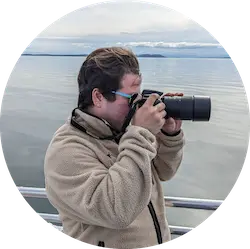
What brought Elijah Foster, ‘25, back to college was discovering OSU’s marine studies program in the College of Liberal Arts. The interdisciplinary, humanities-centered approach felt accessible in a way traditional “hard science” programs did not. Foster realized he could study the ocean, conservation and marine animals without drowning in chemistry or advanced math and, more importantly, without giving up his strengths as a communicator and storyteller.
Once enrolled, Foster dove in. A childhood fascination with killer whales turned into focused academic work and near-constant volunteering, including with OSU's student-led marine club Ocean11. He would also split his time between OSU’s Corvallis campus and the Hatfield Marine Science Center in Newport, while also volunteering at the Depoe Bay Whale Watch Center, helping visitors spot migrating gray whales.
“Almost everyone I talked to in marine studies had the same story,” explained Foster. “They loved everything about the ocean and coastal environments, but didn’t want to spend their time studying organic chemistry. It’s the best program for people who want to connect with the ocean.”
After Foster graduated in 2025, he went on to secure an internship with the Orca Behavior Institute in Washington’s San Juan Islands, where he now spends days on the water observing killer whales and recording their behaviors. Foster hopes to bring what he has learned back to Oregon, strengthening whale research and bringing about more awareness of coastal environments.
Lauren Rice
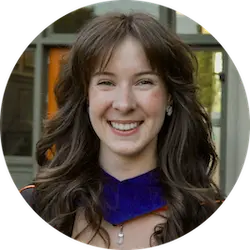
Lauren Rice, ‘23, M.S. ‘25, has a deep appreciation for the unique beauty of ocean coastlines. Rice grew up in Beaverton, Oregon, but was a frequent visitor to the coast, oftentimes beachcombing during her family’s annual camping trip to Nehalem Bay State Park in Manzanita. As a visual artist, Rice would sometimes bring along her acrylic and gouache paints to compose natural landscapes along the coastline.
When it came time to decide what she wanted to pursue in college, she had a feeling that studying something at the intersection between the social sciences and environmental sciences would be the best fit. In Fall 2020, she initially enrolled in the marine biology option, but Rice craved more of a macro-systems perspective compared to learning about topics like DNA replication.
“When I was sitting in classes during my first term of college, I was wondering where the ‘human’ of it all was,” explained Rice. “There was so much emphasis on the environmental changes the planet is going through, but the courses didn’t necessarily emphasize the interrelated systems between people and nature.”
Rice joined CLA’s marine studies program just after the major was created in Winter 2021, which offered a “perfect blend” of marine science, social science, and the arts. During her undergrad studies, Rice joined Dr. Ana Spalding’s research team focused on shellfish aquaculture resilience, and participated in an environmental interpretation internship with the Haystack Rock Awareness Program at Cannon Beach on her beloved Oregon Coast.
“The degree as a whole provides you with so many different lenses and ways of knowing to approach marine science that other degrees may not,” said Rice. “There is such a breadth of disciplines that are covered, but still a unique balance between natural and social sciences.”
Motivated to continue exploring the social sciences side of the ocean, she enrolled in the marine resource management (MRM) master’s program in CEOAS. Described by Rice as the “older sibling of marine studies,” MRM furthers the interdisciplinary exploration of the human and environmental aspects of our oceans and coasts. Now, Rice is a faculty research assistant in Dr. Ethan Doney's Living with Wildlife (LivWild) Lab, where her work explores the social aspects of human-wildlife conflict in Oregon.
Environmental Sciences - College of Earth, Ocean, and Atmospheric Sciences
Natalia Jacquez
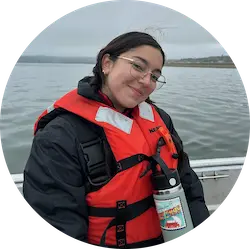
Tigard, Oregon, native Natalia Jacquez was and is “one of those kids out in the ocean.” Jacquez and her Mom used to volunteer at the Haystack Rock Awareness Program at Cannon Beach; this and other experiences gave her a foundational knowledge of ocean issues, leading her to major in environmental sciences with a specialty in aquatic biology.
“What drew me to OSU, CEOAS and environmental sciences was the broadness of the program,” said Jacquez. “I could take classes on oceanography, soil science and ecology, while still having a wider perspective of environmental science. It’s proven to be exactly what I needed.”
Over the summer of 2024, Jacquez worked at the Hatfield Marine Science Center as a Hollings Prep Scholar. This past year, Jazquez was awarded the prestigious Ernest F. Hollings Undergraduate Scholarship from the National Oceanic and Atmospheric Association. Not only did the scholarship cover a portion of her tuition, but it will also give Jacquez an opportunity to work on a NOAA-related research project. This summer, she will be joining biologist Dr. Peter Kiffney at NOAA’s Northwest Fisheries Science Center to study the availability and quality of food for Puget Sound salmonids.
Jacquez continues to pursue undergraduate research opportunities at OSU during the academic year. As part of Dr. Scot Heppell’s lab, Jacquez helps to monitor sea grass restoration efforts around Coos Bay, Oregon, and as part of Dr. Felipe Barreto’s lab, she is a laboratory technician studying the ecological and evolutionary genetics of copepods.
Allison Yuen
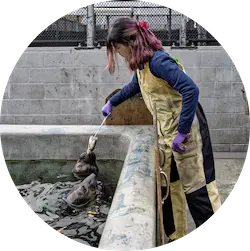
Starting as a teenager, Allison Yuen worked at The Marine Mammal Center in Sausalito, California for nearly four years. A resident of San Francisco, Yuen biked over the Golden Gate Bridge to tend to the many rescued animals residing at the Center, and worked as a docent for visitors. Many of the Center's patients are malnourished pups who are separated from their moms too soon or who can't adequately hunt as their prey moves further out and deeper into the ocean due to warming ocean temperatures.
When she enrolled at OSU, Yuen’s goals were to continue working on marine issues and to enter the science communication field after graduating. She began in CLA’s marine studies program, but wanted something more STEM-heavy, rather than humanities and social sciences-focused. Just before arriving at OSU, she transferred to CEOAS to study environmental sciences, specializing in aquatic biology.
“I viewed environmental science as all encompassing and multidisciplinary,” explained Yuen. “From the start, I felt comfortable in CEOAS and loved the wider perspective the classes brought on environmental and ocean systems.”
With Yuen’s specialty in aquatic biology, she’ll be able to take specialized classes on marine mammals, coastal birds and the biosphere, in addition to the broader and heavier STEM courses. And even as a freshman, she’s gotten involved early with conducting research. Right now, Yuen is a research assistant in two labs: the Menge Lubchenco Laboratory, led by Dr. Bruce Menge and Dr. Jane Lubchenco, and the Little Bird Lab, led by Dr. Jamie Cornelius. Yuen is also a member of Ocean11, OSU’s student-led marine club.
Oceanography - College of Earth, Ocean, and Atmospheric Sciences
Rebecca Knight
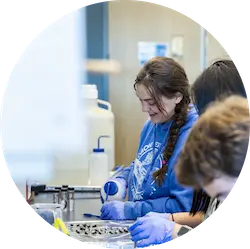
Rebecca entered Oregon State University unsure of her academic direction and initially enrolled as undecided. Although she had a long-standing fascination with marine life and the ocean, she doubted her own ability to succeed in a science-intensive field, believing she was “not smart enough” to pursue what truly interested her. Despite those doubts, she found herself repeatedly drawn back to the idea of studying the oceans, an interest rooted in her childhood curiosity and love for marine environments.
A pivotal moment came when she spoke with her academic advisor, who reframed her self-doubt not as a barrier but as something irrelevant until she actually tried. That straightforward encouragement pushed Knight to begin her journey in oceanography in CEOAS. She felt immediately confident she had made the right choice. Her excitement for the subject helped her persist through challenging coursework like calculus and physics, reinforcing that her passion for oceanography outweighed her fear of academic difficulty.
The jump paid off immensely, as Knight took part in a field oceanography cruise learning to use complex ocean testing equipment, and held a position in the Plankton Ecology Lab through URSA. Ultimately, Knight chose oceanography because it aligned with her deep interest in the natural world, and experiential learning and research at OSU showed her she belonged in the field.
"I never thought to myself, ‘Oh, now I'm not going to get the oceanography degree. I always thought, ‘Now I'm going to take this class again and keep going.’”
Maya Moran
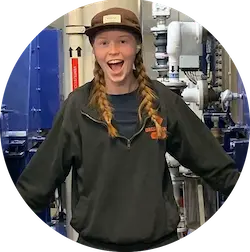
Maya grew up outside Seattle, spending much of her childhood on the water fishing and crabbing with her father and grandfather. Being on boats and near the ocean made her feel most at home, and that strong personal connection to marine environments influenced her decision to attend Oregon State, in part because of its close ties to the ocean and marine research opportunities.
Although she initially enrolled at OSU as an environmental sciences major, Moran soon realized the program didn’t match her expectations. She wanted to immerse herself deeply in a single subject rather than study broad environmental issues. Oceanography appealed to her because of its strong emphasis on mathematics, physical and chemical processes, and the ability to dig deeply into how ocean systems work.
Her decision was further reinforced through hands-on research. As an undergraduate researcher, Moran spent a month aboard a research vessel in the Arctic Circle studying sea ice and sediment processes as a part of Dr. Emily Eidam’s lab on coastal and fluvial sediment dynamics. This rare opportunity confirmed that oceanography allowed her to combine fieldwork, data collection and process-based science in a way that felt both challenging and meaningful. The experience ultimately shaped her honors thesis and solidified her passion for oceanographic research, especially in the context of rapidly changing polar environments.
Marine Biology - College of Science
Noor Denolf
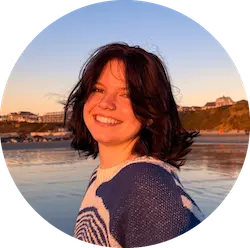
A third grade project asked Noor Denolf to pick a marine mammal to present on. She chose a whale, and then, subsequently, her parents took her whale watching off the California coast. From that point on, she was dedicated to studying whales.
At Oregon State, Denolf enrolled initially in oceanography in CEOAS. Her motivation was to learn more about the geology and physics of the ocean. She loved it, but missed learning and talking about whales specifically. A marine biology course, taught by Dr. Felipe Barreto, sealed the deal; she soon switched to studying biology.
“When you look into the eyes of a whale, you know someone is home,” said Denolf. “They’re so like humans and are more intelligent than we give them credit for.”
Last year, Denolf received a Summer Undergraduate Research Experience (SURE) scholarship from CoS to study the effects of global warming on sea anemones as part of marine physiologist Dr. Virginia Weis’ lab. For six months, she studied images of anemone populations that have experienced mass bleaching events, analyzing their ability (or not) to recover from such catastrophic events.
After Denolf graduates next summer, she is hoping to continue studying marine biology in graduate school, with the goal of becoming a naturalist and continuing to conduct research.
“Both oceanography and marine biology are fantastic programs,” explained Denolf, “but, for me, I just realized my core interests align more in the College of Science.”
Travolis Williams
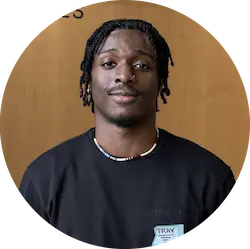
Travolis Williams has been inspired by the natural world his entire life. He grew up watching Steve Irwin’s “The Crocodile Hunter” every morning before going to school, and while in school, he was liking his STEM courses more and more.
Marine biology appealed to Williams, a field he thought he would study because he had an initial interest in working at a zoo. Originally, he was placed in the marine studies program at OSU, but wanted to do more hands-on STEM-heavy research. Environmental Physiology (Z 423), the study of marine organisms’ physical makeup in different environments, confirmed Williams’ path in studying marine biology.
During his sophomore year, Williams received the Vanguarding and Inclusive Ecological Workforce (VIEW) Fellowship, an internship that supports the professional development of students in fisheries and wildlife from underrepresented communities. Williams’ VIEW fellowship took him to Depoe Bay, and Yaquina, Oregon, to conduct marine coastal observation of seagulls, common murres, and cormorants. In addition to his post on the Oregon coast, Williams works on the Corvallis campus alongside Dr. Francis Chan on underwater AI sensors used to research local crustaceans.
Williams was also a research assistant in the Marine and Anadromous Fisheries Ecology Lab, led by Dr. Jessica Miller, at the Hatfield Marine Science Center in Newport. With support from the Cooperative Institute for Marine Ecosystem and Resources Studies, his work focuses on marine survival rates of Coho salmon in Yaquina Bay and Mill Creek.
Fisheries, Wildlife, and Conservation Sciences - College of Agricultural Sciences
Adel Bordas
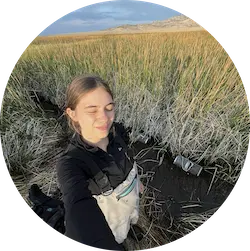
Like many students, Adel Bordas entered college with no idea what she wanted to do. She took a business class, a chemistry class, a political science class, but nothing quite felt like the right fit. She eventually narrowed her interests to the natural sciences, but still kept exploring. Climate science wasn’t interesting to her, so she eliminated Earth systems science, and she found environmental science too broad, but a biology course piqued her interest.
Then, Bordas took Field Sampling of Fish and Wildlife (FW 255) and loved it. The class took students to the William L. Finley National Wildlife Refuge south of Corvallis, where students broke into groups to develop their own hypotheses, conduct original research and draw their own conclusions. Bordas was even able to leverage the experience into getting her first field role. The summer after her sophomore year, Bordas joined Dr. James Peterson’s lab on fish performance and genetics working with steelheads and salmonids.
“I would wake up every day excited to go to my ecology class and work with Dr. Peterson. I loved learning about fish evolution and behavior, something I never thought I would be into.”
A term in the course Communication Skills for Fisheries and Wildlife (FW 289), as well as working in the Human Wellbeing and Conversation Lab, led to Bordas publishing a report that assesses the overall health of the Puget Sound ecosystem, including aspects that directly measure human quality of life and healthy human populations. Bordas is also conducting her own independent research through Washington State University’s Research Experience for Undergraduates program, where she is studying hypoxia in rainbow trout.
Now in Chile with an OSU faculty-led culturally immersive program, called From the Andes to the Sea, Bordas is taking OSU classes with OSU AgSci students. In this “extremely insightful” program Bordas is learning about invasive aquatic species, like the Chinook salmon on the Chilean coast.
“I really love doing field research,” shared Bordas. “I feel that I could be good at this and it’s exciting to be creating new knowledge. I’m so glad I took fisheries classes and I feel all the faculty really care about their students' learning. Everyone is so passionate about what they do. We’re just a bunch of fish nerds.”