

First-generation student Makayla Flannagan reflects on hardship, support, and finding stability in Corvallis and the College of Liberal Arts
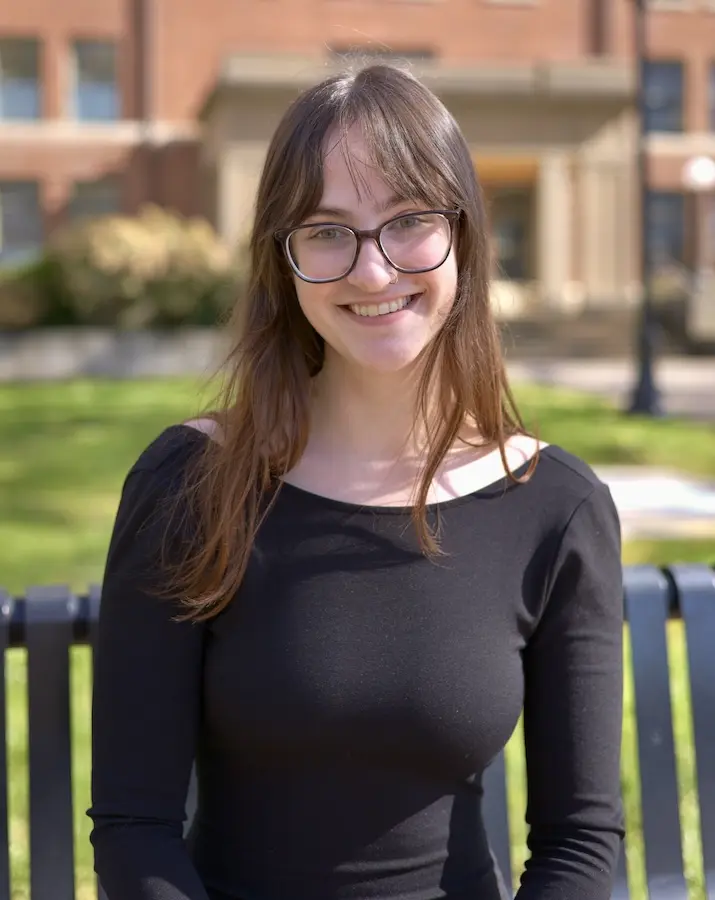
Makayla Flannagan | Credit: Ahmed Rashid
By Taylor Pedersen, CLA Student Writer - May 11, 2025
Makayla Flannagan remembers the first night she slept in her freshman dorm room. Her roommates had gone out, the building was loud: doors opening, voices down the hall, but her room was quiet. She lay on her back, staring at the ceiling.
“All I could think was, wow,” she said. “I did it.”
It was the first time in her life she could remember enjoying taking a deep breath. Born in Portland’s Alberta District, Flannagan spent much of her childhood moving between Oregon and Alabama, navigating two very different worlds while taking on responsibilities that most teenagers never face. By the time she was in high school, she was the primary provider for her family.
Her father lives with an autoimmune disease. Her younger sister, nearly a decade behind her in age, would eventually come to depend on her daily. Her mother, who often lived in a different state, passed away when Flannagan was 17, just as college applications were due. In between, there was school, work, and survival.
“I think it taught me a different type of work ethic from a young age,” Flannagan said. “And a sense of independence that’s affected every facet of my life.”
There was no baseline to compare it to, she added. It was simply the life she knew. In Portland, she was surrounded by extended family; her father’s side, all close-knit and deeply involved in raising her. In Alabama, that network disappeared. She moved between apartments, schools, and relatives she barely knew, at one point attending four different schools in four years. Making friends, for Flannagan, became both a necessity and a skill.
“I’ve always been outgoing,” she said. “But I think moving around made me that way. I was always trying to find where I fit in.”
Alabama also introduced to her a different cultural and political environment. Church functioned as a social hub, but her family didn’t attend, placing her on the margins of community life. It was isolating, but instructive.
“It taught me a lot of tolerance,” she said. “I value being able to talk to anybody, regardless of their beliefs.”
By 17, Flannagan was working full-time as a line cook while finishing high school through a dual-enrollment program. In the kitchen, she was often the youngest person in the room, and at one job, the only woman.
“I had to fight for respect,” she said. “And I didn’t always get it.”
The work was grueling, but it gave her something she needed: structure, independence, and distance from home. It also improved her ability to manage time, navigate conflict, and advocate for herself, all skills she would carry into college.
Additionally, Flannagan was born with spina bifida, a spinal condition typically treated at birth. But her family couldn’t afford the medical care needed, and the diagnosis came late. For years, she struggled to walk without fully understanding why and couldn’t fully walk properly until she was 15.
When she finally received surgery, the change was profound.
“The world opened up,” she remembered.“If I hadn’t gotten that treatment, I might have partial paralysis in my legs,” she said. “Healthcare is a human right. I don’t think that should be an opinion.”
The day her mother passed had an incredible impact on her as well.
"That was the worst day of my life,” Flannagan recalled.
Following that day, she saw only two paths in front of her: one was to stay “in a bad place forever” or better herself and push through. She chose the latter, by knowing that she was going to be the only person to get herself out of those circumstances.
She graduated early, worked, and kept moving. When she arrived at Oregon State University, stability felt almost surreal. She’d been emancipated for years and was prepared to live alone; but, for the first time, food was consistent, healthcare was accessible, and her living space was maintained.
“I wasn’t hungry,” Flannagan said. “The bathroom gets cleaned every weekday. That was crazy to me.”
The absence of constant stress allowed something new to emerge: possibility. She didn’t have to work her first two years. She could focus on school, on friendships, on imagining a future that wasn’t defined by scarcity.
Flannagan arrived intending to study horticulture, drawn in part by her experience using cannabis-based products to manage chronic pain. Hemp, she believed, held potential as a sustainable material for textiles, construction, and medicine. Over time, she pivoted to political science instead, hoping to engage with cannabis policy from a legal and regulatory perspective. She later added minors in history and anthropology. Then, a freshman-year Holocaust history course became a turning point and sparked a greater interest in history.
“I just loved it,” she said. “I liked sitting there and taking notes. I hadn’t felt that way in other classes.”
Now, her capstone project focuses on something far removed from hemp: the criminalization of pregnancy within Alabama’s carceral system. The topic grew out of earlier conversations on medical ethics, about who is protected under the law, and about how systems define harm. She points to Alabama’s “chemical endangerment” law, which was originally intended to protect children from exposure to ingredients used to make methamphetamine, but is now increasingly applied to jailing pregnant women.
“It’s a legal loophole,” she said. “You can be charged because you’re pregnant.”
The research is ongoing, complex, and overwhelming, but it connects so many things that have shaped her thinking: health, inequality, and the consequences of policy.
As an ambassador for the College of Liberal Arts, Flannagan now speaks to prospective students, many of whom share aspects of her background. Her approach is direct.
“I tell the truth,” she said.
She talks about resources, but also about the difficulty of finding them. She shares her own experiences navigating financial insecurity and institutional barriers. She hands out materials specifically for first-generation students. For a long time, she said, she felt out of place, surrounded by peers whose families had histories with higher education. But that has changed.
“I woke up one day and was like, what am I doing?” she said. “This is my life. I’m here just like everybody else.”
Now, she sees her background as a point of pride.
“I worked really hard to be here,” she said.
After graduation, Flannagan is considering the Peace Corps. Whatever comes next, her goals are less about a single career path and more about impact.
She knows she won’t change systems overnight. But she believes in incremental change: in conversations, in representation, in making resources visible.
“I just want to make things less scary,” she said. “More inviting. And change how we think about ourselves.”