

Dr. Razan Ghazzawi reflects on their start as a grassroots activist during the Syrian Revolution and the journey behind their current research on Syria and sexuality politics at times of revolution and counter-revolution
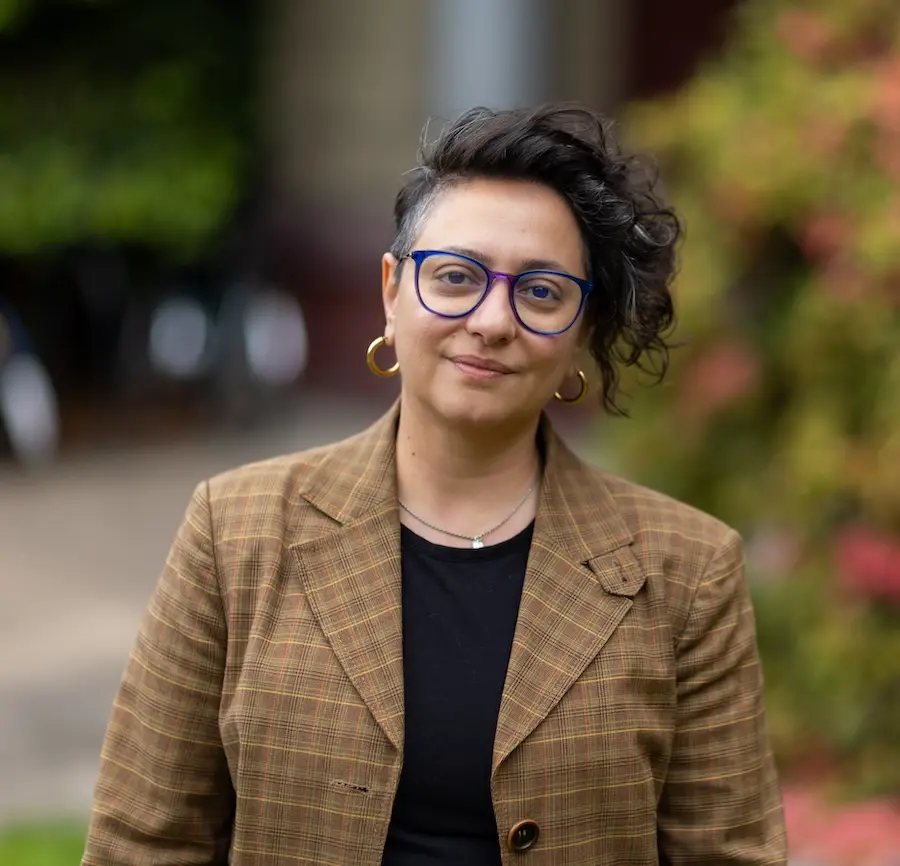
Razan Ghazzawi | Credit: Blake Brown
By Selene Lawrence, CLA Student Writer - April 29, 2026
As a young community organizer and activist, Razan Ghazzawi launched a blog documenting their daily life and commentary on human rights movements in Syria and its surrounding countries. Their work would span over a decade, during which time they would return to school to switch fields, make international news, and witness the start of a revolution. Now, long retired from blogging, Ghazzawi has made a name for themself as an international, interdisciplinary scholar-practitioner. From working in Syria, Lebanon, the United Kingdom, and the United States, Ghazzawi has shown that no matter where life takes them, their voice will never be silenced.
Ghazzawi grew up in Damascus. Having been an introverted child, they discovered early on their great love for writing. It seemed natural that they would go on to study English literature for their undergraduate degree. However, the class sizes and digital grading system made it difficult for Ghazzawi to explore their potential as a scholar. “It was very computerized. The idea of the class was not really applicable; we’d have lectures, and in each lecture, there would be thousands of students. I did not learn how to write an essay, how to write a critique—all of the things you usually learn as a first year in college,” said Ghazzawi. “My parents really pushed me towards my graduate studies. I owe it to them that I’m here today.” Shortly after finishing their bachelor’s degree at the University of Damascus, Ghazzawi began to pursue what would be their first master’s degree.
Traveling frequently between Lebanon and Syria, they studied part-time at the University of Balamand. Ghazzawi’s master’s degree in comparative literature centered on Arab-Jewish Iraqi literature in Israel and the work of author Shimon Ballas. Their studies drew upon their involvement in activism, as well as their personal history and place in society as a Syrian-Palestinian. “Being Syrian-Palestinian, I was particularly interested at that time in connecting to my Palestinian heritage,” Ghazzawi said. “My mom is Syrian, and my dad is kind of assimilated into Syrian culture, but my grandfather is someone who has always talked to me about being Palestinian. I lived with him for a few months when I did my first year of college. It was something that shaped that part of my identity.”
In the summer of 2006, while Ghazzawi was in grad school, war broke out in Lebanon between the Israel Defense Forces (IDF) and Hezbollah, a Shi’a political party and militia formed in response to Israeli invasion during the Lebanese Civil War. In an attempt to bargain for the release of Lebanese citizens imprisoned during Israel’s long-term occupation of South Lebanon, Hezbollah staged an armed abduction of two IDF soldiers, killing eight Israeli soldiers in the process. The IDF then initiated a large-scale artillery and airstrike attack, marking the start of what would become a 34-day war between the two parties. 55 Israeli and 1,109 Lebanese citizens were killed in the conflict, with most Lebanese deaths being civilian noncombatants. Most attacks were concentrated on Lebanese civilian infrastructure, including homes, water, facilities, and hospitals. Some of the greatest destruction occurred in Dahieh, a Beirut suburb just an hour’s drive down the coast from the University of Balamand.
It was at this time that Ghazzawi started blogging. “Blogging started to become the new big thing; today it would be like TikTok or Instagram,” Ghazzawi explained. “I saw that there was an opportunity to talk about settler colonialism and the war against South Lebanon. At that time, a lot of us looked up to bloggers in the region, so I started blogging as part of that community.” As time passed, Ghazzawi’s blogging became an important component of their existing work as a queer feminist activist and Syrian Palestinian in Lebanon. But back home in Syria, pressures were brewing, and a cataclysmic change was hurtling toward the life Ghazzawi was building.
In March 2011, an escalating violent crackdown on protestors invoked the start of the Syrian Revolution. Over the preceding months, a number of demonstrations had been held calling for an end to the country’s state of emergency and operation under emergency laws, which had been established nearly 50 years prior with the coup that allowed the Ba’ath Party to take control of the government and dissolve other political parties. In 1970, Minister of Defense Hafez al-Assad seized power and became Syria’s President, marking the start of the Assad Regime. The period was marked by mass human rights violations, including widespread arrests and detentions, physical, sexual, and psychological torture of detainees; abductions and forced disappearances, violence against protesters with denial of medical assistance, and a ban on public gatherings.
With the start of the revolution, activists became disproportionately targeted victims of state violence and arbitrary arrests. During this time, Ghazzawi joined the Syrian Center for Media and Freedom of Expression (SCM) as a media officer. “I documented the detention and imprisonment of media workers, and if there were any murders targeting journalists, photographers, or filmmakers. I coordinated with a lot of those contacts as well,” they said. “I was so lucky to work in that position in Syria and be paid for it; it was like a dream. At the time, it was new territory for us. We had never lived through a revolution before. There was a lot of trial and error. I don't think it was safe for us to do that job, but we tried our best to be secure. Our manager, Mazen Darwish, did his best to think about these issues.” Ghazzawi’s blogging platform and work as a media officer led them to later publish journalistic articles on human rights in Syria with prominent news sources, including openDemocracy and Al Jazeera.
In November 2011, Ghazzawi was arrested on the Jordan-Syria border on their way to attend a workshop on media freedom organized by human rights organizations in Jordan. They were imprisoned for nearly a month. Shortly after their release, Ghazzawi was detained again, along with several of their colleagues, in a raid on SCM. “The first detention was because of my blogging and organizing on the ground. The second detention was with the center because it had been targeted,” they explained. The experience of detainment was a significant interruption to Ghazzawi’s life, but there was still another storm they would have to contend with after their release: the international media’s coverage of their arrests.
“I struggled with it, and it took me a long time to understand how to deal with it. I think I've only managed to deal with it very recently, specifically at OSU, to be honest,” Ghazzawi said. “I felt like a lot of the attention was focused on the individual me rather than the collective movement. It was very personifying—I think that’s how mainstream media works, trying to make icons so people can relate to the revolution rather than actually focus on the revolution as being something that was very decentralized but still collective and collaborative across classes and religions. That was a beauty that was not represented, and I think that created some tension in the revolutionary community itself. With my portrayal and how the international media represented me, there was a lot of emphasis on me having been born in the U.S. and being queer. They outed me. When I was in prison, I didn’t know what was happening; it was very disturbing to see when I was released.”
After being released from their second detention, Ghazzawi moved north to Kafr Nabl. The town had been liberated by the local community and the Free Syrian Army in late 2012, and would remain liberated until Al-Qaeda seized control of the area in 2014. There, they organized a support program for displaced children. In December 2013, Syria’s activist community suffered a devastating blow with the abduction of four prominent human rights defenders—later referred to as the Douma Four—by unidentified masked gunmen: Samira al-Khalil, Razan Zaitouneh, Wael Hammadeh, and Nazem Hammadi. All four activists were members of the SCM. Razan Zaitouneh, founder of the Violations Documentation Center in Syria, was a mentor and essential inspiration to Ghazzawi’s activist work. The fate of the Douma Four is still unknown today.
As time went on, it was all Ghazzawi could do to pick themself up and try to move in a meaningful direction, even if that meant letting go of their online presence. “I did not blog much during the revolution,” they confessed. “Staying alive and staying safe was taking a lot of energy, and then when I was exiled, there was also the labor of surviving exile. I was burnt out. I stopped blogging after that.” Exiled from Syria, Ghazzawi lived for a period in Lebanon, and then in Turkey, before moving to Europe, where they eventually began to build an academic home for themself in the United Kingdom. “I did not want to be part of the NGO-ization of the revolution,” they explained. “That term was used by the Palestinian anthropologist Islah Jad, who talked about the individualization of the Palestinian movement after the Oslo Accords. We’ve seen that kind of thing happen after a social movement where a hierarchy of those who are experts or organizers is created. I did not want to be a part of that. That’s why I shifted to academic work.” In 2016, Ghazzawi earned a second master’s degree from the University of Leeds, where their focus on gender studies allowed them to research queerness in the social context of revolutions. Soon after, they began their Ph.D. in gender studies at the University of Sussex.
“The first year was hard. During my master’s, I was really struggling with being homesick, and feeling like, ‘what am I doing here?’ But with my Ph.D., it was very supportive, I didn’t feel alone,” they said. “My cohort and the working groups I met during conferences were all part of creating this community that would offer a lot of mentorship and support, especially my supervisors, Malcolm James and Cynthia Weber. They really appreciated my experience and my reflection about my activism in Syria, which I wrote about for my Ph.D.” Ghazzawi is currently in the process of reworking their Ph.D. research into a monograph that unites queer theory and ethnography. At the heart of the book are Ghazzawi’s interviews with fellow queer Syrian-Palestinians on their individual relationships with their identity while navigating checkpoints, prison, and queer exile in Syria and Lebanon. Their research also served as the subject of their article “Popular Sovereignty and Trans Mothering of Antiwar Syrian Soldiers,” published earlier this year. Other recent works include chapters in “I Will Always Be Looking For You – A Queer Anthology on Arab Art” and in OSU’s openly accessible textbook, “Resisting Gender Violence.”
“I’m hoping to make an intervention in Syrian curricula in the future,” said Ghazzawi. “I'm definitely interested in challenging mainstream ideas about citizenry, like who gets to be a citizen? What is it to be a revolutionary? Does it have to be against the government alone, or can we protest in other ways against the regime and social violence? I’m trying to shift the cisnormative or heteronormative way of thinking about revolutionaries by highlighting different kinds of dissent stories. In my book, I hold that the sex workers who I have met in prison, who were protesting the prison management, are also revolutionary and they should be considered revolutionaries. The trans women I have interviewed who were misgendered and taken in the army and asked to carry a gun and go fight on the front lines, who did not want to be a part of the war and escaped, they should not be considered today as the remnants of the regime. People like that who protest the war, who protest army officers, people who are not necessarily revolutionaries or activists the way that I was, but are still challenging everyday structures, they are also anti-military and anti-authoritarian in their own ways.”
After graduating from the University of Sussex and completing a postdoctoral fellowship in Berlin, Ghazzawi sought out tenure-track positions so that they could continue their research while teaching. In 2023, they moved to the United States and began working as an assistant professor in Oregon State’s women, gender, and sexuality studies (WGSS) program. After spending nearly a decade in British academia, Ghazzawi has embraced the differences in OSU’s curriculum. “In WGSS, we encourage merging critical responses with reflections on personal experience,” they said. “There’s more of a conversational style in assignments, so I really enjoy that I get to know the students more. I’m also bringing bits and pieces of my work and interests to my teaching. The curriculum is more focused on American scholarship, but I discuss how it applies globally as well as in transnational contexts.”
The past three years have marked the start of a welcome new chapter in Ghazzawi’s life and research, but, living in America, the landscape of authoritarianism and political upheaval that defined Ghazzawi’s young adulthood is far from fading into memory. Over the course of the past year, the start of the second Trump presidency has swept fear and uncertainty across much of the population, especially given wavering democratic structures, increases in state-sanctioned violence, and widespread attacks on LGBTQ rights. For Ghazzawi, the pursuit of knowledge and justice go hand in hand. “I feel like I have a lot to offer because I've already been through authoritarianism; they definitely have different contexts and circumstances, but there's a lot to learn from Global South cultures and movements,” they said. “I think that it's okay to have that shift of the hierarchy, because the U.S. has always been the center of knowledge. Now, maybe it's time to collaborate more and to hear from other perspectives.” Ghazzawi describes their scholarship as building on a cross-cultural knowledge base of revolutionary theory and action. Even outside of the classroom, activism remains a meaningful outlet in their life.
“I love being a part of organizing,” Ghazzawi said, “and I'm feeling I want to be part of it, but it’s only my third year here, so I'm still kind of new at the same time. I'm starting to build my community and my networks. I'm trying to continue my political activism in a different way, but of course, that's going to take time, and it's going to look different from before. I'm very inspired by the anti-ICE movement and activism, and by the student organizing and Palestinian encampments. I feel like there needs to be more opportunities and space created on campus for those students to be visible in their movement and to bring back this kind of energy and mobilization.”
In December 2024, Bashar al-Assad fled Syria and was granted asylum in Russia, marking the fall of the Assad regime. Ahmed al-Sharaa became Syria’s new president in January 2025 and implemented a transitional government two months later. In the summer of 2025, Ghazzawi finally returned to their home country for the first time in 12 years. “I've seen people I haven't seen in a long time,” they shared. “I spent time with my family there; that was beautiful. I wanted to go to my friend's funeral, but I couldn't. I just felt it was too much for me. I think next summer is going to be different, but for now, I’m focused on seeing friends and trying to reestablish and repair the connections that we've lost because of geography and time differences.” However, the end of the Assad regime has not ended sociopolitical turmoil in Syria. The new government has brought about new worries for the Syrian people as they continue the fight for justice and freedom. While al-Sharaa presents himself as a moderate technocrat, his past affiliation with Al-Qaeda has brought criticism to his leadership, as have concerns about the ongoing sectarian and gender-based violence crisis.
“It's very worrying that Trump and al-Sharaa are close. People kind of see the success of al-Sharaa as a success of Trump,” Ghazzawi shared. “The talk has already started about Syria's economy being privatized. Education in Syria is public; a lot of other social services are public and state-owned. Now there's a lot of talk about privatization, of investing in Syria and the new Syrian economy and the new state. Our issue with Assad was not just authoritarianism in the political, disciplinary, and punitive form, but also as a neoliberal kind of authoritarian capitalism. This is all coming together; it's becoming an upper-class, political elite, and that has not changed. I think this is what's becoming the expense of minorities today, which we have seen with the massacres, with the kidnapping of women, and the crackdown against trans women and the LGBTQ community. This interim government has committed two massacres so far, the first in the coastal areas and the second in Sweida, two weeks after I’d been staying there. I had visited a friend, her husband, and her kids; she was my colleague and my classmate, so it was beautiful to see her again. Then the massacre happened, and she had to leave the village. We’re trying to see how she can apply for asylum. I don't have any hope whatsoever for the new government. I'm very much feeling that the revolution is not over yet.”
Sources:
Abouzeid, Rania. "Is Syria About to Jettison Its Emergency Law?” Israeli attacks on civilian infrastructure." TIME, 27 Mar. 2011, time.com/archive/6956986/is-syria-about-to-jettison-its-emergency-law/.
Amnesty International. "Israel/Lebanon: Deliberate destruction or “collateral damage”? Israeli attacks on civilian infrastructure." Amnesty International, 22 Aug. 2006, www.amnesty.org/en/documents/mde18/007/2006/en/.
Amnesty International. "Israel/Lebanon: Out of all proportion – civilians bear the brunt of the war." Amnesty International, 21 Nov. 2006, www.amnesty.org/en/documents/mde02/033/2006/en/.
Human Rights Watch. "No Room to Breathe: State Repression of Human Rights Activism in Syria." Human Rights Watch, 16 Oct. 2007, www.hrw.org/reports/2007/syria1007/3.htm.
Human Rights Watch. "Why They Died: Civilian Casualties in Lebanon during the 2006 War." Human Rights Watch, 5 Sept. 2007, www.hrw.org/report/2007/09/05/why-they-died/civilian-casualties-lebanon….