

Ph.D. student Joseph Slade researches the intersection of artificial intelligence and the psychology of education
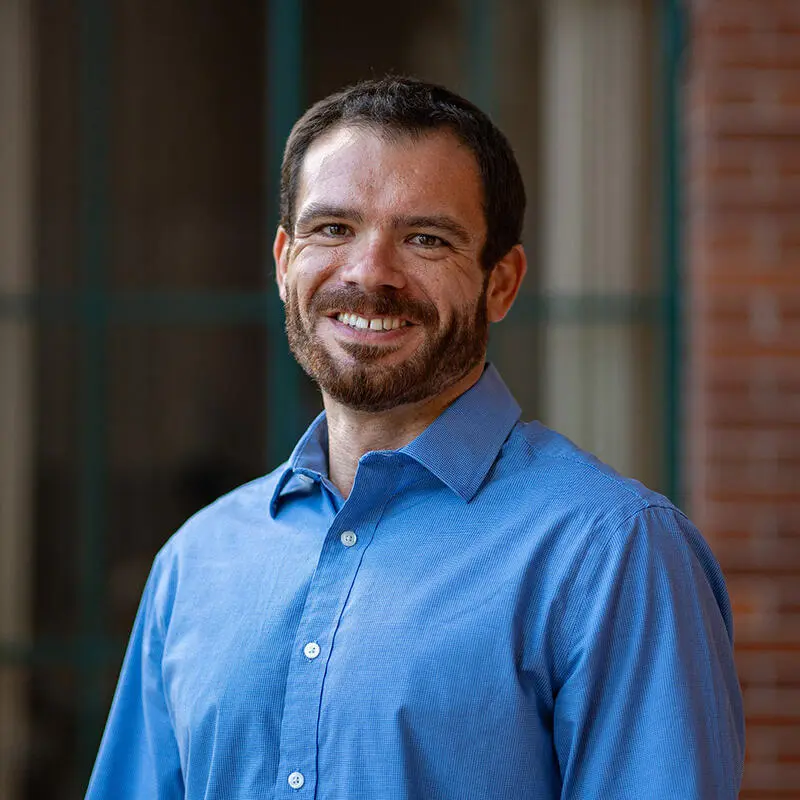
Joseph Slade
By Jessica Florescu, CLA Student Writer - April 13, 2026
As a current Ph.D. student in the School of Psychological Science, Joseph Slade, has focused most of his research on the uses and effects of artificial intelligence (AI) in a classroom setting as a member of Dr. Regan Gurung’s lab focused on social cognition.
“I have Dr. Gurung and other supportive mentors to turn to for guidance, but it’s definitely a lot of work,” said Slade. “There’s always so much to do, though much of the teaching and research can be incredibly rewarding.”
Artificial intelligence use has been on the rise, but, according to Slade, there still isn’t a lot of data about the long-term effects on student performance and outcomes in the classroom. Furthermore, universities are still determining the acceptable amount of AI that can be used to help students. For large language models like ChatGPT, Slade sees clear upsides and downsides for AI to help benefit student learning.
“It’s still an open-ended question as to whether or not artificial intelligence can be used as an educational tool without negatively impacting learning or critical thinking. It is very easy for AI to provide ways to skip right to the answer, so we need to be cautious to ensure that students also learn the process behind the solution.”
Prior to starting his Ph.D. journey, Slade worked in construction and as an emergency medical technician (EMT) in Colorado, before spending four years travelling the country in a campervan trying to kickstart a fiction writing career. After spending nine-months at a silent meditation retreat center in North Fork, California, Slade decided to go back to school, enrolling in OSU’s undergraduate psychology program via Ecampus.
“My time at the meditation center was transformative and influenced my decision to go back to school,” said Slade. “I had been trying to be a fiction writer and wasn’t able to make that a sustainable career. I used the nine months to decompress and try to figure out something new. I met a sociology professor at the center, and she suggested graduate school.”
As an online student, Slade had the opportunity to work in both Dr. Gurung’s and Dr. John Edwards’ research labs, conducting research on social cognition at a fundamental level. During Slade’s senior year, a manuscript he co-authored with Dr. Gurung and Ph.D. student Stephanie Byers was accepted into the journal of Scholarship of Teaching and Learning in Psychology.
“Seeing a first academic publication in print was so impactful,” said Slade. “It’s hard to put into words how much that affected my decision to continue into doctoral studies.”
Slade’s research agenda during his doctoral studies turned towards focusing on AI and the psychology of learning.
“When I first used ChatGPT about a month after it came out, it seemed like magic,” he explained. “It felt like I was talking to a real person, even though I knew I was interacting with a machine.”
Currently, Slade has several studies in the works, most of which are randomized controlled trials under different conditions, testing to see how students use LLMs and the resulting effect on their motivation to learn.
Outside of his research, Slade co-founded a startup company, AI Education Labs, Inc., with the goal of developing AI educational tools. He has co-authored several peer-reviewed publications, as well as delivered talks and posters at academic conferences.
“AI can be really good for things like coding projects, brainstorming ideas, or organizing thoughts,” explained Slade. “But there’s a lot left to learn about how to use AI well and its downstream effects on learning.”