

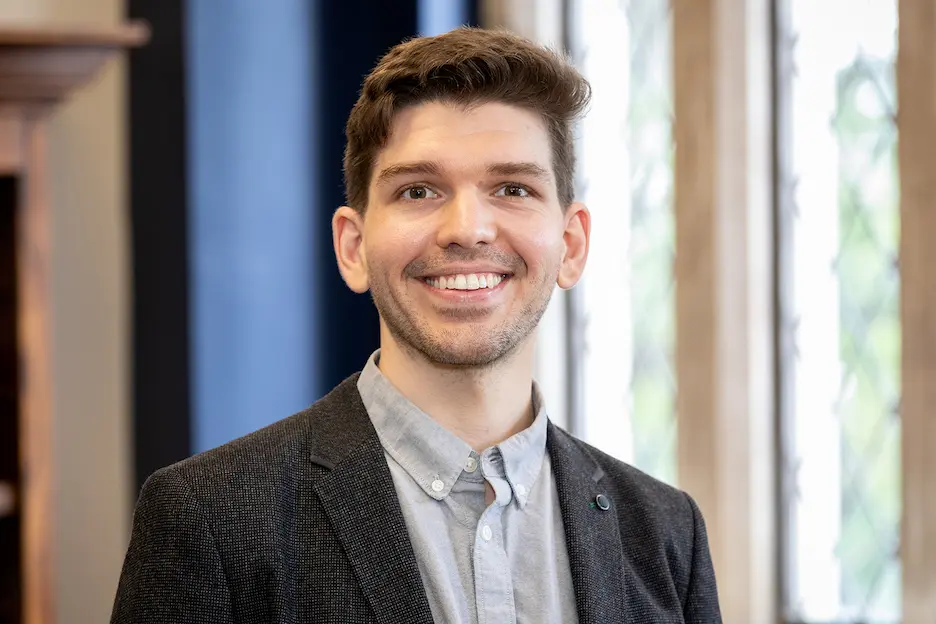
Welcome Erik Fredner
We’re excited to welcome Erik Fredner this fall as our new Assistant Professor of Digital Humanities and Literature. Search Chair Megan Ward had this to say about Erik and why he stood out in a competitive field:
“Erik’s research promises to expand our course offerings for English majors in exciting new directions, as well as to attract students from STEM fields to our classes. We’re inspired by how his research and teaching bring together two things that we’ve historically thought of as opposed: close attention to literary significance with quantitative reasoning.”
Read on for Erik’s takes on the questions we pose to all new faculty, from lost luggage to distant reading to the children’s book that started it all.
Looking back on your campus visit, is there a moment that stands out to you? An interaction or an impression that made you think that you could really be happy here?
My campus visit began with something straight out of a stress dream about a campus visit: The airline didn’t transfer my checked bag to my connecting flight. When I met Tim at the airport and explained the situation, he revealed that the same thing had happened to him on his campus visit. Completing some kind of academic karmic circle, Tim promised to pick up my bag around midnight, when the next flight from Denver arrived. In case the bag didn’t make it on that flight, Megan took me to Fred Meyer after dinner so that, at the very least, I could buy a toothbrush before potentially giving a job talk in airplane clothes. The bag arrived and it all worked out, but the event left the strong impression that everybody in SWLF is friendly, eager to help, and, perhaps most important of all, has a good sense of humor.
What are you looking forward to about joining our faculty?
I’m excited to contribute to the digital humanities at OSU, both through my courses and a DH lab where students can collaborate on new research in literary history and canonicity. Of course, I’m also looking forward to getting to know everybody in SWLF and our students. My wife, Sarah, and I are avid hikers, so we’re eager to explore Oregon’s natural beauty as well.
Can you share a few top-shelf books—books that you love, that you would happily re-read every year, that helped shape your love of literature?
Whenever people ask what my favorite book is, I always think of the book that got me interested in reading as a child: “The Phantom Tollbooth” by Norton Juster. It’s smart, whimsical, and funny. I remember being charmed by its puns, and, of course, Jules Feiffer’s illustrations. I think it’s especially important today for faculty today to share with students how and why we take pleasure in literature.
What is the pleasure of research for you? Where might your research take you in the years ahead?
I enjoy doing research that counterpoises the qualitative and the quantitative. People often think of distant reading as close reading’s antagonist, but I view them as complementary: Evidence from either can inform the other. Quantitative approaches can also be usefully defamiliarizing for texts and oeuvres that we think we know well.
What would a dream teaching day look like for you? What might students have read? How might they engage with it in class, with you, and with one another?
A dream teaching day would involve collaborative research with students on a shared problem. I often end my digital humanities courses with research presentations where students share work that they have done on a common corpus or dataset, and those conversations never fail to inspire. There is still a lot of “low-hanging fruit” in computational literary studies, and it’s exciting to see students make their way toward real research contributions in these presentations.