

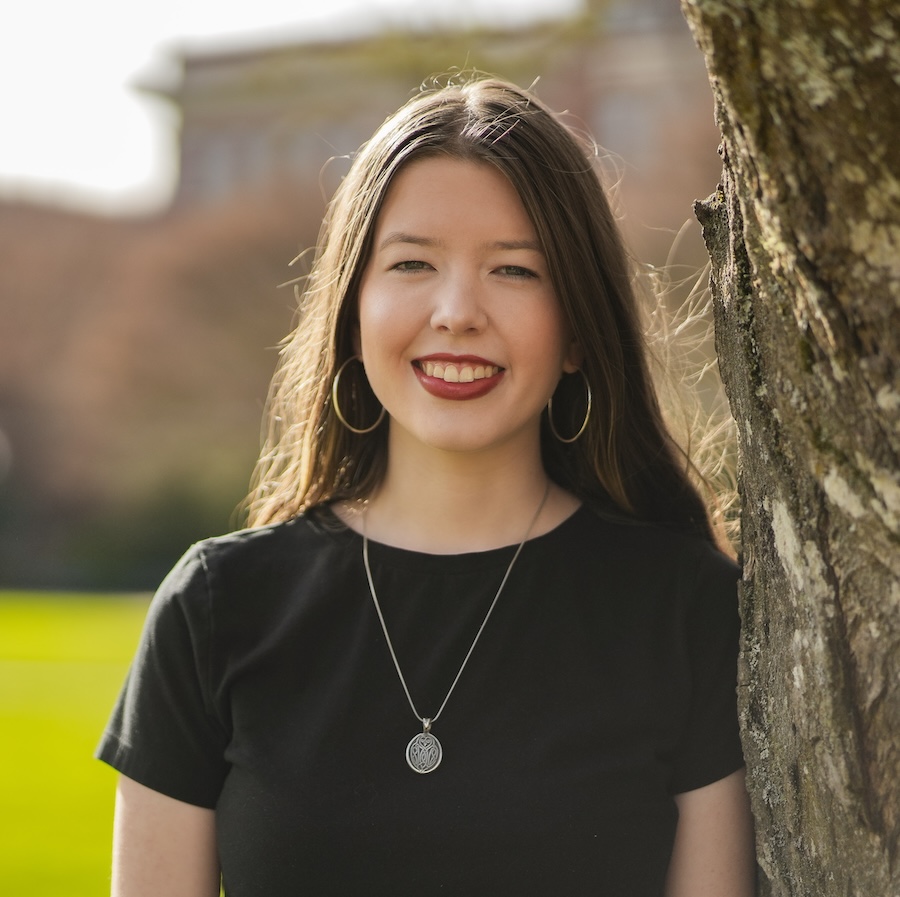
Where are you from?
I am from Hillsboro, Oregon!
What drew you to studying political science and public policy?
I have always had a fascination with politics and found a way to do something with it on the Hillsboro Youth Advisory Council. The Council is composed of high school students as an official city board, and we got to work with city officials, councilors, and even the mayor at times. Being able to be in these rooms helped show policy as not being an abstract or far away concept, but something I could help shape. For example, I helped lead a policy initiative to include MENSA on local demographic collection forms. Studying political science and public policy allows me to connect these two scales: the local and the global. Whether it is a city deciding how to serve its residents or a nation shaping its foreign policy, the underlying question is the same: who is being listened to, and who is being left out? I am drawn to this field because it gives me the tools to critically analyze power, advocate for equity, and work toward policies that acknowledge both complexity and humanity.
What has been your experience as a student of both the College of Liberal Arts and the Honors College?
My experience as a student in both the College of Liberal Arts and the Honors College has been intellectually rigorous and rewarding. The College of Liberal Arts is giving me a strong foundation in critical thinking through political science and public policy coursework that emphasizes context, power, and real-world impact, while the Honors College has complemented this with small, discussion-based classes that encourage interdisciplinary thinking and deeper engagement with complex ideas.
Have you started your honors thesis? If yes, what’s the topic and/or focus of your research? If not, are you considering any ideas so far?
I have not yet formally started my honors thesis, but I am considering a project centered on the idea that “there is no ethical consumption under capitalism” and how that concept is often misinterpreted in public discourse. I am interested in examining how this phrase, which originated as a critique of structural constraints within capitalist systems, is frequently used to absolve individuals and institutions of responsibility rather than to motivate systemic policy change.
What have been some of your favorite classes taken?
My favorite class last term was an honors seminar called “How To Be Less Wrong.” It is a class centered on misconceptions in the world, such as medicine, history, etc.
What are you hoping to do after you graduate?
I am hoping to work in local government, in a city manager, community engagement, or DEI office. With my experience working alongside people holding positions in these offices, I have seen firsthand how local policy decisions directly shape residents’ daily lives and how meaningful change often begins at the municipal level. I am especially drawn to roles that center equity, accessibility, and community voice in policymaking. In addition to local government, I would also enjoy working in a legislative office, where I could contribute to research, constituent services, and policy development while gaining a deeper understanding of the legislative process and its broader impact.
How do you feel that your experience in CLA and HC is setting you up for success?
My experience in the College of Liberal Arts and the Honors College is setting me up for success by equipping me with strong analytical, research, and communication skills. CLA coursework is teaching me how to critically evaluate institutions, power, and policy outcomes, while the Honors College has strengthened my ability to synthesize ideas across disciplines, engage thoughtfully in discussion, and pursue independent, self-directed work.