

At a time when conversations about identity, equity, and inclusion are increasingly politicized, The Hill We Climb poses a question to the wind band world: What does it actually mean to belong?
By Taylor Pedersen, CLA Student Writer - February 5, 2026
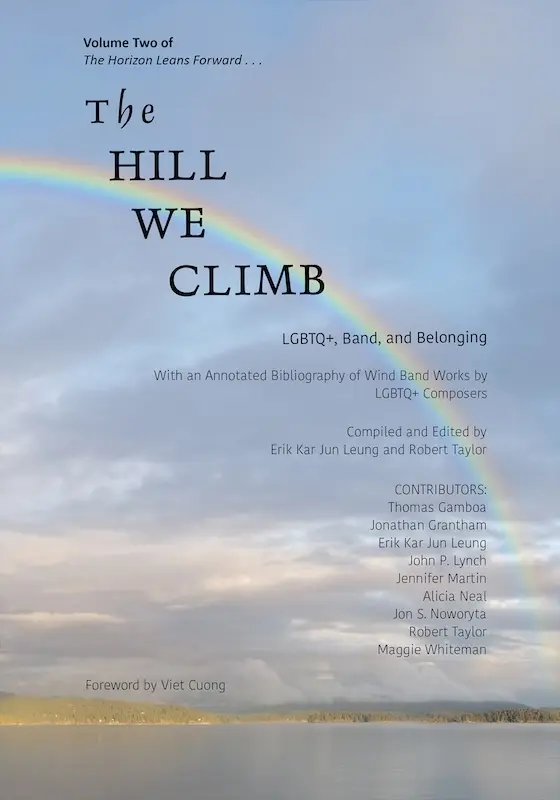
Edited by Erik Kar Jun Leung, director of bands at Oregon State, The Hill We Climb is the second volume in a project that centers the voices and lived experiences of LGBTQ+ musicians, artists, and educators working in wind band music. The collection builds on The Horizon Leans Forward (2020), which addressed systemic inequalities faced by women, BIPOC, and queer musicians. While the first book arrived during the COVID-19 pandemic and the national reckoning following the murder of George Floyd, the second emerges in another charged moment, one shaped by ongoing debates over diversity, equity, and LGBTQ+ rights.
Rather than relying solely on the language of DEI, The Hill We Climb frames its stories through the idea of belonging. For Leung, that shift was intentional. As terms like “diversity” and “inclusion” have become politicized, belonging offers a more human way into the conversation, one grounded in lived experience rather than policy language.
“If we remove the idea that DEI is about people, it becomes easy to weaponize,” Leung said. Belonging, by contrast, is something most people intuitively understand. Nearly everyone has experienced what it feels like to be excluded, just as they have felt the relief of being welcomed into a space. The book uses that shared understanding as a starting point, asking readers to think about how belonging is created, or denied, within music education.
One of the most urgent chapters in The Hill We Climb focuses on trans experiences in the wind band field. Written by a trans woman, the chapter blends personal narrative with practical advice for educators working with trans students. In the context of increasing political attacks on trans rights, the chapter grounds the conversation in real classrooms and rehearsal spaces, emphasizing care, visibility, and responsibility.
Across the collection, contributors reflect on music classrooms and ensembles as spaces that can be both affirming and exclusionary. Many describe ensembles as places of safety, where students are encouraged to express themselves and feel part of a community. At the same time, the book acknowledges that access to those spaces is not always equal. Musical knowledge, institutional norms, and long-standing traditions can quietly create barriers, even in well-intentioned environments.
This tension, between music as a source of harm and music as a source of healing, runs throughout The Hill We Climb. Contributors emphasize that belonging does not happen automatically. It requires active effort from educators, directors, and institutions to create spaces that are welcoming, flexible, and responsive to the people in them.
The book also challenges the idea of the wind band world as a fixed or monolithic space. Historically dominated by white, heterosexual men, the field has begun to shift. Contributors point to expanding repertoires, greater visibility for women and BIPOC composers, and more diverse leadership within ensembles. These changes, the book suggests, matter deeply, especially for students who are still figuring out whether they see a future for themselves in music.
Leung’s role as editor is shaped by an awareness of privilege and responsibility. As a heterosexual man working within higher education, he views the project as a way to use institutional safety to elevate voices that are often marginalized. Rather than positioning himself at the center of the book, The Hill We Climb intentionally foregrounds contributors’ stories, allowing them to speak for themselves.
Ultimately, The Hill We Climb aims to offer connection. For LGBTQ+ musicians and educators who may feel isolated in their own ensembles or institutions, the book serves as a reminder that they are not alone. “There are people who have walked the same path,” Leung said, “and there are people actively creating belonging for them.”
In a moment when many cultural conversations feel divided and abstract, The Hill We Climb brings the focus back to people, and to the everyday work of making music spaces where belonging is not assumed, but intentionally built.