Main

The whole student approach: Weaving culture and wellness into higher education

By Colin Bowyer on Oct. 26, 2025

Keenyn Irene Kehaulani Santiago blends Native Hawaiian health, recreation, and student affairs to develop culturally sound approaches to wellness in higher education

Image
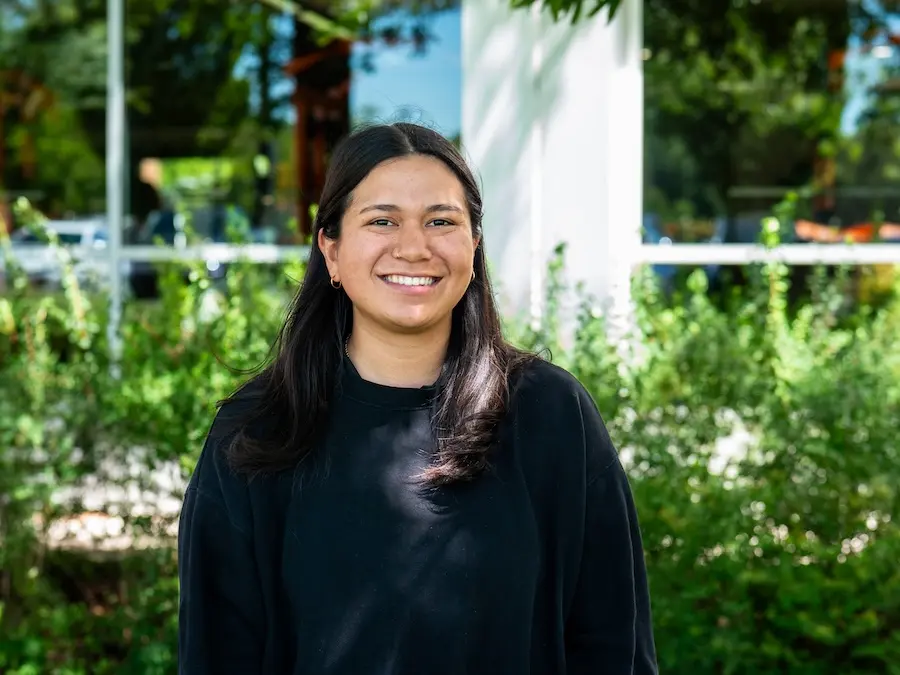
person wearing black shirt standing in front of flowers smiling at the camera

Keenyn Irene Kehaulani Santiago

By Hoku Tiwanak, CLA Student Writer - October 28, 2025

Growing up in the small rural town of Kahuku, located on the north shore of Oahu, Keenyn Irene Kehaulani Santiago learned community, determination, and the value of service. Kahuku is a tight knit community where neighbors look out for one another and culture is passed down through daily life. 

Sports have always been a big part of her community. Growing up playing basketball, Santiago began to notice gaps around her. “There was a need for health and wellness that wasn’t really emphasized, especially for Native people,” she explained. Later as a student at Kamehameha Schools (a private school exclusive to Native Hawaiians), education gave her a broader perspective on what opportunities could look like beyond Kahuku. 

Those lessons from her early years on Oahu continue to shape her journey as she finishes her master’s at the School of Language, Culture, and Society’s College Student Services Administration (CSSA) program. As the current Business Operations and Membership Coordinator for OSU’s Recreational Sports, Santiago is weaving together Native Hawaiian values, recreation, and student development into a vision for healthier, more connected communities.

Santiago had always imagined basketball would carry her into college. But during her senior year of high school, tearing her ACL changed everything. “I was devastated,” Santiago said. “But that injury opened up a new path for me.” Her months of rehabilitation sparked an interest in physical therapy, which motivated her to  enroll at the University of Hawai‘i at Mānoa to study exercise science. 

What started as a student job at the Warrior Recreation Center turned into a passion. “Working there, I found myself loving the leadership side of it,” she said. “Supervising students, building programs, and seeing people grow became more exciting to me than the thought of working in kinesiology."

Encouraged by her mentor, BonnyJean Manini, faculty director of the Office of Student Life & Development, she pursued more opportunities within the rec center, eventually becoming a manager as an undergraduate. “My mentor really pushed me. She saw something in me I didn’t fully see in myself yet.” That mentorship ultimately led Santiago toward graduate school and a new career in student services.

Now in her second year at OSU, Santiago is using her academic work and her role in recreational sports to create environments that support the whole student. Her master’s portfolio  blends Native Hawaiian health, recreation, and student affairs. She’s researching culturally sound approaches to wellness in higher education, focusing on ways to support Native and Indigenous students by revitalizing traditions and preserving cultural practices through their educational experience. “It’s about creating balance,” Santiago said. “Helping students not just survive in college, but thrive. Building community, promoting wellness, and supporting them as whole people.”

At OSU, approximately 100 students identify as Native Hawaiian. For many of those students, finding cultural connections and relevant programming can be difficult. Santiago sees that gap as both a challenge and an opportunity. “The first step is letting students know higher education is possible,” she said. “The second, which is just as important as the first, is giving them the tools to survive and succeed once they’re here.” 

For Native and Indigenous students navigating higher education, her advice comes straight from her own experience: “Take any opportunities wherever they come. Don’t be afraid to apply for jobs, internships, clubs, scholarships, etc. even if you don’t think you’re ready. Bring purpose into what you do, and let go of the limiting stereotypes.”

After she graduates next spring, her long-term vision is clear: to invest in the longevity of her people by blending health, culture, and education. “I want to bring back what I’ve learned and use it to create opportunities that didn’t always exist when I was growing up,” she said.

Santiago’s journey has been defined by resilience, mentorship, and a strong passion for her culture. By bringing Native Hawaiian values into student services and recreation, she not only supports students at OSU today, but also lays the foundation for healthier, stronger communities back home in Hawai‘i. 

Public policy Ph.D. student draws energy economics from Bangladeshi roots

By Colin Bowyer on Oct. 23, 2025

Umama Rahman’s journey to becoming a quantitative energy policy analyst

Image
person sitting on ledge of Crater Lake

Umama Rahman at Crater Lake in Oregon

By Katie Livermore, CLA Student Writer - October 28, 2025

Umama Rahman has always been committed to her education, even when Bangladesh’s societal standards tried to block her path. 

Unlike the standards for women in Bangladesh–getting married around age 20 and having children soon after–Rahman was focused on her dreams of being a Ph.D. student. 

Now, Rahman is in her final year of Ph.D. studies in Oregon State University’s School of Public Policy. As a quantitative energy policy analyst, Rahman is committed to researching energy justice and clean energy access. 

Rahman was born in Bangladesh, which she describes as a small, Southeast Asian, developing country neighboring India and Myanmar. 

“When I'm talking to some people from the United States, they're like, ‘where is Bangladesh? Is that India? Or is it Pakistan?’ It is not all, but some of them,” Rahman said. 

Raised in an educated, middle-class Bangladeshi family in Dhaka, Rahman discovered her experience was not unlike those who grew up in the U.S. Her dad was a banker and completed his master’s degree at the top university in Bangladesh. 

He inspired his children to follow their educational dreams, so much so that Rahman’s older brother and sister pursued higher education in the U.S., too.

Rahman found that U.S. school systems were very different in Bangladesh. Students choose their paths in life at an earlier age. High school is more similar to U.S. universities, as students focus on certain paths like science or engineering, rather than experiencing an array of subjects. 

In eighth grade, Rahman chose science because she planned to be an engineer, as she realized biology wasn’t her favorite subject. Instead, she shifted gears to engineering, thinking she would pursue electrical engineering. 

Following her older sister, putting education before marriage was her first rebellion. 

Rahman’s father sent her to a private college in Bangladesh to ensure she received a strong education. “I'm so so grateful to him for that,” Rahman said. “He was always trying his best to give us the best education.”

Though the societal pressures of STEM made her choose electrical engineering in the beginning, Rahman fell in love with economics and switched paths soon after. 

Graduating magna cum laude with a degree in economics from North South University, Rahman received scholarship offers from University of Tennessee, Knoxville, and the University of Idaho. She chose to pursue her master’s degree in agriculture and resource economics at UT Knoxville, where they awarded Rahman full funding.

At the same time, Rahman started focusing on energy economics and policy. 

Both of her master’s research projects focused on energy. Growing up in Dhaka in the early 90s, Rahman experienced the phenomenon of “load shedding,” where electrical energy in residential areas was turned off to power commercial and industrial equipment. This took place during hot, humid summers when most residential homes had no air conditioning.

“Moms are cooking at that time. They are suffering. They are sweating,” Rahman said. “There was no electricity, no light, so you can't study. We’re trying to just survive. I was wondering: is there any solution that we can do to better our electricity system?”

Focusing on biofuel for her master’s thesis, Rahman studied wood pellets as a way to power residential areas as a renewable energy source. 

The second chapter of her thesis studied the potential supply chain analysis for renewable jet fuel, as the aviation industry is one of the highest polluting industries in terms of carbon dioxide emissions. 

“Energy economics became my passion, and I found where I want to work for the rest of my life,” Rahman said.

After completing her master’s degree, Rahman planned to start working toward her Ph.D.. However, her father’s health was worsening, so she returned home to Bangladesh to care for him. 

Her learning didn’t stop when she returned. Rahman wanted to be sure she enjoyed teaching before enrolling in a Ph.D. program. So, she became a lecturer and faculty member at North South University where she previously graduated. Rahman taught three classes: applied business math, introduction to statistics and applied statistics. While at North South University, Rahman fell in love with teaching and decided: she’d continue her journey in academia. 

After reading–and thoroughly enjoying–a few of his articles, Rahman emailed Dr. David Bernell, associate professor of political science in the School of Public Policy at OSU. She described her research on the cost estimation of a nuclear power plant in Bangladesh and her desire to continue her quantitative studies in economics. 

She ultimately chose OSU because of Dr. Bernell and the interdisciplinary public policy program. Rahman loved the idea of studying the intersection of economics, political science, and sociology. Upon attending OSU, Dr. Bernell became Rahman’s advisor. 

“My research was energy economics, but I also want to see what is happening in the policy world,” Rahman said. “What is the real-life explanation of energy economics? 

Just one term into her Ph.D. at OSU, Rahman’s father, who was constantly supportive of her education, passed away. 

“It was personally very hard to continue the Ph.D. journey, because my mom was by herself in Bangladesh, my brother was in the U.S., and my sister traveled frequently for UNICEF,” Rahman said. “I had a very hard time, but Dr. Bernell was there for me. I would say that a Ph.D. advisor cannot be nicer than him.”

Nonetheless, Rahman continued her Ph.D. as her dad would have wanted.

Her research at OSU is focused on renewable energy. For Rahman’s first project, she chose to examine the impact of different renewable energy policies on community solar project adoption. Using a fixed-effect statistical model, she evaluates the effectiveness of state policies in expanding community solar adoption. 

Last year, she presented her paper at the Western Political Science Association Conference in Vancouver, Canada. 

Rahman is also a member of sociology professor Dr. Hilary Boudet’s team researching community benefit agreements for offshore wind development. 

Through online surveys, Rahman and Boudet, as well as collaborators from universities across the country, are attempting to better understand what coastal communities in Oregon, California, and Maine think of potential offshore wind energy development. 

Results from the survey may inform possible community benefits agreements between the communities, developers, local government agencies, and nonprofit organizations. 

She will present this research paper at the Association for Public Policy Analysis and Management (APPAM) 2025 Conference in Seattle, Washington, one of the most competitive conferences in her field.

Rahman’s third project examines lithium mining in southeastern Oregon. Lithium is a critical mineral, with its popular uses for phone and laptop batteries, electric cars, and more. 

“The U.S. government wants to increase its domestic lithium production, because U.S. companies rely heavily on China for lithium,” Rahman said. “One of the biggest lithium reserves has been found near McDermitt, in southeastern Oregon. My plan is to conduct a public perception survey in southeastern Oregon and part of Nevada around the McDermitt Caldera to assess local support and opposition to lithium mining in that area.”

She is currently designing a randomized controlled trial (RCT) to examine how individuals evaluate trade-offs between environmental risks, economic benefits, and climate objectives in the context of domestic lithium production. By employing experimental survey methods, spatial modeling, and policy analysis, her research seeks to inform more equitable and socially responsive energy siting practices that promote just benefit distribution among all stakeholders.

This project is being conducted under the mentorship of Professors Hilary Boudet, Shawn Hazboun, and Erika Wolters, as part of a transdisciplinary initiative at Oregon State University focused on the social and human dimensions of critical mineral extraction in Oregon.

In addition, she has been selected to join the highly competitive Critical Mineral Research Lab at Resources for the Future, where she will collaborate with students from institutions such as Carnegie Mellon, Duke University, UC Berkeley, and Northwestern University to conduct research on critical minerals, with a particular focus on lithium mining. She is also a 2025–26 recipient of the Renewable Energy Scholarship Foundation award.

Amid research projects and pursuing her Ph.D., Rahman spends her time teaching both in-person and Ecampus classes at OSU. Her classes include introduction to public policy, U.S. energy policy, environmental politics and policy, international environmental politics and policy, and climate politics and policy.

As a woman from a developing country, Rahman constantly stresses the importance of diversity, equity and inclusion in her work–not just in the energy fields, but in all fields. 

And as for being an independent Bangladeshi woman, Rahman is still unmarried and faces lots of challenges in her community in terms of societal judgment. Her focus is still her education, no matter the pushback. 

“I will try my best to make the world a better place from my own angle for change,” Rahman said. “What I really like is that, as a teacher, you can impact your students' whole lives in a greater way. It can have a big impact.” 

###

Rahman would like to extend her heartfelt thanks to Dr. Hilary Boudet, graduate director at the School of Public Policy, for her exceptional support. In addition to Dr. Bernell, other faculty members were incredibly kind and supportive of Rahman during a particularly difficult time. Their compassion and guidance made a significant difference, and without their help, it would not have been easy to navigate that period.


CLA Research: Racial bias in AI training data

By Colin Bowyer on Oct. 21, 2025

In a newly published study, Assistant Professor Chris Chen of the School of Communication tests if people understand that unrepresentative data used to train a facial expression classification AI system can result in biased performance

Image
woman in red jacket and white shirt wearing glasses looking at camera

Chris Chen

By Colin Bowyer, Communications Manager - October 22, 2025

Artificial intelligence (AI) systems designed to identify emotions from facial expressions often produce biased results, such as associating Black faces with negative emotions. This is primarily due to skewed datasets where race can act as a confounding factor when determining emotions, e.g. a disproportionately higher number of white faces with happy emotions and black faces with unhappy emotions and vice versa. For facial recognition, AI systems factor race into their calculations of emotions, alongside facial features, thus producing biased results. Just like a frown may count toward classifying a face as showing a negative emotion, dark skin color becomes coded as a likely indicator of unhappiness.

In a new study published in Media Psychology, Cheng “Chris” Chen, assistant professor of emerging media and technology at the School of Communication, and her co-authors define race as a confound; an irrelevant variable that influences AI outcomes due to unrepresentative training data. Then, the researchers ask if laypeople can detect racial bias in AI systems caused by unrepresentative training data. The study hoped to explore how users interpret training data, identify ways to improve awareness of algorithmic bias, and propose visual cues to help communicate bias.

The basis of this study was partially motivated by an AI bias that Chen experienced in her professional life. “I was giving a virtual presentation where there were auto-generated transcripts by AI,” Chen explained. “When I saw the transcripts myself afterwards, they were totally different from what I was saying, for example, mishearing and transcribing ‘algorithmic bias’ as ‘algorithmic buys,’ but when I saw the transcripts of my native English-speaking peers, they were accurate.” The transcript misstep by the AI during the virtual presentation prompted Chen to design a study to make people aware of bias in these now universal technologies.

With nearly 800 participants, the researchers conducted three experimental studies using a prototype AI system called Emotion Reader AI, which classifies facial expressions as happy or unhappy. In the first study, Chen focused on the biased representation of races, i.e., race is a systematic error or confound in the training data. The second study focused on the lack of adequate representation of a particular race in the training data. And the third combined both types of race misrepresentation and their counterexamples.

What the findings pointed to first is that most users did not perceive bias from a snapshot of unrepresentative training data. One possible explanation is that users may have relied on simpler cues, such as accuracy to evaluate the racial bias in machine learning algorithms. Given that all facial images in the training sample were classified correctly, users might not have viewed unrepresentative training data with racial confounds as problematic.

Second, users were more likely to perceive bias when the AI system performed poorly, especially when it misclassified emotions based on race. Performance bias had a stronger impact on perceived fairness than training data visuals.

Finally, the user’s race mattered in identifying bias in the training data. Black participants were more sensitive to biased training data, especially when it portrayed Black individuals negatively. White participants were less likely to notice or be concerned about racial bias unless it affected them directly.

“The failure to use racial confounds in the training sample to infer algorithmic bias is surprising given the stark contrast between smiling White subjects and sad Black subjects featured in one of the study’s stimuli,” explained Chen. This study highlights the need for technical solutions to ensure fairness, rather than relying on user perception alone.”


Discovering political communication

By Colin Bowyer on Oct. 17, 2025

Political science student and Experiential Learning Scholarship recipient Annalisa Hagg traveled to D.C. to intern for Oregon Senator Ron Wyden

Image
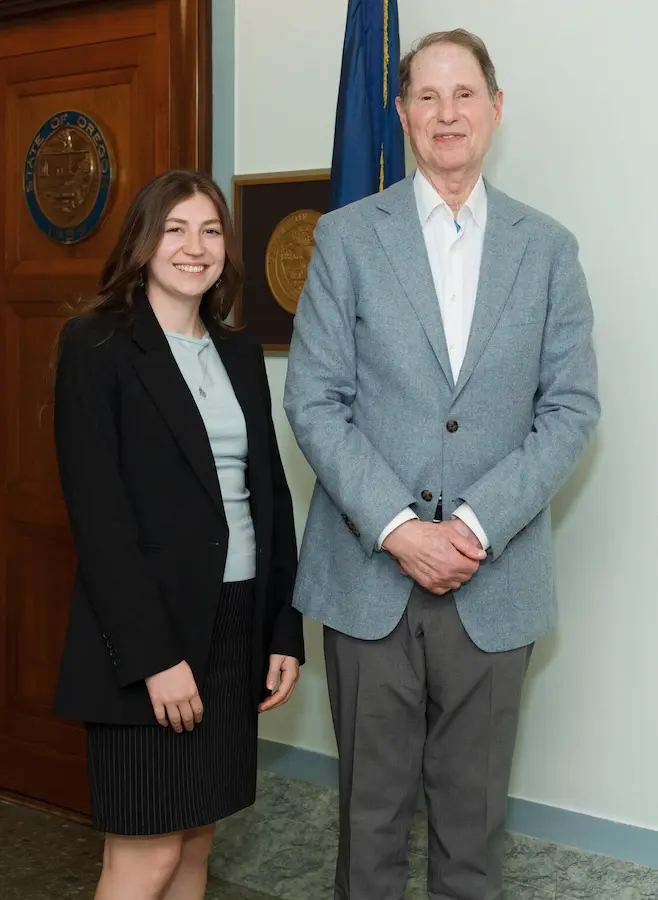
woman and man standing next to one another smiling at the camera

Annalisa Hagg with Senator Ron Wyden

By Colin Bowyer, Communications Manager - October 21, 2025

Senior Annalisa Hagg never imagined that a summer internship would change the trajectory of her career. Raised in Bend, she had always been curious about the world beyond Central Oregon. That curiosity led her to Oregon State University, where she pursued a major in political science in the School of Public Policy and a minor in Asian languages and culture in the School of Language, Culture, and Society. It was a scholarship from the School of Public Policy’s Experiential Learning Fund that launched her into the heart of American politics—Washington, D.C.

As a press intern for Oregon Senator Ron Wyden, Hagg found herself immersed in the fast-paced, high-stakes world of political messaging. “Eighty percent of what I did was writing,” she recalled. “Press releases, memos, quotes, social media posts. You name it.” Her liberal arts foundation gave her the tools to adapt quickly, and her coursework, particularly American Foreign Policy (PS 351), gave her the historical context to understand the nuances of the issues she was helping to communicate.

Her days were a whirlwind of activity: monitoring media for mentions of the senator, compiling daily press clips, drafting press releases, and even ghostwriting statements. She helped research memos for potential TV interviews, drafted talking points for Senator Wyden’s press conferences, and occasionally walked with him to floor votes. “There was a lot of responsibility,” she said. “But also a lot of trust. There was always an open door to take initiative.”

Despite the intensity, Hagg found the office culture welcoming. Senator Wyden himself made time for lunch with the interns, offering advice and sharing stories. “He was incredibly personable,” she said. “It made the experience feel more human, more grounded. The staff always had open doors and really encouraged us to ask questions.”

Still, the experience wasn’t without its challenges. “It was intimidating at first,” she admitted. “Coming from Oregon State, not an Ivy League school, and suddenly being surrounded by people from Harvard and Georgetown, it was a little overwhelming.” But she quickly realized that her background didn’t define her capabilities. “What mattered was showing up, doing the work, and being willing to learn.”

“The hours are long,” Hagg continued. “There was one weekend when we stayed over at the office.” Yet, she found herself drawn to the energy of it all. “There’s something electric about being close to policymaking, even if it’s behind the scenes. You realize that every task is instrumental to the work that helps your community.”

Initially, Hagg had envisioned herself on the legislative side of politics. But her time in the communications office opened her eyes to a different path. “I hadn’t considered communications before,” she said. “But I realized how powerful it is, how much influence messaging has on public perception and policy understanding.” The experience reshaped her career goals, showing her the breadth of opportunities in the political world.

None of it would have been possible without the support of the Experiential Learning Fund and the College of Liberal Arts. “D.C. is incredibly expensive,” she said. “The scholarship covered my flights, rent, and even helped me buy professional clothes. I couldn’t have done it without that support.” 

Now studying abroad at the University of Edinburgh through the Institute for Study Abroad (IFSA) program, Hagg is continuing to expand her global perspective. Her time in D.C. gave her a clearer sense of purpose, and her studies in Scotland are helping her understand politics from an international lens. “It’s all connected,” she said. “Domestic policy, foreign policy, it’s part of a bigger picture, and communication is the string tying it all together.”

After she returns from Edinburgh and graduates from Oregon State, Hagg is considering a return to D.C., perhaps in a communications role, but she’s also keeping her options open. “There’s so much I still want to explore,” she said. “I know that I want to be where decisions are made, and be a part of how those stories are shaped.”


Living and breathing design

By Colin Bowyer on Oct. 17, 2025

Graphic design senior Allie Webb-Bowen immerses herself in the creative community at OSU

Image
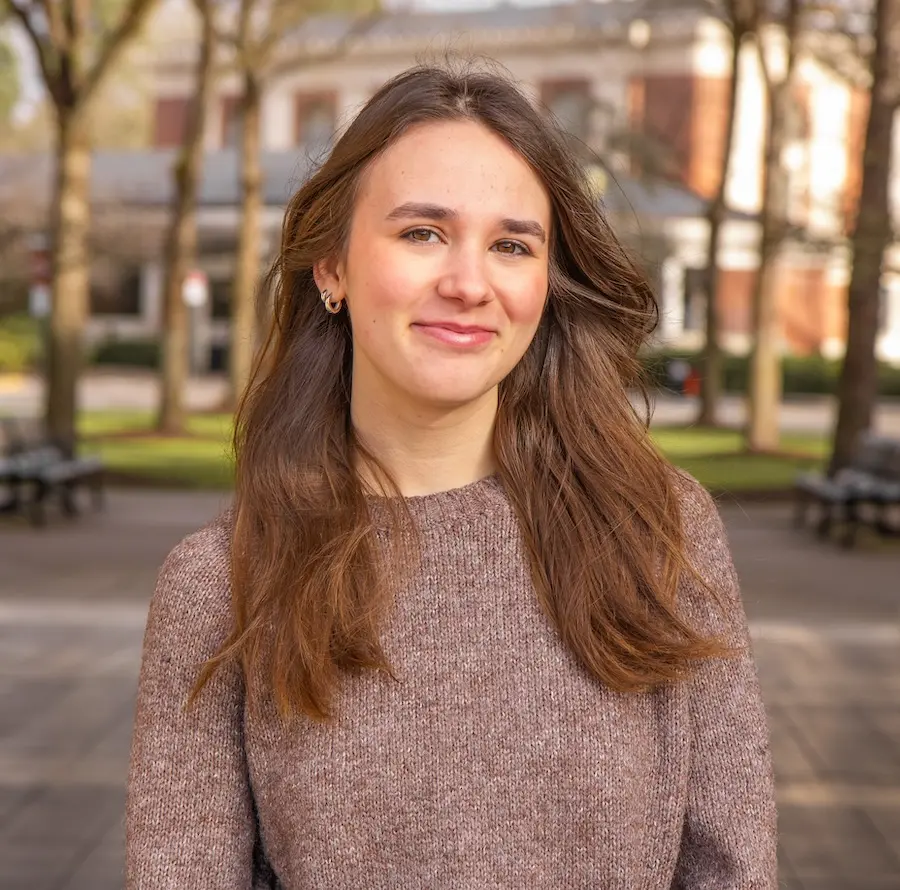
woman in brown sweater looking at camera

Allie Webb-Bowen

By Ellie Webb-Bowen, CLA Student Writer - October 23, 2025

Born and raised in Corvallis, Allie Webb-Bowen knew Oregon State was the place for her. Her grandfather graduated in 1968 and 1978 with degrees in mathematics and business administration, as well as other members of her immediate and extended family. Beaver blood runs through the family, and Webb-Bowen chose to continue the legacy.

Webb-Bowen is now a senior majoring in graphic design. Coming into her first year, she knew she wanted to get involved in a creative field, and graphic design was the perfect fit, “Staying in Corvallis was an easy decision as the graphic design program offers a strategic and rigorous outlet for creatives to work on their craft,” she said.

During summer 2025, Webb-Bowen and other graphic design students traveled to Florence, Italy, for a summer abroad at Academia Italiana, a fine arts college. While there, Webb-Bowen studied digital illustration and package design from an international perspective. Webb-Bowen stated that one of her favorite aspects of the experience was not just learning new methods of graphic design, but also living amongst the incredible art and architecture that Italy has to offer. 

“It was awesome to see international differences in perspective with both everyday things as well as with my studies,” said Webb-Bowen. "I really like to work with impressionist oil pastel, and then within graphic design, I like to be very versatile.".  

Along with letting her creative juices flow through her major, Webb-Bowen is also a member of Chi Theta Phi, an arts and creative-forward sorority on campus. Upon starting at OSU, Webb-Bowen was looking to become more involved in the arts community and discovered Chi Theta Phi during a student clubs fair at the Memorial Union.

 “I decided to try it, I got a bid, and kept going. Now here I am three years later, still regularly involved,” Webb-Bowen said. “It’s fun to have a group of girls who all have a shared interest in the arts.” Currently, Webb-Bowen is part of the executive team as Vice President of Ritual, where she leads initiation, big/little, and senior sendoff events. 

Apart from her classes, Webb-Bowen currently works at KidSpirit, a youth development program on campus,  as marketing design lead. “Webb-Bowen said. In the marketing office, Webb-Bowen designs graphics for social media, brochures, fliers, printed advertisements, and digital signage, as well as helps design interns navigate their own tasks and objectives. 

“I initially applied to be a camp counselor, and then ended up in the marketing sphere, so it has been fun to do a little bit of everything,” Webb-Bowen said. “From my experience, the graphic design program has been more conceptual and less technical, so it’s been productive to have this opportunity where I can apply what I’ve learned in the classroom to the ‘real world.’” 

This academic year, she will wrap up her time in the program, Chi Theta Phi and KidSpirit, and enter the job market. "I want to leave where I feel at ease and know that I’ve done everything I could while at OSU,” she said.

The author of this article is directly related to Allie Webb-Bowen. 

Building on their Spanish fluency

By Colin Bowyer on Oct. 10, 2025

Spanish students in the School of Language, Culture, of Society apply their language skills in classrooms and nonprofits in the U.S. and Mexico

By Colin Bowyer, Communications Manager - October 20, 2025

Each year, fall through summer, both on-campus and Ecampus students majoring or minoring in Spanish are able to receive academic credit for applying their Spanish skills in a professional setting. Overseen by Senior Instructor Raven Chakerian in the School of Language, Culture, and Society, the internship program facilitates partnerships between local schools and non profit organizations with students looking to utilize their Spanish language skills in settings outside of the classroom. With what started initially as a capstone class in spring 2021, Spanish 410 grew into a thriving practicum course benefiting students, as well as the  host organizations and their patrons.

“When students are looking to participate in an internship,” explained Chakerian, “we usually start with these questions: What are your goals? What do you want to get out of this opportunity? And, what can you provide to this organization? From there we try to create a connection that will benefit both the student and the host organization.” 

Though students are welcome to pitch a new internship location, Chakerian maintains a database of local schools and organizations accepting volunteers. Here are just a few students who participated in Spanish 410 internships over the course of a few years:

Marlin Perez, '25 

Image
woman in white shirt and multicolored scarf looking at camera

Perez, ‘25, who grew up in a bilingual community, chose to minor in Spanish to gain a better grasp on the language and its instruction. Paired with her major of human development and family sciences (HDFS), Perez looks to work in the human service field after graduating, specifically helping to support youth. 

Aiding her experience working with young adults as part of the HDFS curriculum was her internship at Linus Pauling Middle School in Corvallis. Working in a 6th-grade language arts class, Perez assisted the teacher with bilingual instruction, helping students with comprehension, understanding vocabulary, and answering questions.

“Linus Pauling is a bilingual school,” Perez explained, “so many enrolled students are living in Latino households learning Spanish through their home environment from their parents, just like I was. I was so happy to be at Linus Pauling. Often, students who learn Spanish at home struggle having to navigate their language learning and growing identity as a Latino in an academic environment. I could relate to that experience. I cherished connecting with students and being able to talk about larger issues happening in their communities.” 

Building the interpersonal connections with students was hugely valuable and bolstered Perez’s passion for human service work. The students felt supported and comfortable around Perez, but especially those of families whose parents were working in the agricultural fields in the Willamette Valley. 

“As someone who grew up speaking Spanish and with parents who work in the fields, I could empathize with the pre-teens and connect at a personal level with them.” 

Perez also completed a second internship as an assistant for Dr. Valeria Ochoa in the School of Language, Culture, and Society’s Heritage Spanish program, and served as a volunteer for 4-H Youth Development program through OSU’s Extension Service, helping children of Latino families navigate their transition to living in Oregon.

Perez is now a graduate from OSU and works as a Community Health Worker in Linn, Benton, and Lane counties at a local organization. She helps Latino families navigate the health system through resources and services around Oregon.


Lara Rupnawar

Image
woman in grey sweatshirt looking at camera

Since enrolling at OSU, senior Lara Rupnawar searched for interdisciplinary ways to combine her major in mechanical 

engineering with her Spanish minor. Each summer, as a member of the College of Engineering’s SHARE Lab, Rupnawar would participate in events hosted by the College Assistant Migrant Program, where prospective first-generation college students could interact with faculty and current students of schools, departments, and labs on campus. 

Rupnawar would often volunteer with other lab members at the SHARE Lab’s station that offered a small hands-on activity. Soon after starting, she began to realize that with Spanish being the primary language spoken at the events, none of her materials were. 

Working with members of the SHARE Lab, Rupnawar created a simple circuit activity for kids attending the program with their parents. Rupnawar wrote step-by-step instructions in Spanish for both children and young adults to create a closed circuit made up entirely of paper that would bring energy from a small battery to illuminate a lightbulb. 

“I noticed a need for bilingual resources because some program participants preferred speaking in Spanish,” she said. “It was not only a new side to learning Spanish, but it also helped me develop my confidence in applying Spanish to more complex engineering topics.”


Kelsey Olivas

Image
woman in orange shirt looking at the camera

Junior Kelsey Olivas, majoring in both business and Spanish, grew up speaking Spanish in California’s Salinas Valley. After briefly switching to studying German, Olivas felt her Spanish proficiency slip while living in Oregon. Wanting to get back on track and work in a Spanish-speaking professional setting, Olivas learned about an internship opportunity from Chakerian that would combine both her academic pursuits.

Former OSU language instructor Ana Gomez founded a coffee company called 94 Pueblos that works with small, women-owned coffee plantations in Colombia. To supplement their coffee business, Gomez started Capra Travel to offer guided tours of coffee farms and local communities in Colombia. Needing more help with market research, Gomez hired Olivas as an intern. 

“The tours are targeted towards educators who are interested in single-origin coffee plantations,” explained Olivas. “Though these tours are extremely unique, I helped Carrie and Ana by researching other coffee tourism opportunities in South America, comparing and contrasting what travel groups and companies have to offer.”

Olivas’s Spanish-language background put her a step ahead when conducting research online and speaking with representatives. Though Olivas’ family is from Mexico, communicating with Spanish speakers from Central and South America provided the biggest opportunity and challenge. Now, finishing her last year at OSU, Olivas is looking forward to applying her market research skills towards finishing her business degree.


Adam Lemcio, '25

Image
man looking at camera with a white background

Spanish major Ecampus student, Adam Lemcio, ‘25, already had decades of experience in the tech industry. As a non-traditional student, Lemcio returned to the (virtual) classroom to master the Spanish language, something he’d been wanting to do for years. Lemcio, who lives in the Seattle area, was looking to apply what he was learning digitally to his everyday life.

“One of the challenges of learning Spanish online is that there’s a smaller speaking element,” said Lemcio. “I was building a foundational knowledge through reading and writing, but you learn the most when speaking it in the moment, non-scripted.” 

Lemcio interned at the Latino Educational Training Institute (LETI) in Everett, Washington. LETI supports Latino immigrants and low-income individuals to achieve personal and financial success through GE and English classes as well as vocational training. Lemcio plugged into LETI as a beginning English instructor, building a curriculum from the ground up and leading instruction. Over the course of six months, Lemcio taught pronunciation, numbers, verb conjugation and more to mostly working professionals with representation from across Latin America.

“It really hit home the urgency and need to learn practical, consumable bits of English language, and not just starting from page one of a textbook,” explained Lemcio. “The students in the class had already spent their entire week working and now they’re choosing to attend English classes on their Saturdays. I needed to make the most of their time and give them something to take home.”

Lemcio described his time at LETI as one of the most “profound and longest lasting educational experiences” he’s ever had. “I was standing in front of them as an English teacher, but also as a Spanish student. I was learning as much from them as they were learning from me.”


Valerie Iriarte, '25

Image
woman in orange shirt smiling at the camera

Ecampus student Valerie Iriarte, ‘25, saw the online flexibility of the Spanish program as a huge advantage as she continued to work close to her home in Northern California. Though growing up in a Spanish-speaking household, Iriarte still wanted to gain a better understanding of the language and its roots, as well as potentially pursue a career in translation services. 

For Spanish 410, Iriarte was searching for an internship near where she lived, but nothing came to fruition. After talking to Chakerian, she pointed Iriarte to Zooniverse, an online platform where students can volunteer to be a team member of academic research projects across the country. 

For her Zooniverse project, Iriarte joined a team from all over the world researching Gonçalo António da Silva Ferreira Sampaio, an 19th Century Portuguese botanist known for his discoveries of algae, lichen, and the the mycological genus Sampaioa. Iriarte’s contributions to the project were translating letters to and from Sampaio from Spanish to English. 

“I gained a huge appreciation of history and patience,” said Iriarte. “Translating 19th Century documents written in older Spanish was a huge challenge for me, but I felt prepared enough to feel confident in what I was doing.” 


Nancy Aguilar, '25

Nancy Aguilar, ‘25, first came to the United States when she was 15, arriving alone from Mexico and settling in Ontario, Oregon. Navigating school and work, Aguilar began to see a pattern: immigrants like her were often stuck in difficult jobs, the kind that came with low pay, no benefits, and few protections. At first, she believed it was simply a language issue; maybe if people spoke English better, they’d have better opportunities. But over time, especially after enrolling in Spanish courses at OSU, Aguilar realized the problem went much deeper.

Double majoring in psychology and Spanish, Aguilar initially wanted to support the Spanish-speaking community by entering the healthcare field, but what she found in the School of Language, Culture, and Society was far more than just language instruction. Aguilar found a community. Professors and students who were passionate, thoughtful, and unafraid to face the hard truths of our world. Thanks to that foundation, Aguilar took advantage of multiple internship opportunities, offering her the experience to work with underserved populations in Oregon and abroad.

 Aguilar began working at the Science & Math Investigative Learning Experiences (SMILE) pre-college program, leading culturally specific workshops for children, many of whom came from immigrant backgrounds.

“Incorporating Spanish-language and culturally relevant materials into programs like SMILE is so critical,” said Aguilar. “It’s not just about language, it’s about validation. It’s about creating a space where students feel safe, seen, and excited to learn.”

 For another internship, Aguilar returned to her hometown San Miguel Acuexcomac, Puebla, after being inspired from co-teaching at dual-immersion Garfield Elementary School in Corvallis. Aguilar reached out to the town’s city council to host a summer school program at the local public library. For three months, Aguilar created a safe space for children and taught age-appropriate and interactive lessons that she designed.

Eloise Flanagan

Sophomore Eloise Flanagan hopes to become an elementary school teacher after graduating with an education degree, and a stint leading an afterschool Spanish program at Franklin School in Corvallis may have provided a new perspective. During the 2025 academic year, Flanagan helped run the K-8 school’s Spanish club that gave middle school students the opportunity to learn the language’s fundamentals. 

“This was a great opportunity for me to work with students outside of my primary age group and in a new learning environment,” said Flanagan. “It also allowed me to practice Spanish and provide experience teaching the language in front of students.”

Flanagan drafted lesson plans that were relevant to the learning styles of not only pre-teens, but also those who, for the most part, had no knowledge of Spanish.

“It was a little off-putting at first and I had to lose any sort of awkwardness and nervousness quickly,” said Flanagan. “But the rapport I built with the students was so rewarding. I learned how to better connect and engage with young people.”

Changing minds: Alexia Obrochta explores psychedelics, cannabis, and their intersection with mental health

By Colin Bowyer on Oct. 8, 2025

Obrochta, a clinical psychology Ph.D. student, looks at how substance co-use can affect people’s ability to manage stress and anxiety

Image
woman in green shirt smiling at the camera

Alexia Obrochta

By Taylor Pedersen, CLA Student Writer - October 10, 2025

For Alexia Obrochta, a second-year Ph.D. student in the School of Psychological Science’s clinical psychology program, research isn’t just about data; it’s about dialogue. Dialogue between substances and stress, between emerging science and cultural stigma, and between her personal curiosities and the evolving field of psychedelic-assisted therapy.

Originally from Daytona Beach, Florida, Obrochta’s path to Oregon and psychedelic research started with a book: Michael Pollan’s How to Change Your Mind. The bestselling exploration of psychedelic science prompted her to imagine how substances like psilocybin (the active compound in psychedelic mushrooms) could help people navigate mental health challenges.

“When I first read that book, I saw how psilocybin was being used to treat substance use disorders and other mental health issues,” Obrochta said. “And I thought if it can help with alcohol use disorder, why couldn’t it be helpful for cannabis use disorder too?” 

Obrochta is now one of the early researchers in OSU’s brand new clinical psychology Ph.D. program, housed in the College of Liberal Arts. Her research focuses on the co-use of cannabis and psilocybin, specifically, how people who use both substances report stress and anxiety, and whether the combination may compound or relieve those symptoms.

Obrochta’s interest in cannabis is rooted in observation. She’s grown up watching how cannabis use has become increasingly normalized, especially as alcohol consumption declines among younger generations. However, she’s also aware that normalization doesn’t always equate to safety.

“Cannabis can be incredibly therapeutic for some people, but for others, it can actually make things worse,” she said. “We’re seeing increases in cannabis use disorders, and not enough discussion about the potential harms. I’ve always cared deeply about harm reduction and how we can help people use substances more safely, whatever those substances may be.”

That harm-reduction lens drives her curiosity about cannabis and psilocybin co-use. She’s particularly interested in whether psilocybin could interrupt a potential feedback loop where people turn to cannabis to manage stress, but end up feeling worse in the long run.

“There’s research suggesting cannabis may dysregulate your body’s stress response. So I’m asking: could psilocybin help reset that? Or does it just add more complexity?”

For Obrochta, the field’s newness is part of the draw, but novelty comes with responsibility. As a clinical psychologist-in-training, Obrochta is committed to separating enthusiasm from evidence.

“It’s easy to get caught up in the hype around psychedelics, but I’m open to whatever the data says, even if that data ends up contradicting my hypotheses,” she said. “I just want the public to have access to good science.”

That scientific grounding is especially important in a field where cultural baggage still looms large. She acknowledges that stigma and legal gray areas make recruitment and community engagement a delicate process.

“Some people are really excited when they hear what I research. Others are more hesitant. Building trust is crucial, not just with participants, but with the broader public.”

Obrochta’s move from Florida to Oregon wasn’t just a climate change; it was a change in lifestyle and perspective. After visiting Portland during her undergraduate years, she knew she wanted to live in the Pacific Northwest.

“Even though I came to OSU during a snowstorm, I saw the beauty in Oregon’s extremes. The faculty were so welcoming and clearly passionate about the program—it just felt right.”

Now, she finds inspiration not only in her lab, but in the landscape. Paddleboarding midweek or hiking after a long day of writing. Oregon’s emphasis on nature has helped her find balance.

“Being in nature just makes me a better person. It grounds me, and that makes me a better researcher, too.”

With two more years left in her Ph.D. program, Obrochta is still exploring where her work will ultimately take her. She loves teaching, clinical work, and research, and hopes to build a career that allows her to do all three.

As for the field of psychedelics, she’s cautiously optimistic.

“The research is promising, but access is still a big issue. Oregon’s psilocybin therapy model is expensive and out of reach for a lot of people. I hope that, as evidence grows, we can push for more equitable models like getting insurance to cover treatment.”

Until then, Obrochta is focused on the science: building strong data, engaging with communities ethically, and staying curious.

“Everything in this field surprises me,” she said. “Whether it’s a new paper showing something positive or negative, I’m just excited the research is being done. People care, and that gives me hope.”


Charting new waters: An oceanographer with an economist’s eye

By Colin Bowyer on Oct. 7, 2025

Oceanography and economics student Lauren Damon hopes to use data-driven research to shape environmental policy

Image
woman looking over her should at the camera

Lauren Damon

By Taylor Pedersen, CLA Student Writer - October 9, 2025

While most children in Bellingham, Washington, were spending their summers on the shore, Lauren Damon was already waist-deep in the saltwater, crabbing, shrimping, and hopping from island to island weren’t just weekend activities; they were her earliest lessons in how people live with, and depend on, the ocean.

“It just allowed me to be more involved in the ocean,” Damon recalled. “Not just standing on the beach, but actually experiencing it.”

Now an incoming senior in both the College of Earth, Ocean, and Atmospheric Sciences (CEOAS) and School of Public Policy in the College of Liberal Arts, Damon has turned those early experiences into an ambitious double major in oceanography and economics. What began as a love for the water evolved into a fascination with how science and policy intersect; how data about tides and currents can inform decisions about fisheries, coastal development, and climate change mitigation.

“I didn’t want to be cornered into studying one species like in marine biology,” Damon explained. “Oceanography lets you look at the broader systems: waves, wind, tides. And then economics comes in when you ask, ‘Okay, if we know what’s happening, how do we make decisions about it?’”

That realization came early in her OSU career. An introductory microeconomics course caught her interest, helped along by a friendship that bloomed in the lecture hall. Soon after, a class in environmental economics and policy sealed the connection. “That was the course where I saw it click,” she said. “We talked about hazardous waste cleanups, non-market valuation, and how you put a dollar amount on the environment. It was exactly the intersection I wanted.”

Damon has since leaned fully into both disciplines. She served as president of the United for Oceanography Club and held leadership roles in the Economics Club, all while remaining active in her sorority, Alpha Omicron Pi. “AOII [pronounced ā-ō-pie] has really connected me to the community,” she said. “I’ve done park cleanups with the Corvallis Parks Department, organized service events, and built leadership skills. It’s taught me how to organize people and take charge. These are skills I’ll carry into my career.”

This past summer, Damon tested those skills during an internship with The Balmoral Group, an environmental consulting firm in Seattle. There, she worked alongside other interns to assess the company’s carbon emissions and recommend sustainability strategies. The hybrid schedule gave her a taste of both city-life professionalism and the realities of remote work. “I loved the balance,” she said. “One day I’d dress up, take the light rail downtown, and work face-to-face. Other days, I could roll out of bed and start in my PJs. It was the perfect mix.”

Her biggest project involved collecting utility data, surveying employees about commuting and sustainable practices, and quantifying the firm’s carbon footprint. The team then presented recommendations to the company’s sustainability council. “It was rewarding to know our work could actually shape the company’s environmental goals,” Damon said.

For Damon, the appeal of this kind of work lies in its tangibility. Policy, she admits, can sometimes feel abstract. But when applied to coastal communities, it becomes concrete. “Take erosion, for example,” she explained. “You look at the environmental factors causing it, then weigh the strategies to fix or slow it down. Each option has costs and benefits. Economics helps decide which is the best strategy. That’s where I see myself: helping communities make those decisions.”

Balancing two majors, multiple leadership roles, and internships hasn’t been without challenges. Time, she says, is her biggest struggle. “I want to do everything, and I don’t want to give less than my best,” she said. Her solution: an arsenal of calendars and to-do lists. “If it’s not written down, it’s not happening,” she laughed.

During summer and into fall term last year, Damon studied abroad via OSU Go at James Cook University in Townsville Australia. Focusing strictly on oceanography, Damon was considered a marine science student in one of the highest-ranked programs in the world, right on the Great Barrier Reef. She frequently used her advanced open water scuba certification, participating in many dives along the reef and around Australia.

Upon returning, she began working in the Coastal and Fluvial Sediments Dynamics lab under CEOAS Associate Professor Emily Eidam. While a lab member, Damon analyzed the concentration of the radioisotope lead-210 in ocean seafloor sediment from the north and south poles to determine how old the sediment is and how fast it's accumulating. 

After she graduates this December, completing two majors in just over three years, Damon plans to step back before diving into her career. She’s heading to New Zealand on a working holiday visa, ready to balance travel with part-time work. “I’ve been going non-stop,” she said. “I want to take a moment to not do school, explore a bit, and then come back ready to lock in.”

Whether her future leads to the private sector, graduate school, or consulting work, Damon already has a vision for her dream role: analyzing environmental restoration projects and advising organizations on the best path forward. “I’d love to be the person who gets called in when there’s an issue, like erosion or restoration, and run the economic analysis of the options,” she said. “And then, years later, to check back and see if the recommendation actually made a difference. That would be really rewarding.”

From Bellingham’s tides to OSU’s labs and now toward a global horizon, Damon has found a way to blend her two worlds – waves and numbers, and science and policy. For her, the ocean isn’t just a place of childhood memory. It’s a future she’s determined to help shape.


Pushing for representation in sports journalism

By Colin Bowyer on Oct. 6, 2025

College of Liberal Arts alumna Lindsay Schnell uses identity to uplift voices and pave way for representation of women in sports journalism

Image
woman in black jacket and orange shirt looking at the camera

Lindsay Schnell

By Katie Livermore, CLA Student Writer - October 10, 2025

Lindsay Schnell, ‘09, grew up living and breathing sports. She’s always seen the game—and reporting on it—as something more than just what’s on the field, court or mat.

In a male-dominated field, Schnell has used her identity as a woman to approach stories from a different angle.

When reporting for The Oregonian in 2011, every news outlet planned to write a profile on Kenjon Barner, then a star running back for the University of Oregon football team, leading up to the game against Washington State. 

The previous season’s matchup between the Ducks and Cougars had been a scary day in college football, with Barner leaving the field in an ambulance after being knocked unconscious while returning a punt. 

Instead of writing the typical athlete profile, Schnell asked: “what was it like for Barner’s mom to witness her son’s injury?”

“We know there's so much data about how dangerous football is, and there are a lot of parents who won't let their child play football because of the danger,” Schnell said. “So I called his mom.”

As it turned out, Barner’s mom was afraid of flying. So much so, she hadn’t been on an airplane in 25 years. When she witnessed the play on TV at home in California, she hopped on a plane and flew to Pullman. She was with him when he woke up in the hospital. 

“I wrote through her lens. She hadn't wanted him to play football, and she had tried to discourage it,” Schnell said. “I think that I came at that from a different perspective than a lot of men would.”

Over the years, Schnell has fought for representation of women sports reporters, lending her journalistic talents to The Oregonian, ESPN, Sports Illustrated, USA Today, and more. She’s covered sports in 42 states.

Now, she’s a reporter for The Athletic, a subscription-based sports journalism website owned by The New York Times

From humble Oregon beginnings

Raised in Sandy, Oregon, Schnell’s parents nurtured her learning and education. Her dad taught at Mt. Hood Community College and her mom taught at a local elementary school. 

Schnell practically grew up in a gym. Outside of their day jobs, her dad was the college’s basketball coach and her mom was an official. Whether it was playing or watching or debating the game, Schnell’s family, including her two younger brothers, loved all things sports. 

Above all, Schnell’s obsession was basketball. 

“When I was in middle school, I watched so much college basketball on TV,” Schnell said. “I initially wanted to be like a color analyst because I had some very strong opinions. But I also always loved reading and writing. Later in middle school I realized, ‘Oh, these two things fit together.’”

That’s when she manifested her dream of writing for Sports Illustrated, by etching it into her middle school yearbook like a prophecy of the future.

During her first year at Sandy High School, Schnell enrolled in an introductory class in journalism. From there, she knew exactly what she would pursue with her life, and committed with full force. 

She was all in. 

After writing as a reporter, Schnell became sports editor of Sandy High School’s student newspaper.

Senior year, she attended the National High School Journalism Convention, went to newspaper camp at Oregon State, and meticulously researched college journalism programs. 

“I knew what I wanted to do,” Schnell said. “I was super nerdy in a good way, and just really leaned in.” 

In 2005, Schnell was named the High School Journalist of the Year, and has started a trend at Sandy High School—three more Sandy students have won the award since.

With her love of journalism and a plan, Schnell was set on attending University of Missouri, considered one of the best journalism schools in the world. 

“I wanted to go so badly,” Schnell said. “I slept in a Missouri shirt every night, and my parents were like, ‘we're not letting you take out that many student loans.’ Obviously, I was 18, so I was very dramatic, and I thought they were ruining my life.”

Meanwhile, Oregon State University’s newspaper, The Daily Barometer, was named Best-All Around Daily Student Newspaper from the Society of Professional Journalists in 2002.

At most other journalism schools, like Mizzou, Schnell would be forced to wait until her junior year to be published in the student paper. The Daily Barometer was different; Schnell could write immediately. 

OSU became the obvious choice. She jumped into reporting for The Daily Barometer, focusing on sports. 

During that first year, Schnell and Leslie Davis, ‘07, KBVR-FM’s station manager, drove from Corvallis, Oregon, to Omaha, Nebraska, to cover OSU in the Men’s College World Series, which culminated in the Beavers’ first baseball national championship. This came after she’d traveled to Oklahoma City to report on the OSU softball team, which was making its first-ever appearance in the Women’s College World Series. 

The two drove through the night, napped in the car in Walmart parking lots, all to see OSU baseball crushed by the University of Miami, 11-1, in their first game. 

“I was like, ‘oh my God, we drove halfway across the country and they're gonna lose,’” Schnell said. “Instead, they won every elimination game. It was really incredible.”

They were there for two weeks. It was both exhausting and rewarding to see the dawn of OSU baseball’s transformation into the powerhouse they are today.

Schnell still remembers the half second of silence among the crowd, when outfielder Tyler Graham caught the final out in Game 3 of the championship series, cementing OSU’s 3-2 win over North Carolina. Disbelief washed over fans. 

“We had no idea what we were doing, but we were at every game, we were at every practice, we were in every press conference,” Schnell said. “It was a really good lesson in being persistent, in trusting your instincts. I was so adamant that we had to be there.”

From the beginning, Schnell was adamant OSU baseball would win the whole thing. And they did. 

At the same time she covered OSU’s CWS run for The Daily Barometer, Schnell also wrote for The Bulletin in Bend, Oregon, and The McMinnville News, bringing news back to local communities from Omaha.

Getting her start

After graduating, Schnell moved on from student journalism to explore freelance work. She covered Oregon sports, particularly the Beavers, and pitched profiles on student-athletes throughout the state. 

By 2008, Schnell was the number two beat writer for Oregon sports for The Oregonian—as a freelancer. 

“I had worked really hard to become better,” Schnell said. “Anytime I was in a press box, and there was a professional journalist there, I was trying to make friends with them, get their feedback. All of those things really helped.”

As a woman covering sports in a male-dominated field, Schnell said the greatest positive is “at halftime in the press box, there’s never a line for the bathroom.” 

All jokes aside, it’s challenging. 

“I was fortunate in that growing up in Oregon, being an athlete in this area, I knew a lot of the people who would eventually become my colleagues and co-workers,” Schnell said. “They knew my family and I as athletes, so I think that did give me a foundation of respect.”

Schnell has always leaned into her unique lens in sports reporting. And it’s paid off. 

“As a woman, you move through the world differently, and so you see things differently, and then you bring that perspective to a newsroom, just like if you're a person of color, a person of the LGBTQ+ community,” Schnell said. “We need more diversity within our industry, especially because we cover a very diverse group of people in athletics. The reporters in the locker rooms and in the press conferences don't always reflect that diversity.”

In late 2009, Schnell ran her Corvallis apartment complex for reduced rent, was a part-time employee at the Hattie Redmond Women’s Center, and worked as a receptionist at a nearby therapy clinic.

All while freelancing for The Oregonian

When she finished her day jobs, Schnell headed out to report on OSU’s football practice.

In winter 2010, ESPN hired Schnell as a full-time freelancer, where she focused on high school girls’ basketball recruitment. 

By September 2010, The Oregonian hired her full-time to report on football, baseball and women' s basketball. 

After four football seasons, Schnell would fulfill her dream—working for Sports Illustrated. For the next three years, she built connections, won multiple awards, and refined her craft. 

Then came the lay offs, a common experience among journalists. Schnell describes it as an “unfortunate rite of passage.”

“I didn't have a backup plan,” Schnell said. “All I wanted to do was be a journalist. Within this industry, journalism in general, but in particular sports journalism, it is not nine to five. You work so much. So many weird hours, weekends–and I'm not complaining—but to go from that to nothing was very jarring.”

Four months later, however, Schnell found herself back on her feet. Originally hired to cover men’s college basketball at USA Today, she deviated from sports and moved to the national news desk for three years, covering topics such as domestic violence in Alaska, Catholic Church sex abuse scandals, and more. She moved back to sports full time in July 2022, just in time to cover the World Track Championships in Eugene, the first time that meet had ever been held in the United States. All together, she spent seven years at USA Today, covering national stories and women’s sports.

Calling the shots

Earlier this year, Schnell became a reporter at The Athletic, which has opened a new world for her reporting. 

“I really think The Athletic set the standard within sports journalism,” Schnell said. “They steer the conversation. That's when you get better, is when you're around people that are better than you.”

The biggest change from USA Today to The Athletic was moving from women’s sports to primarily men’s basketball. Still, she finds ways to explore sports through her own lens.

While covering the College World Series this year, Schnell received a phone call informing her she’d won the Billie Jean King Award for Excellence in Women’s Sports Coverage by the Associated Press Sports Editors. This award, created in 2024, aims to elevate journalism in the field of women’s sports reporting, according to the A.P. 

Stories in her portfolio highlighted topics of race, motherhood, mental health, and body image in women’s sports. 

Next, Schnell looks forward to covering more college hoops, and the Winter Olympics in Italy for The Athletic. For now, she resides in Portland and primarily writes remotely for The Athletic. She also teaches the next generation of journalism students at Linfield College. 

"I know it's unorthodox or unusual to work as a national reporter if you don't have a journalism degree or 'traditional' background. In college, my CLA adviser, Polly Jeneva, once told me 'You can create a world-class education for yourself no matter where you go to school.' I really bought into that, and I think my career is proof she was right. I'm really proud to be an Oregon State alum — and die-hard Beaver women's basketball fan, of course." 

Image
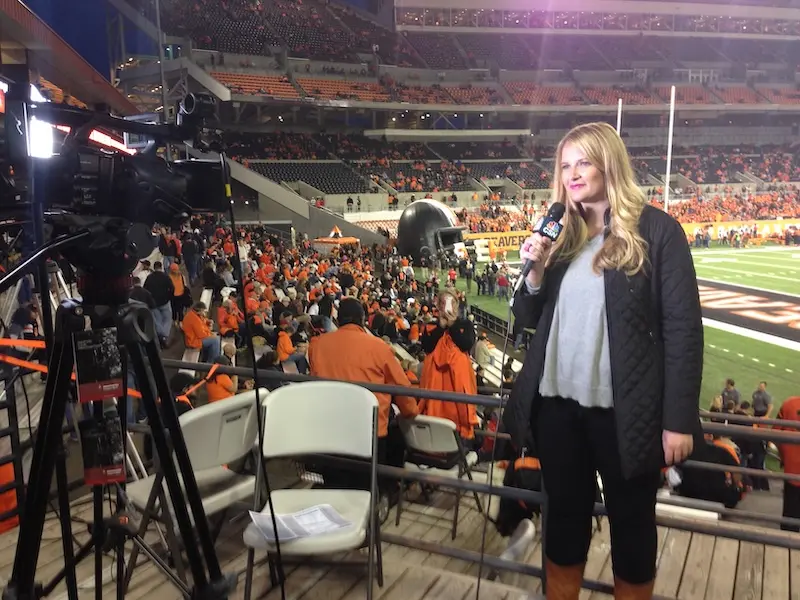
woman speaking into a microphone in front of a television camera at a football game

A pregame TV hit for Comcast Sports Northwest before the Oregon State-Utah football game in October 2014.

Image
a selfie on the streets of Paris

Schnell at the women's skateboarding medal rounds at the Summer Olympics outside Place de la Concorde in Paris in July 2024.

Image
three women taking a selfie at a sporting event

Schnell with her USA TODAY colleagues Rachel Bowers (center) and Nancy Armour (right) at the 2024 Paris Olympics women's gold medal basketball game at Bercy Arena in August 2024.