

School of Communication graduate student Ximena Andrade explores the role of AI in corporate crisis communication
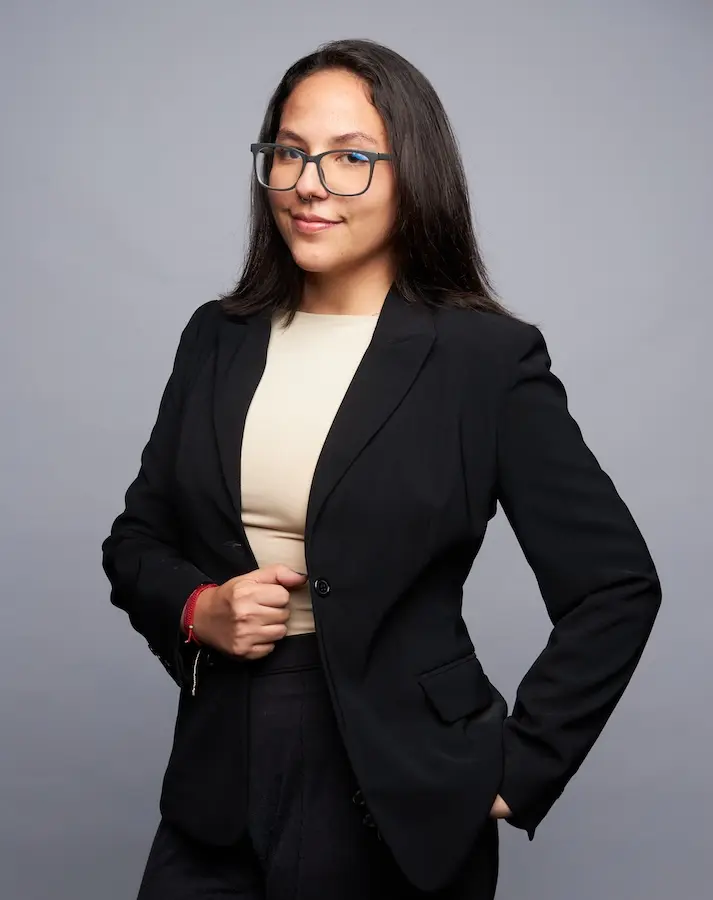
Ximena Andrade
By Taylor Pedersen, CLA Student Writer - December 10, 2025
When Ximena Andrade first stepped into the fast-paced world of public relations in Lima, Peru, she wasn’t entirely sure what she was getting herself into. “Honestly, I didn’t even know what PR was,” she said with a laugh. “But I think it was perfect for me. As a social scientist, I’ve always been drawn to understanding people and communication, and PR found me.”
Today, Andrade is a master’s student in the College of Liberal Arts’ School of Communication, researching how artificial intelligence is reshaping crisis communication and how audiences perceive its use. But before academia, she was already a seasoned professional working full-time at one of the world’s leading communications and corporate-affairs consulting firms, managing communications for clients in technology, fintech, energy, telecommunications, and hydrocarbons.
Her path into PR, she admitted, wasn’t initially part of the plan. With a degree in political science from Pontificia Universidad Católica del Perú, Andrade envisioned a career in public policy, but after having a positive experience interviewing with the public relations team at a top consulting firm, she switched directions. “Life takes us places we don’t expect,” Andrade said.
What drew her in was the complexity of the work; the need to think strategically, quickly, and empathetically. “Communication isn’t just about messaging anymore,” she said. “It’s deeply connected to politics, economics, and society. I realized PR allowed me to engage with all of that.”
Transitioning from full-time professional work in Peru to graduate school life in Oregon was, as Andrade described it, “a lesson in humility.”
“When you’ve been in a field for a while, it’s easy to feel like you already know everything. But communication is one of those areas where you have to stay open. If you don’t adapt, you become outdated very quickly.”
That openness, what she calls an “adaptability mindset,” has become a defining part of her academic and professional identity. At OSU, Andrade has found space to blend her practical expertise with new tools, examining how the rise of AI is altering not just the practice of communication, but people’s trust in it.
Her research zeroes in on crisis communication: how organizations respond during a crisis and the growing role of artificial intelligence in that process.
“In crises, communication is everything,” Andrade explained. “But when AI starts being used, people’s perceptions change.”
Her early findings suggest that while AI tools can streamline crisis responses, they also introduce new ethical challenges. “One of the main insights we’ve seen is that when people realize AI was used in a crisis message, their trust levels can shift immediately,” she said.
Andrade believes the key challenge for future communicators will be to balance technological precision with emotional intelligence and to ensure that speed and data don’t replace empathy.
Andrade’s global outlook has shaped much of her approach. Born and raised in Peru, she developed a passion for international perspectives early on. “When I was twelve, I traveled to Brazil, and throughout high school, I participated in many student exchange programs through global opportunities,” she recalled. “That really opened my eyes. I realized how much we can learn from stepping outside our own contexts.”
That curiosity eventually led her abroad to Oregon State. “When I first connected with OSU’s School of Communication, there was an instant sense of chemistry,” she said. “It felt like a place where I could bring my professional experience and still keep learning.”
As AI continues to transform the world, Andrade is thinking about what the next generation of professionals will need most.
“Adaptability, for sure,” she said without hesitation. “But also ethics, creativity, and humanity. The technology will keep evolving, so it’s our responsibility to evolve with it responsibly.”
When she finishes her degree, Andrade hopes to bridge her research and professional work, helping organizations navigate communication with transparency and care in an increasingly digital world.
“Communication is changing faster than ever,” she said. “But at its core, it’s still about connection; between people, between cultures, and between ideas.”