

Marine studies and elementary education double-degree student Jeremy Schaffer is challenging misconceptions about the ocean and inspiring stewardship
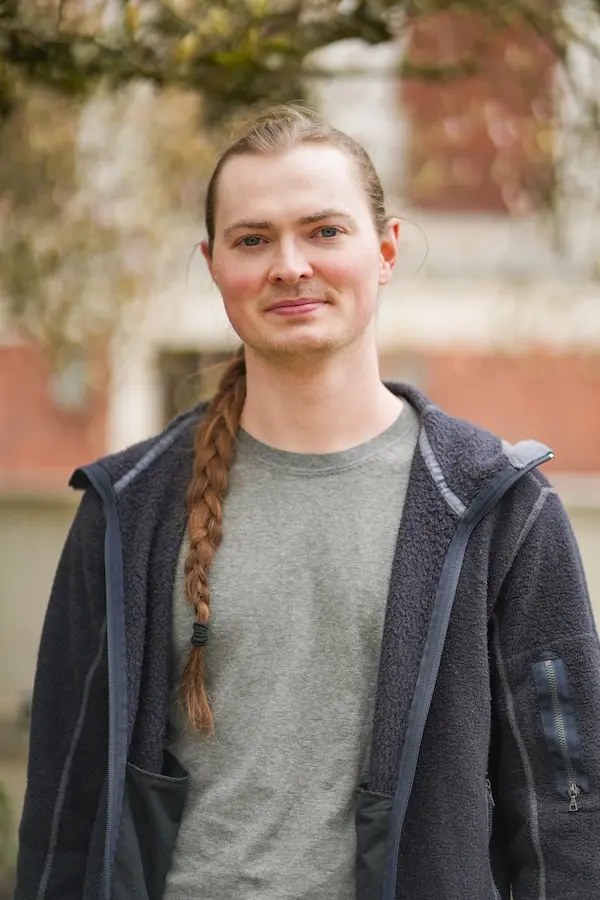
Jeremy Shaffer
By Hoku Tiwanak, CLA Student Writer - April 13, 2026
Jeremy Schaffer moved to Newport, Oregon, when he was in seventh grade. While homeschooled as a child, Schaffer spent much of his time exploring the beach and slowly building his relationship with the ocean. Today, he spends his free time kayaking and seeking out ways to stay connected to marine life outside of the classroom, as well as advocating for sustainable practices. A double major in marine studies and elementary education, as well as an oceanography minor, Schaffer is passionate about working towards educating future generations about marine conservation.
Every summer during high school, Schaffer worked as a volunteer educator at the Oregon Coast Aquarium in Newport. His role as a youth interpretive volunteer was answering questions from visitors and explaining interesting facts about marine life to people encountering it for the first time. Day after day, he noticed the same pattern. “I realized how little most people actually know about the ocean,” he said.
Schaffer began to see education as a powerful tool not just for sharing information, but for shaping how people relate to nature. That desire to become an advocate on behalf of the ocean ultimately led him to Oregon State.
Schaffer came across the College of Liberal Arts’ marine studies (MAST) program through a connection at the aquarium. He wasn’t keen on entering a heavier STEM-related field, but thought MAST could be an apt middle ground, where the social sciences and humanities are emphasized in a marine-related curriculum. With Schaffer’s minor in oceanography, he is receiving an even more comprehensive education on marine ecology that will only enhance his future career in education.
As a student in three distinct colleges, Schaffer also interned with OSU’s Marine and Coastal Opportunities (MACO), where he worked at Cascade Head Biosphere Collaborative Preserve, assisting habitat leaders within the Coastal Climate Change + Community Art, Science & Tradition (4CAST) project. His work involved training and working alongside citizen-science volunteers to develop data collection and monitoring protocols, as well as conducted research on species habitats, and much more.
Perhaps Schaffer’s most impactful experience required him to step away from OSU for a year. Last year, he joined AmeriCorp and served with World Ocean School, an experiential education program based aboard an old-school schooner.
The ship, called the Denis Sullivan, traveled in the Caribbean and up and down the East Coast, hosting ocean-focused programming for students ranging from elementary to high school. “Every day was different,” Schaffer says. “You really had to learn to adapt. Plans changed constantly.”
Days began early with cleaning and preparation before students arrived. During day sails, students rotated through stations, where Schaffer would demonstrate how the schooner navigated.
Longer voyages brought high school students out for week-long sails. As a deckhand and educator, Schaffer taught small groups, often around five students at a time, while also helping to run the ship. The biggest challenge, Schaffer explained, was “it never really felt like you had a break,” he said. “You were always on call.”
Teaching on a boat also meant letting go of traditional classroom comforts. There were no printed lesson packets, projectors, or laptops. Instead, Schaffer taught with reused materials and hands-on tutorials, while constantly adjusting to weather, schedules, and student needs.
Adaptability is one of the most valuable lessons he plans to carry into his future career. “Experiential learning is so much more powerful than just reading and watching,” he says. Being able to teach with what’s available in the moment is a skill he believes can translate anywhere in his career and personal life.
Schaffer looks toward a future in outdoor and outreach-based education, potentially working with organizations like the National Oceanic and Atmospheric Administration (NOAA), where he can engage with people directly.
What continues to motivate him is the many misconceptions people hold about the ocean. Popular media, especially films that portray sharks as evil or constantly highlight the dangers of the ocean, fuel fear and disconnects people from the ocean’s beauty and importance. Schaffer believes change is possible, one lesson, one experience at a time.