

Daniel “tiptoes between worlds” as a marine studies and geology student, incorporating both hard and soft sciences into her academic pursuits
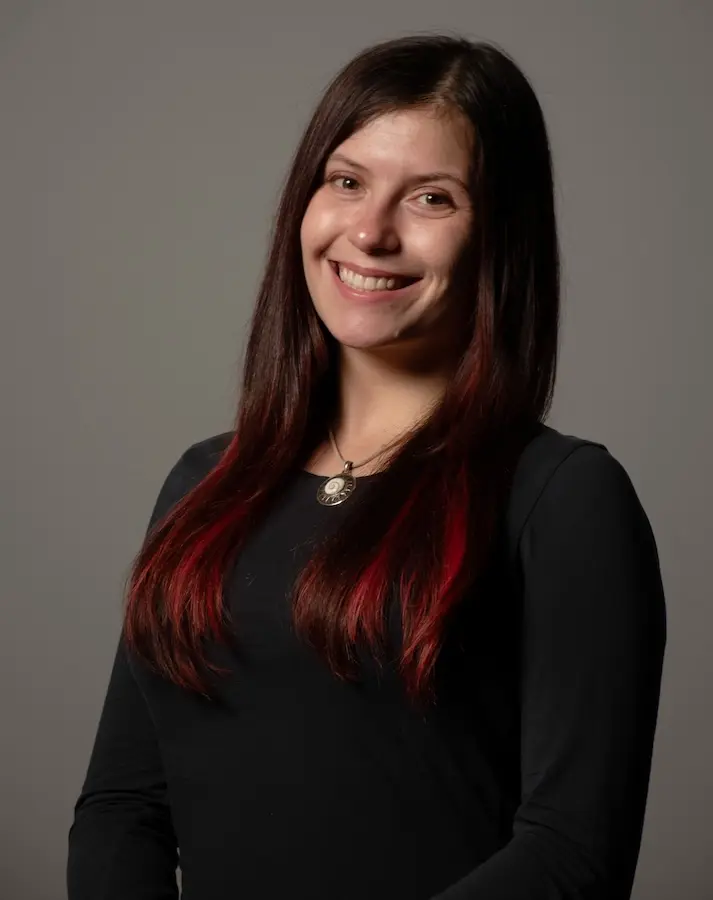
Spencer Daniel
By Taylor Pedersen, CLA Student Writer - April 1, 2025
Spencer Daniel grew up riding BMX bikes through the outskirts of Bend, Oregon, a place she once thought of as gray, dry, and, if she’s being honest, “kind of boring.” The high desert didn’t feel lush or cinematic. It didn’t feel like the kind of place that inspired awe. So she chased movement instead: snowmobiling, biking, being constantly in motion.
“Initially, I didn’t feel very connected to Bend growing up,” Daniel said. “If anything, I thought the town was kind of unappealing, which may have motivated me to look elsewhere for college. But, after moving away, I have a wider appreciation for Bend and the region.”
That sense of distance, paired with a craving for something more fantastical, may be what ultimately pulled her toward the ocean. Water, after all, was everything Bend was not. New, dynamic, mysterious. And it was far away.
Daniel’s path to marine studies wasn’t particularly intentional. She described choosing her major as less like a calling and more like throwing a dart at a dartboard. But what appears, from the outside, to be a neat blend of art, science, and communication is actually the result of years of negotiation between who she was told she could be and who she felt herself becoming.
She was always an artist. That part was never in question. Drawing cartoons and characters, as well as painting, were the things she could confidently say she was good at. Science, on the other hand, felt alienating. In high school, it seemed like a clumsy mashup of subjects she already had to learn: math, writing, and rigid rules. Passion, for her, was not apparent.
“I didn’t have scientists in my life,” she said. “Not real ones.”
Her art teachers, by contrast, cared deeply. They practiced what they taught. And for Daniel, passion is contagious. If the person in front of her believed in the subject, she could too.
COVID hit during her sophomore year of high school, derailing her plan to attend art school. Even before the pandemic, though, she felt uneasy about the idea. Not because she doubted her talent, but because she didn’t want to lose the one thing that felt fully her own. Her dad, a mechanic who turned what he loved into a business, had shown her how easily passion could sour when tied too tightly to money.
“I never wanted that to happen with my art,” she said.
Art school also felt risky in more practical ways. She didn’t feel her portfolio was strong enough, nor did she know how to assemble one. Most options would take her out of state, far from home, at a moment when she wasn’t sure what the dream was anymore.
So she stayed close. She toured Oregon State University and the University of Oregon. UO felt chaotic. OSU felt contained, legible, and solid. So late one night, scrolling through majors on OSU’s website, she landed on marine studies.
It wasn’t marine biology: too technical, too close to the science experiences she didn’t care for. Marine studies, housed in the College of Liberal Arts, promised something else: interdisciplinarity, flexibility, what Daniel called “wiggle room.” It connects science with communication, the humanities, and art. It felt like a way to learn without forcing herself into a mold.
An “artistic approach to science,” for Daniel, was never about painting coral reefs for class, though she sometimes did turn finals into art projects when given the chance; it was about mindset. Art, she said, allows emotion. It invites curiosity, bending rules, and sitting with complexity. Science, she came to believe, is already emotional, especially when it deals with conservation, climate change, and loss. She just refused to pretend otherwise.
Her first term confirmed she’d landed somewhere different. Intro to Oceanography (OC 201) with College of Earth, Oceanic, and Atmospheric Sciences Associate Professor Jennifer Fehrenbacher was challenging, structured, and demanding, but it was taught by someone who genuinely loved learning. Daniel remembers Fehrenbacher’s obsession with foraminifera, tiny microfossils used to reconstruct past ocean climates. That kind of niche passion was new to her. It was also magnetic.
Assistant Professor of Ethnic Studies Patricia Fifita’s course on the Pacific Islands and Oceania (ES 243) offered a sharp contrast. Where oceanography emphasized systems and structure, Fifita centered communication, colonial histories, and discussion. Daniel saw, for the first time, that science could make space for grief and responsibility without collapsing into hopelessness.
“You can feel both,” she said. “Those professors taught me that.”
Fieldwork sealed the deal. In FW 115, a popular course that takes students to Willapa Bay to tag sharks, Daniel found herself doing hands-on science: cold, messy, and unforgettable. It wasn’t only about sharks; it was about realizing she belonged out there.
Then, geology entered her life.
Daniel described falling in love with geology “like a serial partier who swears they’ll never settle down and then gets married immediately.” The catalyst was geology professor Kaplan Yalcin, whose enthusiasm for rocks was unapologetic and contagious. Geology, she realized, offered something rare: the ability to learn something in class and then walk outside and see it everywhere.
“That’s wisdom to me,” she said. “Being able to look at the world and understand how it formed.”
A freezing field trip to Mary’s Peak, led with little sympathy for student discomfort, only deepened her affection. Geology provided technical grounding to her liberal arts major, reframing her understanding of coastal hazards, earthquakes, erosion, and sea level rise. It wasn’t abstract anymore. It was about people, place, and protection.
Now a senior, Daniel described marine studies as giving her permission to “tiptoe between two worlds” without choosing one. That balance is most visible in her capstone project, where she volunteers in microbiologist Corbin Schuster’s lab examining adult Chinook salmon tissues. Twice a week, she spends hours extracting DNA, running Polymerase Chain Reaction (PCRs) Assays, and contributing data that will become part of published research.
For someone who once avoided labs altogether, the transformation felt surreal.
“I’m cutting up fish guts in a lab coat, and it’s going into a study,” she said. “That feels really cool.”
Salmon, for Daniel, are symbolic of the Pacific Northwest, where she hopes to stay, of what’s at stake environmentally. Being trusted with real research, alongside graduate students and professional scientists, has given her a perspective on how demanding and undervalued scientific work can be.
Outside the lab, Daniel found another unexpected home at KBVR, Oregon State’s student radio station. Joining Orange Media Network and becoming a DJ, under the name Broadzilla the Pop Monster, was, she said, one of the best decisions she made in college. Her show plays exclusively pop music by women, blending hyperfeminine energy, celebrity gossip, and joy.
Radio gave her choice, flexibility, and confidence. It also helped her overcome a fear of speaking to large audiences, an essential skill for someone interested in science communication. The persona of DJ Broadzilla is intentionally larger than life, a reminder that being a scientist doesn’t require shrinking other parts of yourself.
“I like being multifaceted,” she said.
Graduating in the spring, Daniel is considering a future in science communication and possibly graduate school somewhere in the Pacific Northwest. She said she doesn’t see her identities as separate anymore (artist, communicator, scientist) but as mutually reinforcing. What once felt like uncertainty now reads as range. And the ocean that once seemed distant and fantastical has become a place where all of Daniel’s worlds blend beautifully.