The winding road to studying whales: Elijah Foster’s triumphant return to college and newfound passion for whale conservation
Foster, a 2025 graduate from the marine studies program, is interning at the Orca Behavior Institute on the San Juan Islands
Elijah Foster
By Halle Sheppard, CLA Student Writer - August 27, 2025
You never know when one day, one moment, can change the trajectory of your whole life. For Elijah Foster, ‘25, that day came unexpectedly, and in the pouring Oregon rain. On a road trip along the Oregon coast, Foster decided to stop by Thor’s Well, a popular sea cave near Yachats, and explore the attraction on foot. That is, until the rain started. As Foster was sprinting back to his rental car to escape the downpour, he was stopped by an Oregon State Park volunteer with the Whale Watching Spoken Here program, asking him if he had seen the whale.
Raised in the suburbs of Chicago and at the time living in Arizona, his first reaction was shock. “There are whales here?” Foster remembers asking excitedly. As he turned back to face the ocean, he saw it.
“It was so teeny and so far away, but that was the first wild whale I ever saw. It was so exciting for me. I asked this poor volunteer every question I could think of, and once I got back to my car, I cried.”
In a blink and you miss it moment, Foster had seen the tiny blow of a gray whale, miles off shore as it traveled south on its long migration towards breeding grounds in Baja California Sur, barely visible through the haze. But, it was enough.
“That whale changed my life,” Foster explained and, with the volunteer’s encouragement, he began to pursue his interest in whales.
Now a graduate of the College of Liberal Arts’ marine studies program, Foster’s journey was anything but straightforward. “I was one of those people who thought I’d never go back to college,” he explained. Fresh out of high school and wanting to flee the freezing Chicago winters, he enrolled at Arizona State University to study supply chain management. By his second semester though, he had dropped out. “I just didn’t care. I knew that it wasn’t the right fit for me,” he explained.
He stuck around Phoenix, Arizona, working in architecture for several years, when he eventually had the opportunity to visit Oregon. That’s when he saw the gray whale in the distance.
After that moment of inspiration and slowly getting involved with whale related volunteer work, Foster soon began hoping for a career working with the charismatic megafauna. It was only after the discovery of the marine studies program, though, that he finally decided to return to school. Afraid of going into a “hard” science program with rigorous math and science requirements, the marine studies program provided a humanities and social sciences-based curriculum. “I don’t have to do math or chemistry, just a lot of writing intensive courses? Sign me up, I can do this.”
“Almost everyone I talked to in marine studies had the same story,” explained Foster. “They loved everything about the ocean and coastal environments, but didn’t want to spend their time studying organic chemistry. I don’t think I would have done college again if not for the marine studies program.”
After Foster enrolled, everything changed from there. A childhood obsession with killer whales grew into a determination to dedicate his life to understanding and protecting them.
Foster expressed his love for the degree, as he could forge his own path and play to his strengths. “It’s the best program for people who want to connect with the ocean.” While challenging, he expressed how this career path is “what I want to do more than anything.”
Enrolling in the marine studies program also proved a point of personal growth. It made him realize that he could push himself and do scary things that he would have never dreamed of doing before.
Foster gained confidence in his own unique strengths, including overcoming his own social anxieties. “Myself 10 years ago would be like, you want a job with people? No!” Through the marine studies program though, he has grown immensely, even quitting his previous comfortable yet isolated remote job to share his love of whales with people.
Ocean11, a marine science club at OSU, hosted an Oregon State Parks employee who suggested Foster volunteer on the coast during the annual Whale Watch Week event in the spring. “That gave me the first steps into talking to people about whales.” Alongside his studies in Corvallis and at the Hatfield campus in Newport, Foster volunteered by manning the Depoe Bay Whale Watch Center, just north of Newport, to look for migrating gray whales up and down the Oregon coast.
His past experiences also aided his work at Hatfield. Before deciding to go to Arizona State University, Foster played the euphonium and was originally supposed to go into professional music, though he hated performing. At Hatfield, he became involved in a study cataloguing the songs of bowhead whales. “My music training really helped me with that,” he explained, as he was able to draw from his own musical talents and training to analyze whale songs.
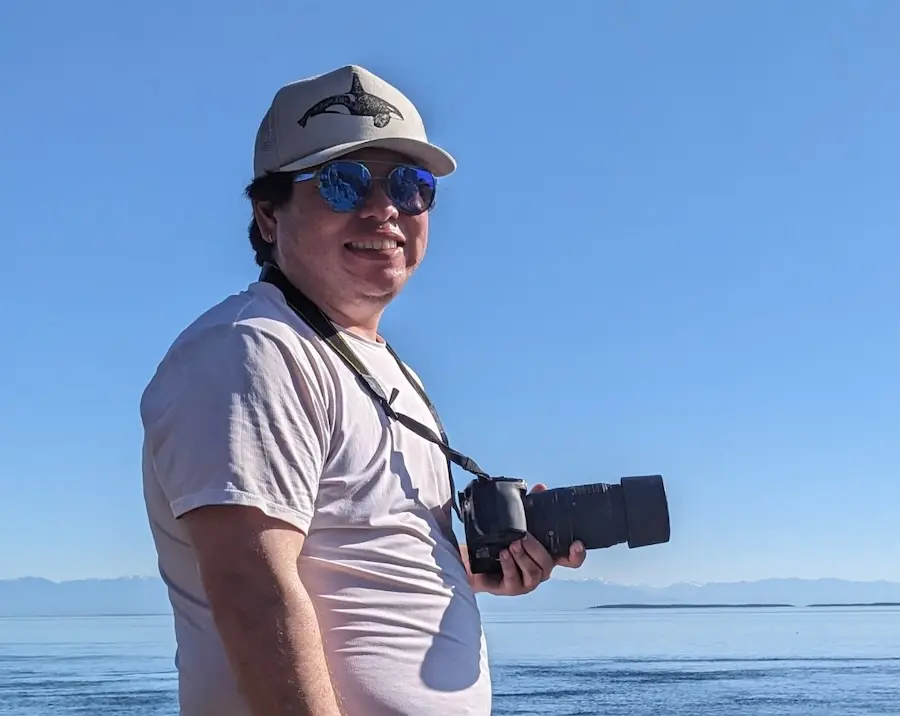
All of this passion and volunteering has led him to an internship at the Orca Behavior Institute located on Washington’s San Juan Islands. As an intern, Foster joins researchers out on the water almost daily, taking behavioral observations of killer whales who frequent the area. Foster is learning a great deal about whale tracking and Washington’s fantastic infrastructure for identification, but desires to return to Oregon soon.
“There’s work to be done in Oregon, I miss my Oregon whales, and my Oregon people.” Foster’s plan for his return is to bring this infrastructure back to Oregon and continue to build it up and continue researching these amazing creatures.
“Teaching people how to see whales” is his goal, and he expressed that “what brings me the greatest joy is helping people see whales for the first time.” Foster hopes to inspire more people to care about whales, and why they must be conserved.
For Foster, though the road was windy and took years to get to, he is finally where he belongs: working to understand and protect whales so that future generations may still observe these incredible giants.