‘Step by step’: Dean Gordon Gilkey’s decades-long effort to establish the College of Liberal Arts

By Colin Bowyer on Oct. 29, 2025

Through the 1960s and 70s, Gilkey would transform the academic landscape at OSU by creating 15 interdisciplinary liberal arts degree programs

Image
black and white photo of middle aged man

Gordon Gilkey in 1947 | Credit: OSU Special Collections & Archives Research Center (SCARC)

By Jessica Krueger, CLA Student Writer - November 7, 2025

Gordon Gilkey was working on a tall glass of brandy when Oregon State’s Dean of Faculty Edmund Volkart broke the news: ‘’’We want you to be dean.’’’ 

“I said, ‘I’m an artist,’” Gilkey recounted in a 1998 interview with the Oregon Historical Society. But Volkart was undeterred. ‘’’You’ll find time.”’ 

The year was 1964 and, for the past year, Gilkey had served as acting dean for the newly-established School of Humanities and Social Sciences while the administration searched for candidates. “They brought in a political scientist candidate from Chapel Hill. They brought in a philosophy professor from Columbia University,” Gilkey said. None of them, apparently, passed muster. Gilkey got the job.

In 1947, Oregon State College (renamed Oregon State University in 1961) had hired Gilkey sight unseen as a full professor and chairman of the art department. A long-time resident of Oregon, Gilkey had just returned from post-World War II Europe where he headed the German Wartime Art Project and served as a liaison for the “Monuments Men.” 

The art department was in its infancy when Gilkey joined the ranks of Oregon State. There were four other faculty members at the time and an equally limited number of art courses available to students. Operating out of a remodeled dormitory (now Fairbanks Hall), Gilkey sometimes taught lessons in an old laundry room. 

Gilkey knew things needed to change, so he got to work. 

“By the time I went into the dean’s office,” Gilkey said, “I had a faculty of (20 to) 25 teachers, full time teachers, teaching painting, drawing, industrial design, printmaking, sculpture, the art crafts, art education, and art history.”

A strong advocate of interdisciplinary education, Gilkey designed art courses for engineers and scientists to improve their manual dexterity. More than this, he understood that art could enrich their lives in a way that technical courses might not. Gilkey believed that art was for everyone.

Gilkey’s greatest contribution to Oregon State, arguably, was his campaign to establish departmental majors in the School of Humanities and Social Sciences. When Gilkey was first hired, students had to attend the University of Oregon if they wished to major in the liberal arts. In such fields as English or music, Oregon State offered only classes. Throughout the 1960s, one by one, Gilkey facilitated the creation of 15 liberal arts majors.

This was no easy feat. “I was quizzed by the State Board’s members and put on a hot seat,’’ Gilkey recounted. “They said, ‘We teach these majors down at the University of Oregon. They can get their Ph.D. down there in art and music, art history, music history.’’’

But Gilkey wouldn’t have it. “I said, ‘That has nothing to do with the education of students at Oregon State. Absolutely nothing.’’’ So Gilkey got his way. 

And he did, again, in 1973 when he convinced Robert MacVicar, then-president of OSU, to recognize the School of Humanities and Social Sciences as its own college under a new name: the College of Liberal Arts. 

Outside of his efforts to establish the College of Liberal Arts, Gilkey worked overtime to create opportunities for international engagement at Oregon State. 

In 1956, Gilkey developed an international print exhibit exchange. He collected prints from artists in Europe and Asia and worked with museums and university galleries across the United States, including Oregon State’s own Memorial Union, to display the art in a series of rotating exhibits. Likewise, museums and university galleries overseas exhibited American-made prints that Gilkey sent in exchange. 

“I started (the program),” Gilkey said, “during a period when the (United States Information Agency) couldn’t bring in foreign exhibits. It was during the McCarthy era, and the U.S.I.A. (could not know whether or not any foreign artist was) a communist. I was interested in art. I didn’t ask their political affiliations. … So quietly, the State Department approved what I was doing.”

As dean, Gilkey organized student exchange programs with universities in Germany, Japan, France, and Mexico. The exchange programs worked in both directions: students from OSU (as well as from other participating universities in Oregon) studied overseas as Oregon universities welcomed foreign students in exchange. 

“We led the pack in this country,” Gilkey said, referencing the introduction of cohorts studying abroad. “We established the pattern, model for international education whereby it was a real change, not living in an isolated, sheltered community over there.”

After thirty years at Oregon State, Gilkey finally retired in 1977. Even when he was promoted to  dean, Gilkey never stopped teaching. In fact, he continued to teach classes in the art department for a short time after his retirement. Such was his commitment to the College of Liberal Arts and to the students of OSU. In 2001, Oregon State celebrated Gilkey’s legacy by renaming Social Science Hall to Gilkey Hall in his honor.


This is the second installment in a series which discusses the life of Gordon Gilkey (1912-2000), a well-known printmaker and the first dean of Oregon State University’s College of Liberal Arts. Born and raised in Lane County, Oregon, Gilkey graduated from the University of Oregon in 1936 with a Master of Fine Arts. After his work with the German Wartime Art Project in post-World War II Europe, Gilkey returned to Oregon where his service to the arts continued. He had tremendous impact on OSU, local and national art scenes, and museums across the U.S. In 1998, oral historian James Strassmaier sat down with Gilkey to document his legacy for the Oregon Historical Society. Read part 1 and part 3 of Gilkey's story.

Image
a picture of two men looking at art

Gilkey (left), pictured here in 1950, as the head of the art department with Dr. C.E. Maser, dean of business and technology | Credit: OSU SCARC

Image
Gilkey Hall in 1945

The Dairly Building, pictured here in 1945, was built in 1912. It was later renamed Social Science Hall in 1951, then Gilkey Hall in 2001. | Credit: OSU SCARC

Image
a black and white photo of two men looking a printed art piece

Gilkey (left), pictured here in 1972, with George Stevens, director of the Memorial Union |Credit: OSU SCARC

Gordon Gilkey and World War II: an artist’s service to the U.S. Military

By Colin Bowyer on Oct. 29, 2025

Gilkey, the College of Liberal Arts’ first dean, headed the German Wartime Art Project during WWII, where he tracked down and gathered over eight thousand pieces of German art produced under Adolf Hitler’s rule

Image
black and white photo of younger man

Undated photograph of Gordon Gilkey | Credit: OHS Research Library, Gordon Gilkey Collection, Acc. 26690.

By Jessica Krueger, CLA Student Writer - October 31, 2025

“Everything was leveled,” Gordon Gilkey said in a 1998 interview with the Oregon Historical Society. “Everything … was bare. It just wiped everything out.”

Before Gilkey gathered German war art in the aftermath of World War II, he served as a captain in the United States Air Force. Tasked with assessing the effectiveness of the U.S.’s atomic bombings of Hiroshima and Nagasaki in early Aug. 1945, Gilkey examined photographs of the damage incurred by the nuclear attacks.

“I thought (they) worked too well,” Gilkey said of the atomic bombs, a brief but poignant statement which no-doubt fails to capture his mourning for the lives destroyed. Confronted with the horrors of the Atomic Age and ever-worsening accounts of Nazi atrocities, Gilkey was forced, like others of his generation, to reckon with extreme and often terrible manifestations of human nature.

In art, Gilkey found solace — and he wanted to save it, resurrect it, even.

After the war’s end, Gilkey headed the German Wartime Art Project of the U.S. Army’s Historical Division. Gilkey and his troops tracked down and gathered over eight thousand pieces of German art produced under Adolf Hitler’s rule, some of which perpetuated violent militarism and Nazi ideology. 

The purpose of this effort was two-fold: first, U.S. occupation authorities wanted to prevent German people from reverting to Nazism after Hitler’s defeat; second, specialists such as Gilkey recognized that art produced under the Third Reich, not all of which was problematic, documented monumental shifts in German politics, military history, and weltanschauung or world view. It was crucial, Gilkey believed, that such art be preserved. 

Gilkey’s official position within the U.S. military was different from members of the Monuments, Fine Arts, and Archives program, better known as “Monuments Men.” While Gilkey gathered and preserved art produced under the Nazi regime, the Monuments Men were tasked with saving masterpieces that the Nazis had looted. More similar than different, Gilkey and the Monuments Men often worked side by side. 

Before the war, Gilkey had worked as a printmaker and art instructor. In 1939, he and other Americans concerned about the safety of European art sent preemptive letters to President Franklin D. Roosevelt requesting, should the U.S. ever declare war, that efforts be made to preserve the cultural relics threatened by Nazi takeover.

Gilkey and the Monuments Men recognized what many others did not. They understood the great power and influence of the arts in society and, furthermore, they understood the oft-overlooked capacity of military forces to protect important artifacts and nurture human culture.

“There was a … community of surviving Jews west of Frankfurt,” Gilkey recounted, “and the elders learned that I was involved in art.” With anti-Jewish sentiments still running high, they wanted to keep their youth safe and off the streets. “Would you come over and get them started making drawings and paintings?” they asked. 

So Gilkey taught them art. 

He had seen first-hand the terrible conditions Holocaust survivors endured under the Nazi regime when he walked through the Dachau concentration camp after its liberation. “I was so mad and sad, but I couldn’t cry then. I cried that night when I got back to my quarters. (It was) horrible,” Gilkey said. 

Gilkey recognized the capacity of art to glorify Hitler’s terrible plans. But he also recognized the dual capacity of art to, in fact, rid the world of people like Hitler, to democratize societies in the creation of a better world. 

“A group of (German generals) wanted to learn art. So (my) colonel volunteered me,” Gilkey said. “I went up and took them these art supplies: ink, brushes, pencils. I said, ‘I want you to make drawings of your memories of the fortifications and so on (where) you fought and some of the places that you were in, and that will become part of the history of the war.’

“I could look at their drawings and tell them to put a little shadow here to emphasize that, and just draw lines around things and then shade it, and they did it. Some of them were very detailed and meticulous. Some of them were quite free,” Gilkey said.

After the war, Gilkey was honored for his service: both for his official duties with the U.S. Air Force and for his efforts to build connections with those he met abroad. He received the U.S.’s Meritorious Service Medal and was knighted by France. He received honors from several other European countries as well. 

In 2014, the Obama administration celebrated Gilkey and the Monuments Men with a Congressional Gold Medal, the highest civilian award possible. It is given to people or groups who have made a significant impact in American history or culture, often for acts of extreme dedication and enduring heroism. 

Approximately 450 pieces of the art that Gilkey collected with the German Wartime Art Project remain in Washington, D.C., under the jurisdiction of the U.S. government. Not all of the pieces produced under the Third Reich exhibited Nazi iconography or propaganda. Some say that Gilkey went too far in collecting German war art. Thankfully, efforts to repatriate the art have been ongoing since 1951. Today, most pieces have been returned to their original artists, rightful owners, or the German government.


This is the first installment in a series which discusses the life of Gordon Gilkey (1912-2000), a well-known printmaker and the first dean of Oregon State University’s College of Liberal Arts. Born and raised in Lane County, Oregon, Gilkey graduated from the University of Oregon in 1936 with a Master of Fine Arts. After his work with the German Wartime Art Project in post-World War II Europe, Gilkey returned to Oregon where his service to the arts continued. He had tremendous impact on OSU, local and national art scenes, and museums across the U.S. In 1998, oral historian James Strassmaier sat down with Gilkey to document his legacy for the Oregon Historical Society. Read part 2 and part 3 of Gilkey's story.


Image
a black and white photo of artwork

Artwork by Gilkey, taken in 1953 | Credit: OSU Special Collections & Archives Research Center

Image
a black and white photo of a couple looking at the camera

Vivian and Gordon Gilkey, taken in 1940 | Credit: Portland Art Museum, Portland, Oregon. The Vivian and Gordon Gilkey Graphic Arts Collection. 2006.41.21.

Image
a stencil artwork

A woodcut print by acclaimed German expressionist and printmaker Max Pechstein, ca. 1927. After WWII ended, Gilkey worked to have Pechstein released from prison and reinstated as professor at the Academy of Arts, Berlin. | Credit: OSU Fairbanks Gallery

The whole student approach: Weaving culture and wellness into higher education

By Colin Bowyer on Oct. 26, 2025

Keenyn Irene Kehaulani Santiago blends Native Hawaiian health, recreation, and student affairs to develop culturally sound approaches to wellness in higher education

Image
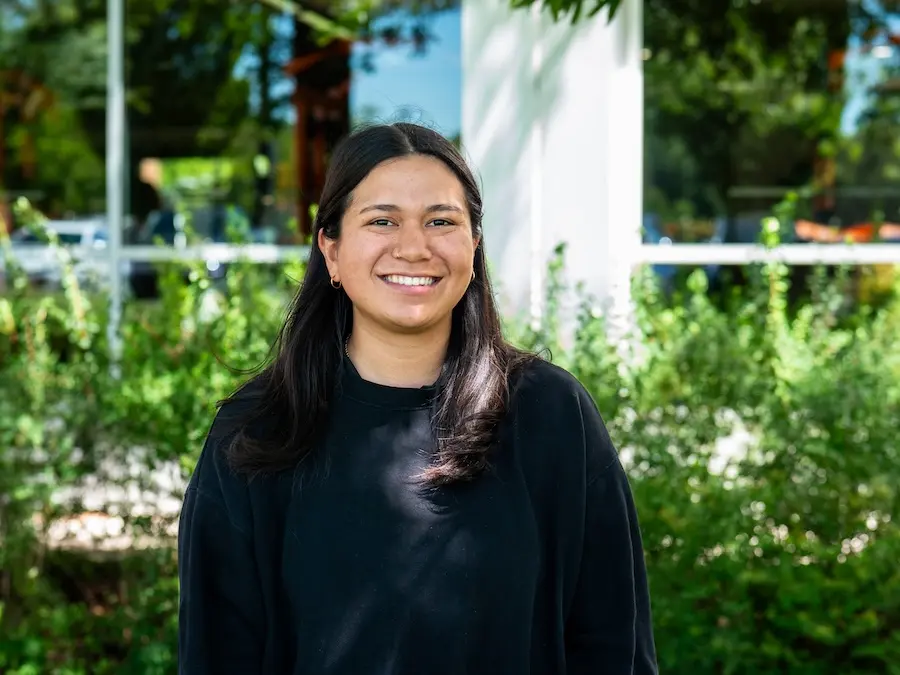
person wearing black shirt standing in front of flowers smiling at the camera

Keenyn Irene Kehaulani Santiago

By Hoku Tiwanak, CLA Student Writer - October 28, 2025

Growing up in the small rural town of Kahuku, located on the north shore of Oahu, Keenyn Irene Kehaulani Santiago learned community, determination, and the value of service. Kahuku is a tight knit community where neighbors look out for one another and culture is passed down through daily life. 

Sports have always been a big part of her community. Growing up playing basketball, Santiago began to notice gaps around her. “There was a need for health and wellness that wasn’t really emphasized, especially for Native people,” she explained. Later as a student at Kamehameha Schools (a private school exclusive to Native Hawaiians), education gave her a broader perspective on what opportunities could look like beyond Kahuku. 

Those lessons from her early years on Oahu continue to shape her journey as she finishes her master’s at the School of Language, Culture, and Society’s College Student Services Administration (CSSA) program. As the current Business Operations and Membership Coordinator for OSU’s Recreational Sports, Santiago is weaving together Native Hawaiian values, recreation, and student development into a vision for healthier, more connected communities.

Santiago had always imagined basketball would carry her into college. But during her senior year of high school, tearing her ACL changed everything. “I was devastated,” Santiago said. “But that injury opened up a new path for me.” Her months of rehabilitation sparked an interest in physical therapy, which motivated her to  enroll at the University of Hawai‘i at Mānoa to study exercise science. 

What started as a student job at the Warrior Recreation Center turned into a passion. “Working there, I found myself loving the leadership side of it,” she said. “Supervising students, building programs, and seeing people grow became more exciting to me than the thought of working in kinesiology."

Encouraged by her mentor, BonnyJean Manini, faculty director of the Office of Student Life & Development, she pursued more opportunities within the rec center, eventually becoming a manager as an undergraduate. “My mentor really pushed me. She saw something in me I didn’t fully see in myself yet.” That mentorship ultimately led Santiago toward graduate school and a new career in student services.

Now in her second year at OSU, Santiago is using her academic work and her role in recreational sports to create environments that support the whole student. Her master’s portfolio  blends Native Hawaiian health, recreation, and student affairs. She’s researching culturally sound approaches to wellness in higher education, focusing on ways to support Native and Indigenous students by revitalizing traditions and preserving cultural practices through their educational experience. “It’s about creating balance,” Santiago said. “Helping students not just survive in college, but thrive. Building community, promoting wellness, and supporting them as whole people.”

At OSU, approximately 100 students identify as Native Hawaiian. For many of those students, finding cultural connections and relevant programming can be difficult. Santiago sees that gap as both a challenge and an opportunity. “The first step is letting students know higher education is possible,” she said. “The second, which is just as important as the first, is giving them the tools to survive and succeed once they’re here.” 

For Native and Indigenous students navigating higher education, her advice comes straight from her own experience: “Take any opportunities wherever they come. Don’t be afraid to apply for jobs, internships, clubs, scholarships, etc. even if you don’t think you’re ready. Bring purpose into what you do, and let go of the limiting stereotypes.”

After she graduates next spring, her long-term vision is clear: to invest in the longevity of her people by blending health, culture, and education. “I want to bring back what I’ve learned and use it to create opportunities that didn’t always exist when I was growing up,” she said.

Santiago’s journey has been defined by resilience, mentorship, and a strong passion for her culture. By bringing Native Hawaiian values into student services and recreation, she not only supports students at OSU today, but also lays the foundation for healthier, stronger communities back home in Hawai‘i. 

Public policy Ph.D. student draws energy economics from Bangladeshi roots

By Colin Bowyer on Oct. 23, 2025

Umama Rahman’s journey to becoming a quantitative energy policy analyst

Image
person sitting on ledge of Crater Lake

Umama Rahman at Crater Lake in Oregon

By Katie Livermore, CLA Student Writer - October 28, 2025

Umama Rahman has always been committed to her education, even when Bangladesh’s societal standards tried to block her path. 

Unlike the standards for women in Bangladesh–getting married around age 20 and having children soon after–Rahman was focused on her dreams of being a Ph.D. student. 

Now, Rahman is in her final year of Ph.D. studies in Oregon State University’s School of Public Policy. As a quantitative energy policy analyst, Rahman is committed to researching energy justice and clean energy access. 

Rahman was born in Bangladesh, which she describes as a small, Southeast Asian, developing country neighboring India and Myanmar. 

“When I'm talking to some people from the United States, they're like, ‘where is Bangladesh? Is that India? Or is it Pakistan?’ It is not all, but some of them,” Rahman said. 

Raised in an educated, middle-class Bangladeshi family in Dhaka, Rahman discovered her experience was not unlike those who grew up in the U.S. Her dad was a banker and completed his master’s degree at the top university in Bangladesh. 

He inspired his children to follow their educational dreams, so much so that Rahman’s older brother and sister pursued higher education in the U.S., too.

Rahman found that U.S. school systems were very different in Bangladesh. Students choose their paths in life at an earlier age. High school is more similar to U.S. universities, as students focus on certain paths like science or engineering, rather than experiencing an array of subjects. 

In eighth grade, Rahman chose science because she planned to be an engineer, as she realized biology wasn’t her favorite subject. Instead, she shifted gears to engineering, thinking she would pursue electrical engineering. 

Following her older sister, putting education before marriage was her first rebellion. 

Rahman’s father sent her to a private college in Bangladesh to ensure she received a strong education. “I'm so so grateful to him for that,” Rahman said. “He was always trying his best to give us the best education.”

Though the societal pressures of STEM made her choose electrical engineering in the beginning, Rahman fell in love with economics and switched paths soon after. 

Graduating magna cum laude with a degree in economics from North South University, Rahman received scholarship offers from University of Tennessee, Knoxville, and the University of Idaho. She chose to pursue her master’s degree in agriculture and resource economics at UT Knoxville, where they awarded Rahman full funding.

At the same time, Rahman started focusing on energy economics and policy. 

Both of her master’s research projects focused on energy. Growing up in Dhaka in the early 90s, Rahman experienced the phenomenon of “load shedding,” where electrical energy in residential areas was turned off to power commercial and industrial equipment. This took place during hot, humid summers when most residential homes had no air conditioning.

“Moms are cooking at that time. They are suffering. They are sweating,” Rahman said. “There was no electricity, no light, so you can't study. We’re trying to just survive. I was wondering: is there any solution that we can do to better our electricity system?”

Focusing on biofuel for her master’s thesis, Rahman studied wood pellets as a way to power residential areas as a renewable energy source. 

The second chapter of her thesis studied the potential supply chain analysis for renewable jet fuel, as the aviation industry is one of the highest polluting industries in terms of carbon dioxide emissions. 

“Energy economics became my passion, and I found where I want to work for the rest of my life,” Rahman said.

After completing her master’s degree, Rahman planned to start working toward her Ph.D.. However, her father’s health was worsening, so she returned home to Bangladesh to care for him. 

Her learning didn’t stop when she returned. Rahman wanted to be sure she enjoyed teaching before enrolling in a Ph.D. program. So, she became a lecturer and faculty member at North South University where she previously graduated. Rahman taught three classes: applied business math, introduction to statistics and applied statistics. While at North South University, Rahman fell in love with teaching and decided: she’d continue her journey in academia. 

After reading–and thoroughly enjoying–a few of his articles, Rahman emailed Dr. David Bernell, associate professor of political science in the School of Public Policy at OSU. She described her research on the cost estimation of a nuclear power plant in Bangladesh and her desire to continue her quantitative studies in economics. 

She ultimately chose OSU because of Dr. Bernell and the interdisciplinary public policy program. Rahman loved the idea of studying the intersection of economics, political science, and sociology. Upon attending OSU, Dr. Bernell became Rahman’s advisor. 

“My research was energy economics, but I also want to see what is happening in the policy world,” Rahman said. “What is the real-life explanation of energy economics? 

Just one term into her Ph.D. at OSU, Rahman’s father, who was constantly supportive of her education, passed away. 

“It was personally very hard to continue the Ph.D. journey, because my mom was by herself in Bangladesh, my brother was in the U.S., and my sister traveled frequently for UNICEF,” Rahman said. “I had a very hard time, but Dr. Bernell was there for me. I would say that a Ph.D. advisor cannot be nicer than him.”

Nonetheless, Rahman continued her Ph.D. as her dad would have wanted.

Her research at OSU is focused on renewable energy. For Rahman’s first project, she chose to examine the impact of different renewable energy policies on community solar project adoption. Using a fixed-effect statistical model, she evaluates the effectiveness of state policies in expanding community solar adoption. 

Last year, she presented her paper at the Western Political Science Association Conference in Vancouver, Canada. 

Rahman is also a member of sociology professor Dr. Hilary Boudet’s team researching community benefit agreements for offshore wind development. 

Through online surveys, Rahman and Boudet, as well as collaborators from universities across the country, are attempting to better understand what coastal communities in Oregon, California, and Maine think of potential offshore wind energy development. 

Results from the survey may inform possible community benefits agreements between the communities, developers, local government agencies, and nonprofit organizations. 

She will present this research paper at the Association for Public Policy Analysis and Management (APPAM) 2025 Conference in Seattle, Washington, one of the most competitive conferences in her field.

Rahman’s third project examines lithium mining in southeastern Oregon. Lithium is a critical mineral, with its popular uses for phone and laptop batteries, electric cars, and more. 

“The U.S. government wants to increase its domestic lithium production, because U.S. companies rely heavily on China for lithium,” Rahman said. “One of the biggest lithium reserves has been found near McDermitt, in southeastern Oregon. My plan is to conduct a public perception survey in southeastern Oregon and part of Nevada around the McDermitt Caldera to assess local support and opposition to lithium mining in that area.”

She is currently designing a randomized controlled trial (RCT) to examine how individuals evaluate trade-offs between environmental risks, economic benefits, and climate objectives in the context of domestic lithium production. By employing experimental survey methods, spatial modeling, and policy analysis, her research seeks to inform more equitable and socially responsive energy siting practices that promote just benefit distribution among all stakeholders.

This project is being conducted under the mentorship of Professors Hilary Boudet, Shawn Hazboun, and Erika Wolters, as part of a transdisciplinary initiative at Oregon State University focused on the social and human dimensions of critical mineral extraction in Oregon.

In addition, she has been selected to join the highly competitive Critical Mineral Research Lab at Resources for the Future, where she will collaborate with students from institutions such as Carnegie Mellon, Duke University, UC Berkeley, and Northwestern University to conduct research on critical minerals, with a particular focus on lithium mining. She is also a 2025–26 recipient of the Renewable Energy Scholarship Foundation award.

Amid research projects and pursuing her Ph.D., Rahman spends her time teaching both in-person and Ecampus classes at OSU. Her classes include introduction to public policy, U.S. energy policy, environmental politics and policy, international environmental politics and policy, and climate politics and policy.

As a woman from a developing country, Rahman constantly stresses the importance of diversity, equity and inclusion in her work–not just in the energy fields, but in all fields. 

And as for being an independent Bangladeshi woman, Rahman is still unmarried and faces lots of challenges in her community in terms of societal judgment. Her focus is still her education, no matter the pushback. 

“I will try my best to make the world a better place from my own angle for change,” Rahman said. “What I really like is that, as a teacher, you can impact your students' whole lives in a greater way. It can have a big impact.” 

###

Rahman would like to extend her heartfelt thanks to Dr. Hilary Boudet, graduate director at the School of Public Policy, for her exceptional support. In addition to Dr. Bernell, other faculty members were incredibly kind and supportive of Rahman during a particularly difficult time. Their compassion and guidance made a significant difference, and without their help, it would not have been easy to navigate that period.


CLA Research: Racial bias in AI training data

By Colin Bowyer on Oct. 21, 2025

In a newly published study, Assistant Professor Chris Chen of the School of Communication tests if people understand that unrepresentative data used to train a facial expression classification AI system can result in biased performance

Image
woman in red jacket and white shirt wearing glasses looking at camera

Chris Chen

By Colin Bowyer, Communications Manager - October 22, 2025

Artificial intelligence (AI) systems designed to identify emotions from facial expressions often produce biased results, such as associating Black faces with negative emotions. This is primarily due to skewed datasets where race can act as a confounding factor when determining emotions, e.g. a disproportionately higher number of white faces with happy emotions and black faces with unhappy emotions and vice versa. For facial recognition, AI systems factor race into their calculations of emotions, alongside facial features, thus producing biased results. Just like a frown may count toward classifying a face as showing a negative emotion, dark skin color becomes coded as a likely indicator of unhappiness.

In a new study published in Media Psychology, Cheng “Chris” Chen, assistant professor of emerging media and technology at the School of Communication, and her co-authors define race as a confound; an irrelevant variable that influences AI outcomes due to unrepresentative training data. Then, the researchers ask if laypeople can detect racial bias in AI systems caused by unrepresentative training data. The study hoped to explore how users interpret training data, identify ways to improve awareness of algorithmic bias, and propose visual cues to help communicate bias.

The basis of this study was partially motivated by an AI bias that Chen experienced in her professional life. “I was giving a virtual presentation where there were auto-generated transcripts by AI,” Chen explained. “When I saw the transcripts myself afterwards, they were totally different from what I was saying, for example, mishearing and transcribing ‘algorithmic bias’ as ‘algorithmic buys,’ but when I saw the transcripts of my native English-speaking peers, they were accurate.” The transcript misstep by the AI during the virtual presentation prompted Chen to design a study to make people aware of bias in these now universal technologies.

With nearly 800 participants, the researchers conducted three experimental studies using a prototype AI system called Emotion Reader AI, which classifies facial expressions as happy or unhappy. In the first study, Chen focused on the biased representation of races, i.e., race is a systematic error or confound in the training data. The second study focused on the lack of adequate representation of a particular race in the training data. And the third combined both types of race misrepresentation and their counterexamples.

What the findings pointed to first is that most users did not perceive bias from a snapshot of unrepresentative training data. One possible explanation is that users may have relied on simpler cues, such as accuracy to evaluate the racial bias in machine learning algorithms. Given that all facial images in the training sample were classified correctly, users might not have viewed unrepresentative training data with racial confounds as problematic.

Second, users were more likely to perceive bias when the AI system performed poorly, especially when it misclassified emotions based on race. Performance bias had a stronger impact on perceived fairness than training data visuals.

Finally, the user’s race mattered in identifying bias in the training data. Black participants were more sensitive to biased training data, especially when it portrayed Black individuals negatively. White participants were less likely to notice or be concerned about racial bias unless it affected them directly.

“The failure to use racial confounds in the training sample to infer algorithmic bias is surprising given the stark contrast between smiling White subjects and sad Black subjects featured in one of the study’s stimuli,” explained Chen. This study highlights the need for technical solutions to ensure fairness, rather than relying on user perception alone.”


Discovering political communication

By Colin Bowyer on Oct. 17, 2025

Political science student and Experiential Learning Scholarship recipient Annalisa Hagg traveled to D.C. to intern for Oregon Senator Ron Wyden

Image
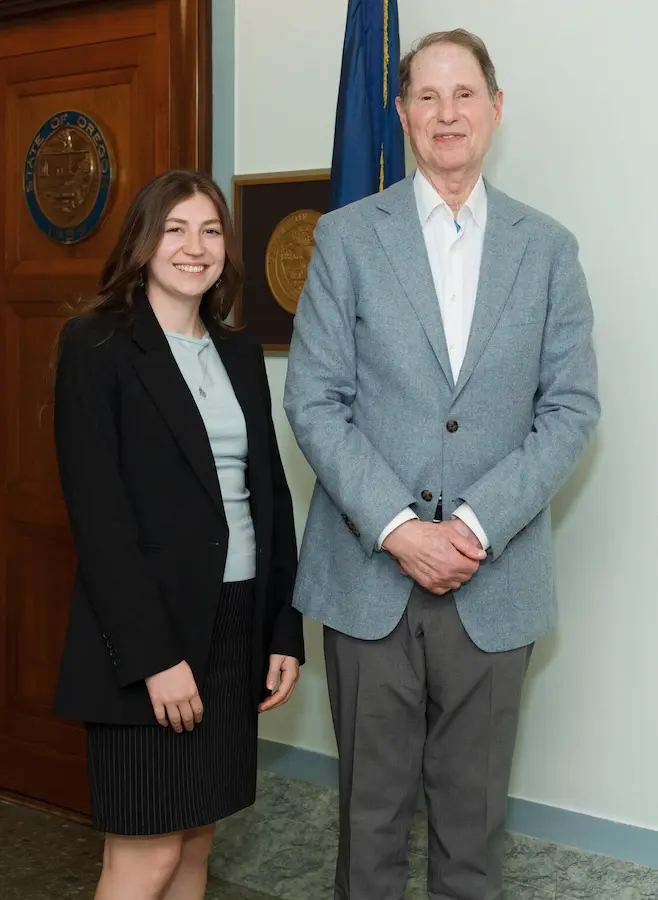
woman and man standing next to one another smiling at the camera

Annalisa Hagg with Senator Ron Wyden

By Colin Bowyer, Communications Manager - October 21, 2025

Senior Annalisa Hagg never imagined that a summer internship would change the trajectory of her career. Raised in Bend, she had always been curious about the world beyond Central Oregon. That curiosity led her to Oregon State University, where she pursued a major in political science in the School of Public Policy and a minor in Asian languages and culture in the School of Language, Culture, and Society. It was a scholarship from the School of Public Policy’s Experiential Learning Fund that launched her into the heart of American politics—Washington, D.C.

As a press intern for Oregon Senator Ron Wyden, Hagg found herself immersed in the fast-paced, high-stakes world of political messaging. “Eighty percent of what I did was writing,” she recalled. “Press releases, memos, quotes, social media posts. You name it.” Her liberal arts foundation gave her the tools to adapt quickly, and her coursework, particularly American Foreign Policy (PS 351), gave her the historical context to understand the nuances of the issues she was helping to communicate.

Her days were a whirlwind of activity: monitoring media for mentions of the senator, compiling daily press clips, drafting press releases, and even ghostwriting statements. She helped research memos for potential TV interviews, drafted talking points for Senator Wyden’s press conferences, and occasionally walked with him to floor votes. “There was a lot of responsibility,” she said. “But also a lot of trust. There was always an open door to take initiative.”

Despite the intensity, Hagg found the office culture welcoming. Senator Wyden himself made time for lunch with the interns, offering advice and sharing stories. “He was incredibly personable,” she said. “It made the experience feel more human, more grounded. The staff always had open doors and really encouraged us to ask questions.”

Still, the experience wasn’t without its challenges. “It was intimidating at first,” she admitted. “Coming from Oregon State, not an Ivy League school, and suddenly being surrounded by people from Harvard and Georgetown, it was a little overwhelming.” But she quickly realized that her background didn’t define her capabilities. “What mattered was showing up, doing the work, and being willing to learn.”

“The hours are long,” Hagg continued. “There was one weekend when we stayed over at the office.” Yet, she found herself drawn to the energy of it all. “There’s something electric about being close to policymaking, even if it’s behind the scenes. You realize that every task is instrumental to the work that helps your community.”

Initially, Hagg had envisioned herself on the legislative side of politics. But her time in the communications office opened her eyes to a different path. “I hadn’t considered communications before,” she said. “But I realized how powerful it is, how much influence messaging has on public perception and policy understanding.” The experience reshaped her career goals, showing her the breadth of opportunities in the political world.

None of it would have been possible without the support of the Experiential Learning Fund and the College of Liberal Arts. “D.C. is incredibly expensive,” she said. “The scholarship covered my flights, rent, and even helped me buy professional clothes. I couldn’t have done it without that support.” 

Now studying abroad at the University of Edinburgh through the Institute for Study Abroad (IFSA) program, Hagg is continuing to expand her global perspective. Her time in D.C. gave her a clearer sense of purpose, and her studies in Scotland are helping her understand politics from an international lens. “It’s all connected,” she said. “Domestic policy, foreign policy, it’s part of a bigger picture, and communication is the string tying it all together.”

After she returns from Edinburgh and graduates from Oregon State, Hagg is considering a return to D.C., perhaps in a communications role, but she’s also keeping her options open. “There’s so much I still want to explore,” she said. “I know that I want to be where decisions are made, and be a part of how those stories are shaped.”


Living and breathing design

By Colin Bowyer on Oct. 17, 2025

Graphic design senior Allie Webb-Bowen immerses herself in the creative community at OSU

Image
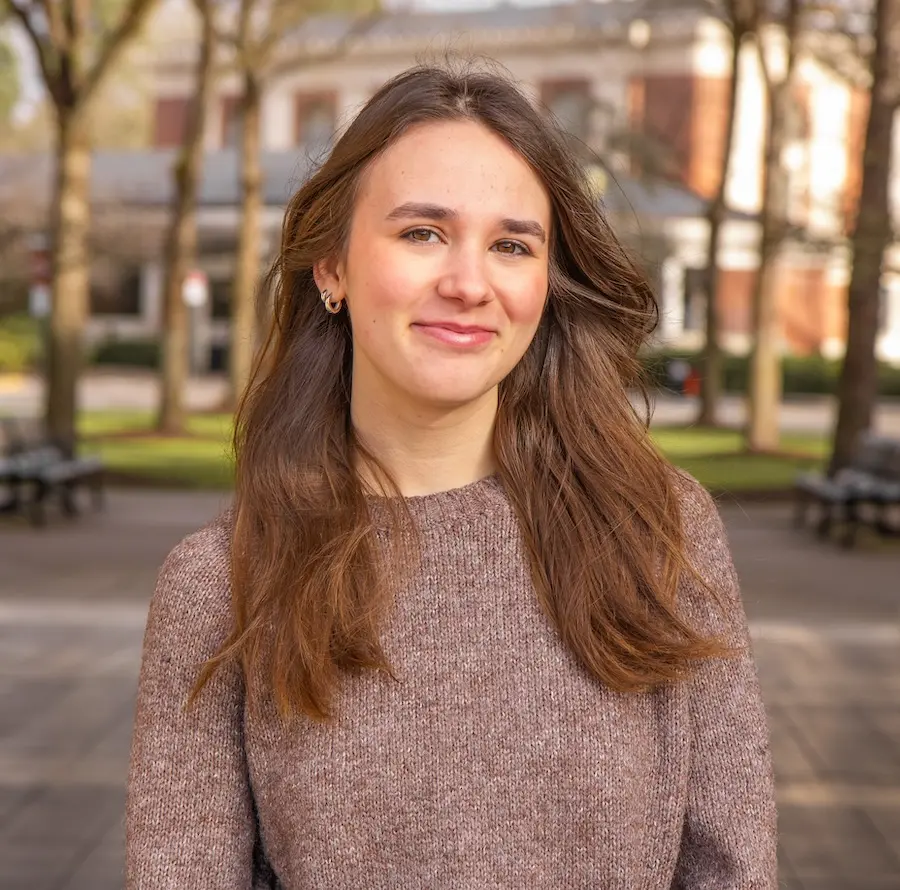
woman in brown sweater looking at camera

Allie Webb-Bowen

By Ellie Webb-Bowen, CLA Student Writer - October 23, 2025

Born and raised in Corvallis, Allie Webb-Bowen knew Oregon State was the place for her. Her grandfather graduated in 1968 and 1978 with degrees in mathematics and business administration, as well as other members of her immediate and extended family. Beaver blood runs through the family, and Webb-Bowen chose to continue the legacy.

Webb-Bowen is now a senior majoring in graphic design. Coming into her first year, she knew she wanted to get involved in a creative field, and graphic design was the perfect fit, “Staying in Corvallis was an easy decision as the graphic design program offers a strategic and rigorous outlet for creatives to work on their craft,” she said.

During summer 2025, Webb-Bowen and other graphic design students traveled to Florence, Italy, for a summer abroad at Academia Italiana, a fine arts college. While there, Webb-Bowen studied digital illustration and package design from an international perspective. Webb-Bowen stated that one of her favorite aspects of the experience was not just learning new methods of graphic design, but also living amongst the incredible art and architecture that Italy has to offer. 

“It was awesome to see international differences in perspective with both everyday things as well as with my studies,” said Webb-Bowen. "I really like to work with impressionist oil pastel, and then within graphic design, I like to be very versatile.".  

Along with letting her creative juices flow through her major, Webb-Bowen is also a member of Chi Theta Phi, an arts and creative-forward sorority on campus. Upon starting at OSU, Webb-Bowen was looking to become more involved in the arts community and discovered Chi Theta Phi during a student clubs fair at the Memorial Union.

 “I decided to try it, I got a bid, and kept going. Now here I am three years later, still regularly involved,” Webb-Bowen said. “It’s fun to have a group of girls who all have a shared interest in the arts.” Currently, Webb-Bowen is part of the executive team as Vice President of Ritual, where she leads initiation, big/little, and senior sendoff events. 

Apart from her classes, Webb-Bowen currently works at KidSpirit, a youth development program on campus,  as marketing design lead. “Webb-Bowen said. In the marketing office, Webb-Bowen designs graphics for social media, brochures, fliers, printed advertisements, and digital signage, as well as helps design interns navigate their own tasks and objectives. 

“I initially applied to be a camp counselor, and then ended up in the marketing sphere, so it has been fun to do a little bit of everything,” Webb-Bowen said. “From my experience, the graphic design program has been more conceptual and less technical, so it’s been productive to have this opportunity where I can apply what I’ve learned in the classroom to the ‘real world.’” 

This academic year, she will wrap up her time in the program, Chi Theta Phi and KidSpirit, and enter the job market. "I want to leave where I feel at ease and know that I’ve done everything I could while at OSU,” she said.

The author of this article is directly related to Allie Webb-Bowen.