

Lanenga balances being a professional photographer, school board member, part-time public policy graduate student, and legislative aide in pursuit of improving educational outcomes through effective policymaking.

Ali Lanenga
By Taylor Pedersen, CLA Student Writer - February 25, 2026
Alejandra (Ali) Lanenga never planned on working in government. If anything, her life has been filled with detours; early adulthood was shaped by responsibility, years spent behind a camera lens, and a return to education after burnout motivated her to leave the classroom entirely. But for Lanenga, whose path has moved between creativity and structure, policymaking has become another way of framing the world, one that allows her to influence both individual lives and entire systems.
Raised in rural Sandpoint, Idaho, Lanenga grew up surrounded by both people and responsibility. Though she has older half-siblings, she often occupied the role of the oldest child. That position, paired with life on a farm, shaped her early understanding of obligation. There were animals to feed, siblings to watch, and expectations that weren’t easily bent.
“I came out of the womb a rule follower,” she said, laughing. “I’m the kind of person who naturally holds the line on whatever the rule or value is.” That instinct, to uphold structure and follow through, would carry her through nearly every chapter of her life, even when the structure itself began to crack.
Lanenga graduated from high school at 17 and began college at Brigham Young University (BYU) in Provo, Utah, shortly after. She married young, at 18, towards the end of her freshman year. Looking back now, she sees that period as a crash course in independence.
Once married, Lanenga and her husband were effectively on their own. They paid for college, insurance, and necessities without family financial support. Their weekly grocery budget for two adults hovered around $20. “We had to choose between food, tuition, and books,” she said. “And we just figured it out.”
The struggle taught her how to prioritize, sacrifice, and lean on community; skills that would resurface years later in far different contexts. “We learned to value relationships and support systems,” she said. “That sense of chosen community mattered.”
After graduating from BYU with a degree in family and consumer sciences education, Lanenga accepted her first teaching job in Utah, outside of Salt Lake City, working with seventh- and ninth-grade students. She was barely older than many of her students herself, just 21, and quickly found herself overwhelmed.
She taught classes of more than 50 students, many of whom came from unstable home environments marked by poverty, foster care involvement, and incarceration. “I didn’t feel like I knew what I was doing,” she admitted. “Because I didn’t.”
Lanenga poured herself into the work anyway. She stayed late to tutor students, meticulously planned lessons, and tried to support kids whose needs extended far beyond the classroom. The result was total burnout. By the end of her first year, while pregnant with her first daughter, she reached her breaking point.
“I was done,” she said. “I wasn’t going to do all of this and be pregnant. I hit my limit.”
After leaving teaching and later having a second child, Lanenga found herself struggling with postpartum depression. It was during this period that photography, an interest she had held quietly for years, became a saving grace.
Working in manual mode, she found comfort in the mechanics of the camera. Adjusting ISO, aperture, and light gave her a sense of control when her internal world felt anything but stable. “I could see how changing one thing changed the outcome,” she said. “That helped me reset.”
Photography became both an emotional outlet and a practical one. She began with stock images, then moved into portraits, weddings, and events. Eventually, though, she found herself drawn away from people altogether.
“Flowers don’t have vanity,” Lanenga laughed. “People care deeply about how they’re seen. With flowers, I could tell the story I wanted to tell.”
Her work shifted almost entirely to flowers and inanimate objects, images that conveyed feeling without expectation. Over time, her photography evolved into a successful business. She now sells her work to interior designers, galleries, private collectors, and art licensing companies, supplying images for hotels, offices, and commercial spaces.
The business side, she said, came through trial by fire. “You fail your way to success,” she said. “You make art nobody buys. You make art nobody likes. And you keep refining.”
The flexibility of being an artist allowed Lanenga to remain a stay-at-home mother until another turning point arrived.
In 2019, her family moved to Portland. Then the pandemic hit. Suddenly, Lanenga was an artist, a mother, and a teacher again, this time teaching her own children from her living room.
“That’s when it became very clear the system wasn’t working,” she said. “Why was I paying taxes for my kids to go to school if I was the one teaching the lessons?”
Teaching at home exposed gaps she couldn’t ignore: weak curriculum, poor outcomes, and policies that didn’t align with the realities families were facing. Oregon’s consistently low performance on national education metrics only reinforced what she was seeing firsthand. That motivated Lanenga to enter the race for Riverdale School District school board where won a four-year board position.
What kept her going after that initial push was policy work. As chair of the board’s policy subcommittee, Lanenga found a new outlet for her analytical instincts. “School boards don’t run districts, superintendents do,” she explained. “Boards set expectations. Policy is how boards let superintendents know what they expect.”
One of her proudest accomplishments has been pushing for meaningful academic metrics in every grade, not just those required by the state or federal government. By implementing district-wide benchmarks for English and math across all grade levels, Lanenga helped create a system that allows for earlier intervention and more informed financial decisions.
“It lets us adjust resources in real time,” she said. “That’s how you actually support students.”
Her growing interest in policy led her to Oregon State University, where she completed a public policy microcredential first, then a certificate program, and eventually enrolled as a part-time executive master’s student online. The “stackable” programs allowed Lanenga to smoothly roll her credits into the next program on her time and without having to reapply.
Classes like Public Policy Theory (PPOL 512) supplemented her work as a school board member and Intro to Econometrics (ECON 524) gave her the technical tools to help her understand public policy through large amounts of data.
“From all stages of the public policy program, I saw an intense application to the real world,” explained Lanenga. “Econometrics was probably one of the hardest classes I’ve ever taken, but Professor Bollman took the time to walk me through it day-by-day. I learned so much from her and the entire program.”
She also began interning with Oregon State Senator Janeen Sollman (D-Hillsboro) and now works full-time as a legislative aide.
The leap from art to policy doesn’t feel as wide for her as it might seem. “Creativity is failing forward,” she said. “It’s looking at something from every angle.”
That mindset, she believes, is essential in policymaking, where decisions affect people with different experiences and needs. “You have to invite people in,” she said. “Ask about their experiences. Listen. Then apply that.”
Life, she reflected, rarely unfolds as planned. “Most of it is an adventure,” she said. “You’re never sure where you’ll end up.”
For Lanenga, that uncertainty has become a strength. Whether behind a camera lens or drafting policy language, she’s learned to frame the world carefully, adjusting light, perspective, and focus until the right picture finally comes into view.
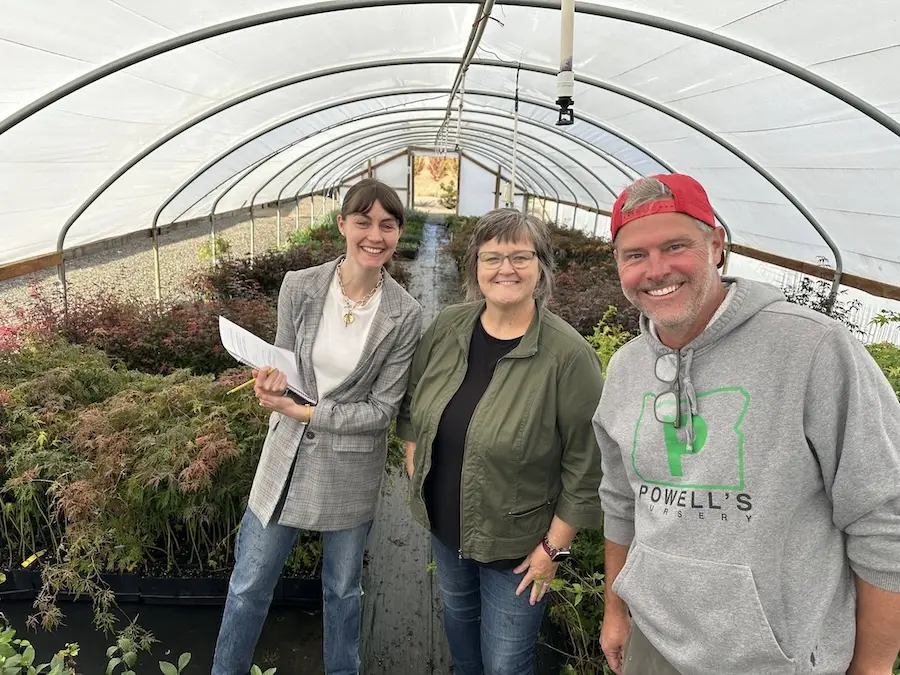
Lanenga on location with Senator Sollman (center) and Patrick Newton, President of the Oregon Association of Nurseries (OAN)

Lanenga with her family and Governor Kotek (right)
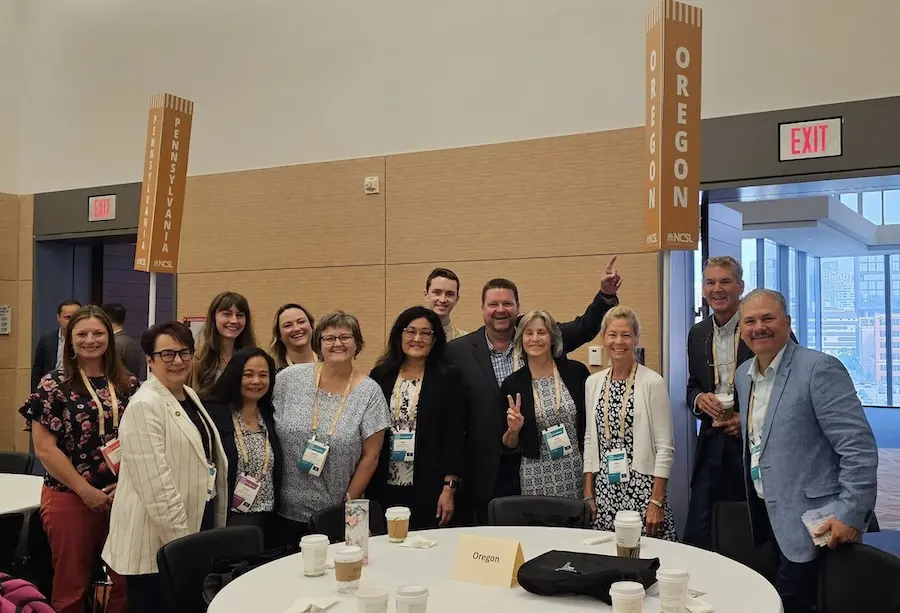
Lanenga with members of the Oregon Legislature and staffers at the National Conference of State Legislatures, 2025