

As a Ph.D. student in the School of Public Policy, Bani Samari’s research assesses how resilience-based investments and policies can limit vulnerability to extreme weather events among low- and middle-income communities
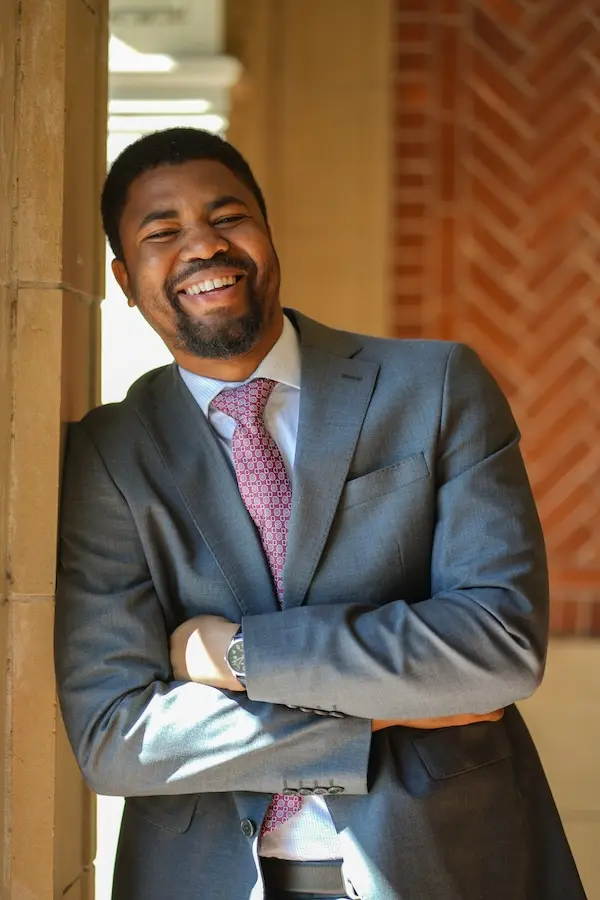
Rachad Bani Samari | Credit: Kiarra Ruff
By Jessica Krueger, CLA Student Writer - April 14, 2026
“How can I end poverty?” is a question Rachad Bani Samari thinks about on a daily basis. A second-year public policy doctoral student at Oregon State University, Bani Samari is obsessed about this topic and is working on a solution.
One of the reasons Bani Samari chose OSU’s public policy program is because it allows him to address poverty alleviation through a lens of both rural development and environmental policy. His goal is to develop policies that help low- to middle-income communities build resilience to extreme weather events caused by climate change. Bani Samari thinks current policies in emerging economies are very limited in building resilience among disadvantaged communities.
Bani Samari wants to see a world in which funding for disaster relief is allocated before a disaster strikes—not after a devastating loss occurred. Providing vulnerable communities with the resources they need to withstand climate change in a preventative way, he believes, will help communities truly thrive. There are existing policy frameworks that align with this philosophy, he said, but more work needs to be done to efficiently implement them. Likewise, he said, more studies are needed to prove, in a quantitative way, that resilience-based policies can lead to better outcomes for people living in poverty.
That’s where Bani Samari’s research comes in. Currently, he is developing a study that he began during his master’s degree at The American University in Cairo, Egypt. Using climate data gathered by NASA and pooled datasets from the Egyptian Household Income Expenditure and Consumption Survey (HIECS), Bani Samari is creating econometric models to show how heatwaves “affect household income and vulnerability to poverty among construction workers in Egypt.” The goal is to better understand what policies best protect service industry workers from poverty caused by, or made worse because of, heat stress. His study is potentially the first of its kind.
Bani Samari is also conducting research in agriculture and rural development. Last summer, with support from the School of Public Policy’s Experiential Learning Scholarship, Bani Samari worked as a research fellow for OKThink Inc., a California-based nonprofit managed by business executive turned philanthropist Kat Taylor. During the fellowship, Bani Samari met with high-ranking policy actors at the State Capitol and also interacted with smallholder farmers in California’s Sacramento Valley to better understand challenges they faced. In particular, Bani Samari focused on issues related to land access and regenerative agriculture (like organic and climate-smart farming). “If we have a better understanding of the world, and of why things work or do not work, maybe we can do something to address the structural issues that low-income farmers face in rural areas,” he said.
Bani Samari has been concerned about poverty since he was very young. He first witnessed poverty as a child when he traveled with his father, an engineer in rural development and hydrology, to rural villages in Benin in West Africa. As he returned again and again, Bani Samari noticed that his friends living there often wore the same clothes. Concerned for their well-being, Bani Samari asked his friends more about their daily lives. Not only did Bani Samari find out his friends did not have enough clothes, but they also struggled to get through school, and lived in precarious conditions. “I asked my dad,” Bani Samari reflected, “Why are these people poor? Why are they living in these difficult conditions?” Since then, the issue of poverty has never left his mind.
“The mere fact that I’m born in a city with electricity, and someone else is born in a village where there is none, automatically changes the opportunities we have in life,” he said. It’s essential, Bani Samari believes, that people come together to help others who are less fortunate. He constantly refers to his dad who often says, "Although we cannot be physically here forever, the love that we give to people will be”.
Throughout his academic and professional career, Bani Samari has held a wide variety of roles. After completing his bachelor’s degree in translation studies (French/English/Arabic) at the University of Ghana in Accra, Bani Samari was selected as part of the prestigious Next Generation Internship at the West Africa Civil Society Institute (WACSI). He then joined the Media Foundation for West Africa (MFWA) as program assistant, and was later promoted to program associate. In that role, he helped to promote healthy democracy and good governance across West Africa. After completing his master’s degree from The American University in Cairo (AUC), Bani Samari served briefly as a senior regional associate for Africa at the Worldwide Initiative for Grantmakers Support (WINGS) based in Brazil. Outside of his research, Bani Samari now works as a graduate teaching assistant for the School of Public Policy.
“I believe that we should do things that are valuable and important to us,” Bani Samari said. “People will do things they don't like, or that they hate. And I will say, if you hate it, what is the use? You have only one life. So do something that you really love, that matters, that goes beyond your single existence. And do it to the best of your abilities. Go 100 percent always. Because if you love it, if you are passionate about it, you will excel.”