A new angle of the ocean

By Colin Bowyer on Feb. 11, 2026

What started as a hobby with a drone quickly became a passion for Charlie Pingree, a marine studies major who spends his summers documenting whales and sharing his passion with the public

Image
a man wearing an orange shirt standing in front of a building

Charlie Pingree

By Hoku Tiwanak, CLA Student Writer - February 17, 2026

Charlie Pingree, originally from Marblehead, Massachusetts, is a fourth-year marine studies student at the College of Liberal Arts. For most of his childhood and high school years, Pingree was a competitive skier. He trained and competed, regularly traveling across the country, including to Oregon’s Mt. Hood. 

It was those trips to Oregon that unexpectedly opened a new chapter of his life. After training at Timberline on Mt. Hood  as a high schooler, he decided to tour Oregon State University.

The moment he walked onto campus Pingree said he was “totally hooked.” Despite being a bigger university in both campus size and student population compared to New England colleges, it wasn’t overwhelming to Pringree. “It felt homey, welcoming, and having the Hatfield Marine Science Center so close, I knew this was the place,” he said.

When he enrolled as a marine studies major, Pingree found an immediate community in the Ocean11 marine club, a student-led group that organizes field trips, beach cleanups, speaker events, and networking opportunities. “As a freshman, it was the perfect place to meet people with the same interests. I made a lot of close connections there.”

Pingree’s decision to major in marine studies stemmed from his interest in documenting whales up and down the New England coast. Pingree’s journey in whale filmmaking began with a DJI drone he and his dad had bought simply for fun. His first big opportunity came in the spring of 2021, when endangered North Atlantic right whales moved close to shore near his hometown. It was too early in the season for boats to be operating, so Pingree set up onshore, launching his drone over the water and capturing his first whale footage. The videos he captured even made local news. 

The drone gave him a new vantage point. It let him see the ocean in ways he never had before. “That moment really set everything in motion,” he said. “Once summer came around, I had endless opportunities to film.”

He spent many days out on Stellwagen Bank National Marine Sanctuary off the Massachusetts coast filming humpback whales, offering an angle most people never get to see. Pingree’s work eventually caught the attention of the National Oceanic and Atmospheric Administration, who he shared his footage with. Pingree sees his filmmaking as both art and potential scientific data.

“I love the artistic side of videography,” Pingree explains. “But the aerial perspective also gives researchers a different look at these animals. It’s cool knowing the footage could be useful in scientific contexts.” All of Pingree’s work can be found on his website: Stellwagencreations.

The marine studies program introduced Pingree to an academic community who share his passions and expand the way he thinks about outreach, communication, and conservation. Over the years, two classes have stood out: Society, Culture, and the Marine Environment (MAST 300) (“It opened my eyes to what opportunities are out there,” Pingree said) and Marine Mammals Ecology and Conservation (FW 457X), a 9-credit, five-week field-intensive class taught at the Hatfield Marine Science Center in Newport. With just 11 students, Pingree spent time with the Marine Mammal Institute, learning from experts around the world about marine mammal behavior, bioacoustics, feeding strategies, migration, and conservation. 

This past summer, Pingree returned to Massachusetts to intern with Cape Ann Whale Watch in Gloucester, working as both an onboard educator and a research assistant. It was immersive, high-energy, and involved talking to hundreds of people every day.

“There are usually three educators on each trip,” he explained. “We teach passengers about species, ecosystems, and migration patterns using maps, charts, and samples like real whale baleen. Once we reach the whales, we switch into data-collection mode.” 

Whale researchers depend heavily on identification catalogs, using unique markings on the underside of a humpback’s tail, like a fingerprint. Pingree and the other interns identified the individual whales, recorded behavior, collected data, and shared it with ongoing regional efforts.

“I never thought of myself as a good public speaker,” Pingree admits. “But trying to educate 200 people at a time, three trips a day, for 10 weeks straight, you get good at it.”

After graduating this spring, he is interested in pursuing marine tourism, particularly whale watching, while continuing to expand his filmmaking. “I’ve found a real love for sharing what I get to see. Taking people out to experience whales, maybe even for the first time, can spark the same passion I grew up with.”
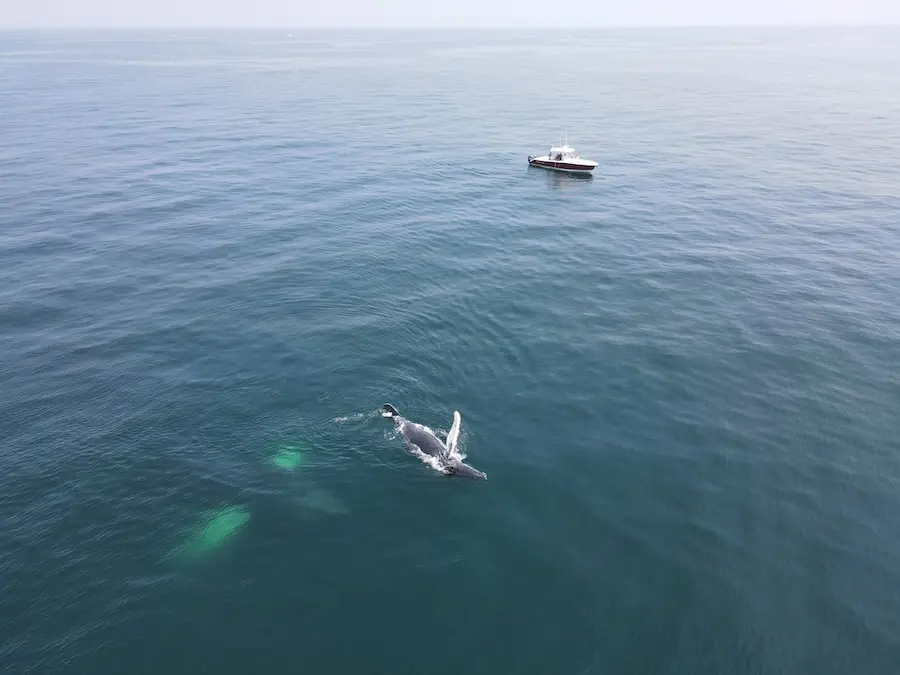
Image
an overhead view of a whale

A humpback whale known to researchers as "Nine" rising below her calf who is flipper slapping at the surface in an area off the Massachusetts coast known as Jeffreys Ledge (2021)

Image
an overhead view of a whale

A humpback whale known to researchers as "Valley" tail lobbing on Jeffreys Ledge (2023)
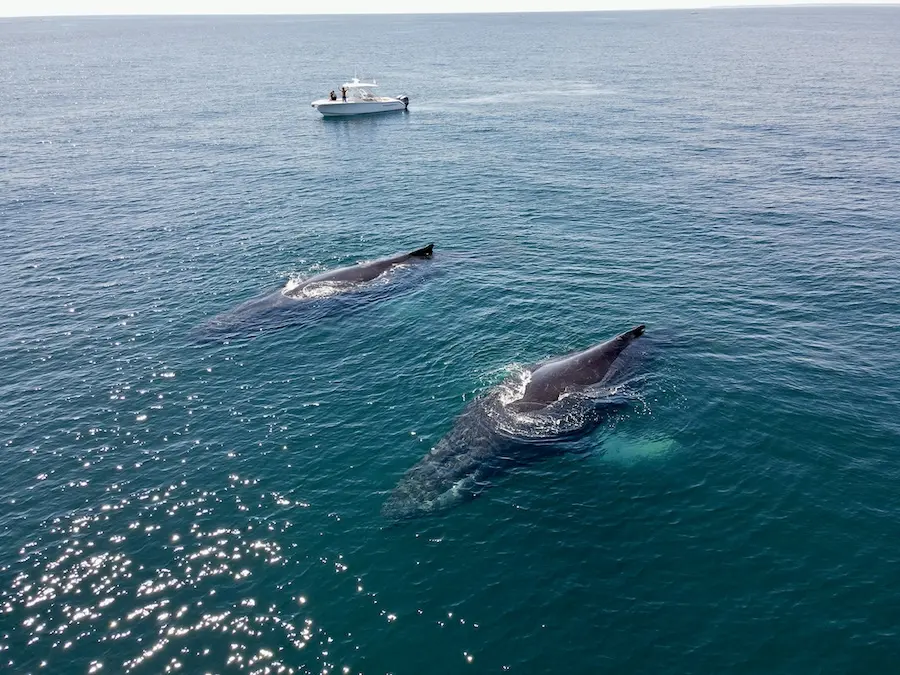
Image
overhead view of two humpback whales

Two humpback whales popped up next to Pingree's boat and began exhibiting logging behavior in the Stellwagen Bank National Marine Sanctuary (2022)
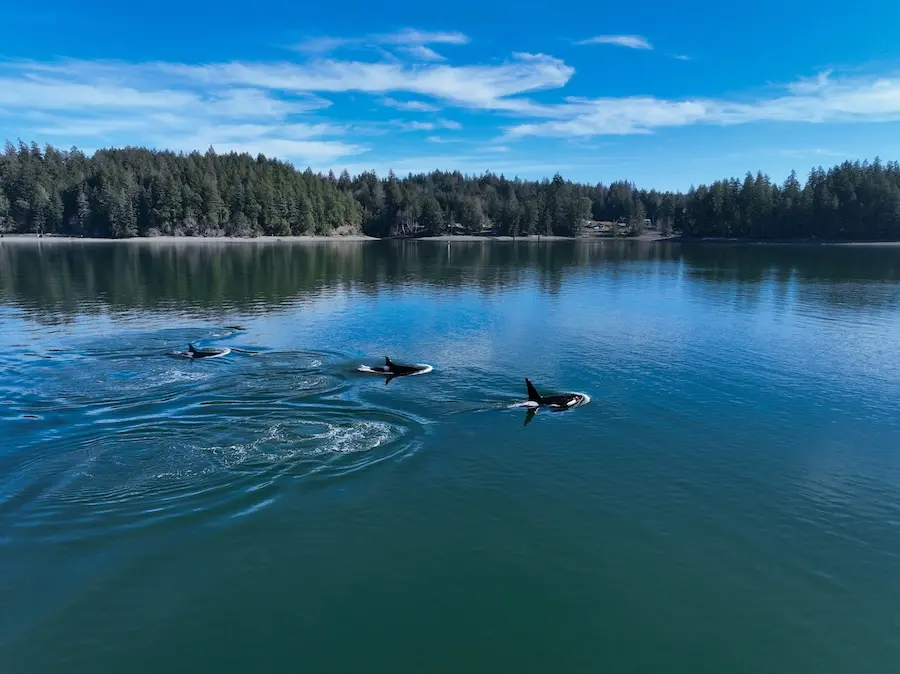
Image
an overhead view of two orca whales

A pod of transient orca whales traveling through southern the Puget Sound (2025)

Image
an overhead view of a shark

 A large great white shark known to researchers as "Large Marge" swimming of the coast of Provincetown, MA (2024)
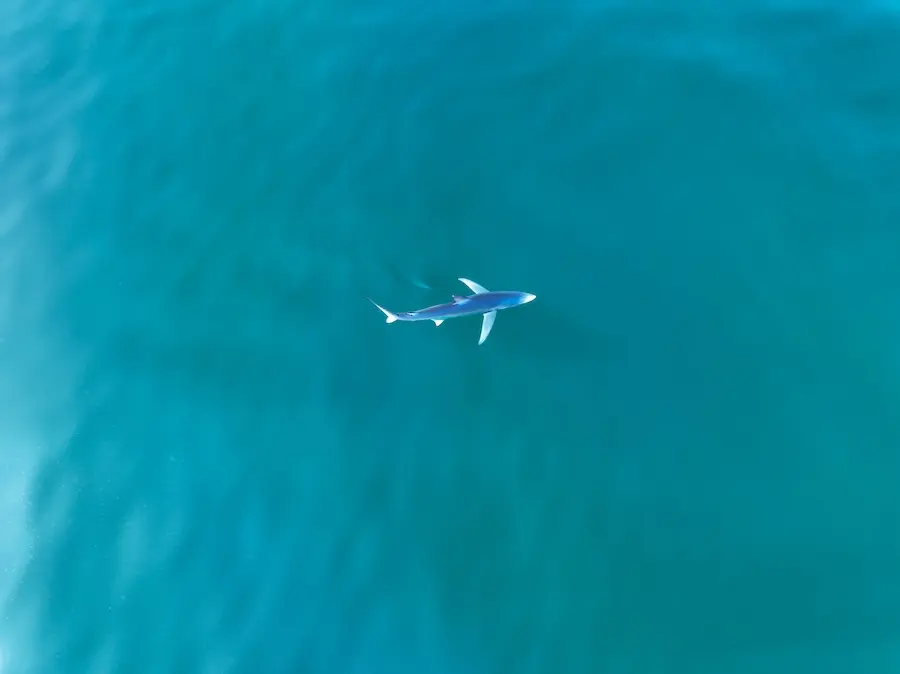
Image
overhead view of a shark

A blue shark traveling in calm seas in the Stellwagen Bank National Marine Sanctuary (2024)
The roots of OSU’s Master of Fine Arts in Creative Writing

By Colin Bowyer on Feb. 3, 2026

How author and distinguished professor Tracy Daugherty helped shape the nationally-recognized program

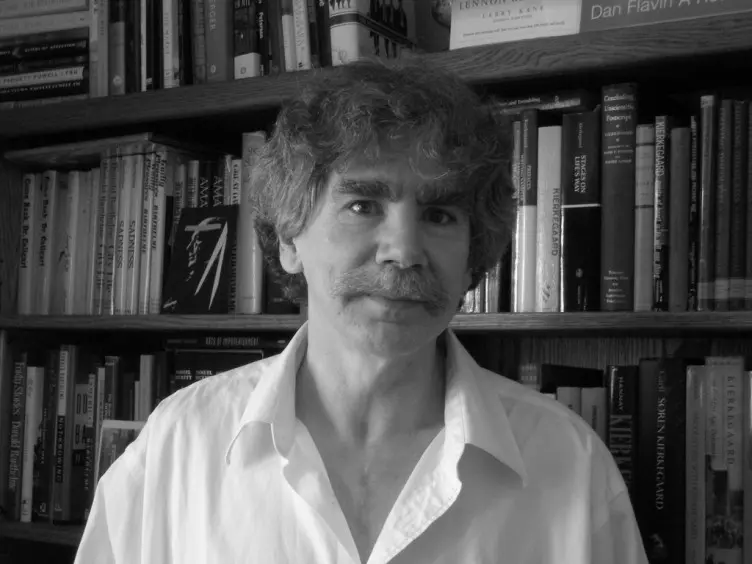
Image
a black and white picture of a man standing in front of a bookcase

Tracy Daugherty

By Jessica Krueger, CLA Student Writer - February 5, 2026

In 2015, Tracy Daugherty sat down to talk about his life and career for Oregon State University’s Sesquicentennial Oral History Project — and certainly there was a lot to say. A Distinguished Professor Emeritus of English and Creative Writing at OSU, Daugherty taught at the university from 1986 until 2013, twenty-seven years. During this time, Daugherty and his colleagues in the English department built and designed what now, perhaps, is one of OSU’s most prestigious programs: the Master of Fine Arts in Creative Writing.

Nationally recognized, the M.F.A. in creative writing program is taught by award-winning faculty specializing in fiction, creative nonfiction, and poetry. Today, so many people apply to the program that it is only able to accept four percent of applicants. That being said, the admissions process is a wholistic one. And students that are accepted into the program receive full funding through graduate assistantships. “I really think the university has gotten behind this program and in a way that we might not have expected,” Daugherty said in 2015. “It has flourished and it's one of the best in the country right now.”

When Daugherty arrived at OSU in 1986, courses and programs offered by the English department were relatively limited. And there were no graduate degrees . Daugherty explained that, at the time, “The idea of an English major still sounded strange to a lot of people. We were service providers. Our job was to teach students to be better writers so they could succeed in other fields.” Still, OSU’s English department was, and continues to be, home to a great many prominent writers. Bernard Malamud, for instance, winner of a Pulitzer Prize and two National Book Awards, taught there from 1949 to 1961.

Throughout the late 1980s and 1990s, Daugherty said, the English department continued to grow, adding more courses and faculty to meet rising demand. “The (creative writing) courses were becoming very popular. A lot of students wanted to continue their studies,” Daugherty said. “So there began to be pressure from the students to have further courses, which led to us hiring more creative writing teachers. That was great for me,” Daugherty added, “because I got company and colleagues.”

By 2002, the M.F.A. in creative writing program was not only up and running — thanks to Daugherty and his colleagues in the English department, including Marjorie Sandor and Ehud Havazelet — it had graduated its first cohort of students. Today, alumni of the M.F.A. program enjoy literary and academic success. The program continues to graduate accomplished writers of nonfiction, fiction, and poetry. It also hosts a variety of events and visiting writers to bolster its students’ education and to nurture the Corvallis writing community.

Daugherty chose to teach at OSU back in 1986 because he was excited about the future of the university’s English department. He enjoyed the company of his peers there. “I had an offer from one other school, but because OSU had seemed so very warm, I just came,” Daugherty said. “I felt I was getting in on the ground floor of something that was just being built, and that was a really exciting thing.”

Before moving to Corvallis to teach at OSU, Daugherty lived in Texas. He grew up in Midland, where his father worked as a geologist in the oil industry. “I think I was expected to become an oil man,” Daugherty said, “though I was never pushed by my family to do one thing or the other. They didn't say to me ‘you have to stay here and follow in your father's footsteps.’ … (They) were quite willing to let me follow my own path.” After high school, Daugherty studied creative writing at Southern Methodist University. There, he earned his undergraduate and master’s degrees. Later, Daugherty received his doctorate from the University of Houston, where he studied under postmodernist writer Donald Barthelme.

Throughout his career at Oregon State, Daugherty kept busy and he continues to write today. Over the years, he has authored seven novels, seven short story or novella collections, and ten works of nonfiction. His 2023 biography of novelist and screenwriter Larry McMurtry was a finalist for a 2024 Pulitzer Prize. It received critical acclaim from The New York Times Book Review, as did Daugherty’s 2015 work, The Last Love Song: A Biography of Joan Didion. Daugherty's 2010 biography on his mentor Barthelme was a Times notable book of the year. Daugherty has also received five Oregon Book Awards. 

Even after retiring from his faculty position at Oregon State, Daugherty stays involved in the local writing community. “I feel it's important,” Daugherty said, “not to be the kind of writer who withdraws from the world into the ivory tower. It’s essential to promote literature, not just your own, but others, to be a part of literary culture, to help.” Because Daugherty was a founder of OSU’s M.F.A. in creative writing, this philosophy undergirds the program as well.

“The people who care about literature,” Daugherty said, “are going to go out into the world and create the future. I mean, quite literally. Whatever shape literature is going to have, it's going to be because of these people now here. It means that they can't just focus on their own writing and lock themselves in a room. They have to go out and do something and be part of something."

CLA Research: How class still affects access and outcomes in academic careers

By Colin Bowyer on Feb. 3, 2026

Sociologist Allison Hurst leads a series of studies looking at working-class inequalities in academia

Image
woman wearing glasses sitting in front of a bookcase

Allison Hurst

By Colin Bowyer, Communications Manager - February 4, 2026

In 2022, the American Sociological Association (ASA) surveyed the experiences, challenges, and opportunities of sociologists from first-generation and working-class (FGWC) backgrounds. Drawing on responses from nearly 2,000 ASA members, the report revealed persistent disparities in educational mobility, professional advancement, and resource access. 

Allison Hurst, a professor of sociology at the School of Public Policy was a member of the Task Force conducting the survey and has collaborated with other task force members to publish the findings. Hurst and her colleagues discovered clear gaps in representations, as well as identified ways in which cultural, social, and economic access influence perspectives in sociology. Some of their key findings from the initial task force included:

  • FGWC scholars are underrepresented in top-ranked graduate programs and faculty positions at elite institutions.
  • FGWC faculty report lower salaries, higher student debt, and greater obligations to support extended family compared to peers.
  • Both FGWC graduate students and faculty experience significantly higher levels of isolation in departments, on campuses, and at professional conferences.
  • Race and socioeconomic background intersect to compound inequalities, with BIPOC scholars disproportionately represented among FGWC respondents.

“Underlying systems of inequality shape the professional trajectories of FGWC sociologists,” said Hurst. “Our hope is that these initial findings will inform policies and practices that foster a more inclusive and equitable discipline.”

The following year, Hurst and her colleagues delved further into the survey responses and published an article in the journal Sociology of Education that further analyzed the initial report’s survey and qualitative data. The findings revealed systematic disadvantages for FGWC in access to high‑status graduate programs and unequal experiences during graduate training, including higher debt, fewer institutional resources, weaker mentoring, and stronger feelings of isolation.  

“Graduate education is increasingly the gateway to professional and academic careers,” said Hurst. “Yet our research shows that graduate training often reproduces, rather than reduces, social class inequality.” 

Described as “pipeline inequalities,” FGWC scholars are significantly less likely to have attended private undergraduate institutions, a factor strongly associated with admission to top‑ranked graduate programs. As a result, these students are also much less likely to be enrolled in elite graduate programs, even after controlling for race, gender, and other background factors. Once in graduate school, FGWC students face heightened financial precarity, including receiving fewer fellowships and a higher likelihood to take out student loans and accumulate more debt.  

“Many students simply don’t receive the same guidance about which programs to apply to, what funding is available, or how graduate admissions work,” explained Hurst. “Those knowledge gaps have lasting consequences.”

In 2025, Hurst and her colleagues from The Ohio State University and Whitworth University published a second article related to the task force survey in Sociological Perspectives. Focusing only on the open-ended responses from ASA members, Hurst documents how first‑generation and working‑class scholars experience the academic profession differently than their peers from more advantaged backgrounds. 

More than 90 percent of respondents reported that socioeconomic background matters for success in academia. Yet, important differences are apparent from the data in how class disadvantage is understood and experienced, particularly between scholars who have lived these inequalities and those who observe them from a distance. Hurst and her colleagues found enduring structural disadvantages, psychological and social costs, financial challenges, and intersectional inequalities. 

“Our findings challenge assumptions that upward mobility eliminates classbased inequality,” explained Hurst. “Academic careers are continuing to be structured in ways to reward prior access to wealth, networks, and institutional familiarity.”

Current diversity, equity, and inclusion efforts in higher education often overlook social class or treat it as secondary to race and gender. In doing so, the authors contend it leaves significant structural barriers unaddressed.

“Talking about class only indirectly, or assuming it disappears with educational success, limits our ability to build truly equitable academic institutions,” said Hurst.

Since 2022, Hurst has been working with a team of qualitative researchers, including OSU graduate students to interview dozens of FGWC sociologists who originally took the survey. Findings from this data will be published in the coming years.

Ensuring a space to belong in music: Inside The Hill We Climb

By Colin Bowyer on Feb. 3, 2026

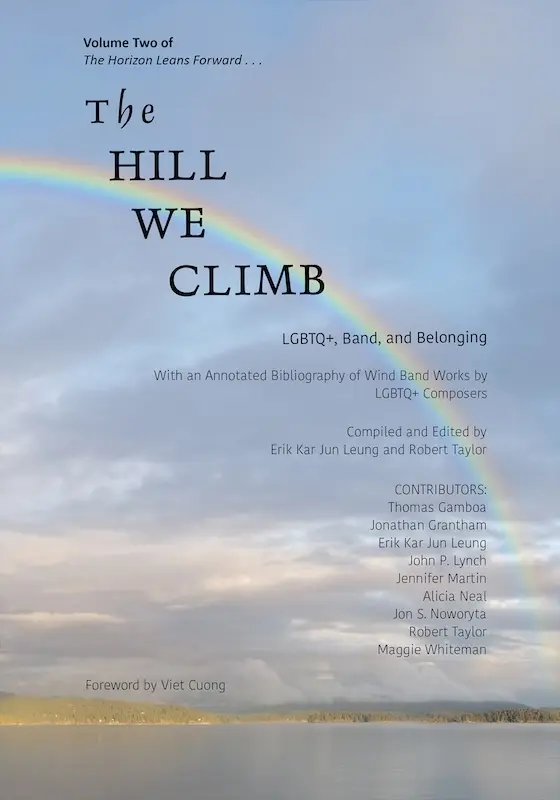
At a time when conversations about identity, equity, and inclusion are increasingly politicized, The Hill We Climb poses a question to the wind band world: What does it actually mean to belong?

Image
book cover of The Hill We Climb

By Taylor Pedersen, CLA Student Writer - February 5, 2026

Edited by Erik Kar Jun Leung, director of bands at Oregon State, The Hill We Climb is the second volume in a project that centers the voices and lived experiences of LGBTQ+ musicians, artists, and educators working in wind band music. The collection builds on The Horizon Leans Forward (2020), which addressed systemic inequalities faced by women, BIPOC, and queer musicians. While the first book arrived during the COVID-19 pandemic and the national reckoning following the murder of George Floyd, the second emerges in another charged moment, one shaped by ongoing debates over diversity, equity, and LGBTQ+ rights.

Rather than relying solely on the language of DEI, The Hill We Climb frames its stories through the idea of belonging. For Leung, that shift was intentional. As terms like “diversity” and “inclusion” have become politicized, belonging offers a more human way into the conversation, one grounded in lived experience rather than policy language.

“If we remove the idea that DEI is about people, it becomes easy to weaponize,” Leung said. Belonging, by contrast, is something most people intuitively understand. Nearly everyone has experienced what it feels like to be excluded, just as they have felt the relief of being welcomed into a space. The book uses that shared understanding as a starting point, asking readers to think about how belonging is created, or denied, within music education.

One of the most urgent chapters in The Hill We Climb focuses on trans experiences in the wind band field. Written by a trans woman, the chapter blends personal narrative with practical advice for educators working with trans students. In the context of increasing political attacks on trans rights, the chapter grounds the conversation in real classrooms and rehearsal spaces, emphasizing care, visibility, and responsibility.

Across the collection, contributors reflect on music classrooms and ensembles as spaces that can be both affirming and exclusionary. Many describe ensembles as places of safety, where students are encouraged to express themselves and feel part of a community. At the same time, the book acknowledges that access to those spaces is not always equal. Musical knowledge, institutional norms, and long-standing traditions can quietly create barriers, even in well-intentioned environments.

This tension, between music as a source of harm and music as a source of healing, runs throughout The Hill We Climb. Contributors emphasize that belonging does not happen automatically. It requires active effort from educators, directors, and institutions to create spaces that are welcoming, flexible, and responsive to the people in them.

The book also challenges the idea of the wind band world as a fixed or monolithic space. Historically dominated by white, heterosexual men, the field has begun to shift. Contributors point to expanding repertoires, greater visibility for women and BIPOC composers, and more diverse leadership within ensembles. These changes, the book suggests, matter deeply, especially for students who are still figuring out whether they see a future for themselves in music.

Leung’s role as editor is shaped by an awareness of privilege and responsibility. As a heterosexual man working within higher education, he views the project as a way to use institutional safety to elevate voices that are often marginalized. Rather than positioning himself at the center of the book, The Hill We Climb intentionally foregrounds contributors’ stories, allowing them to speak for themselves.

Ultimately, The Hill We Climb aims to offer connection. For LGBTQ+ musicians and educators who may feel isolated in their own ensembles or institutions, the book serves as a reminder that they are not alone. “There are people who have walked the same path,” Leung said, “and there are people actively creating belonging for them.”

In a moment when many cultural conversations feel divided and abstract, The Hill We Climb brings the focus back to people, and to the everyday work of making music spaces where belonging is not assumed, but intentionally built.

Alternate reproductive care models: Mady Gibbs bridges anthropology and public health

By Colin Bowyer on Feb. 2, 2026

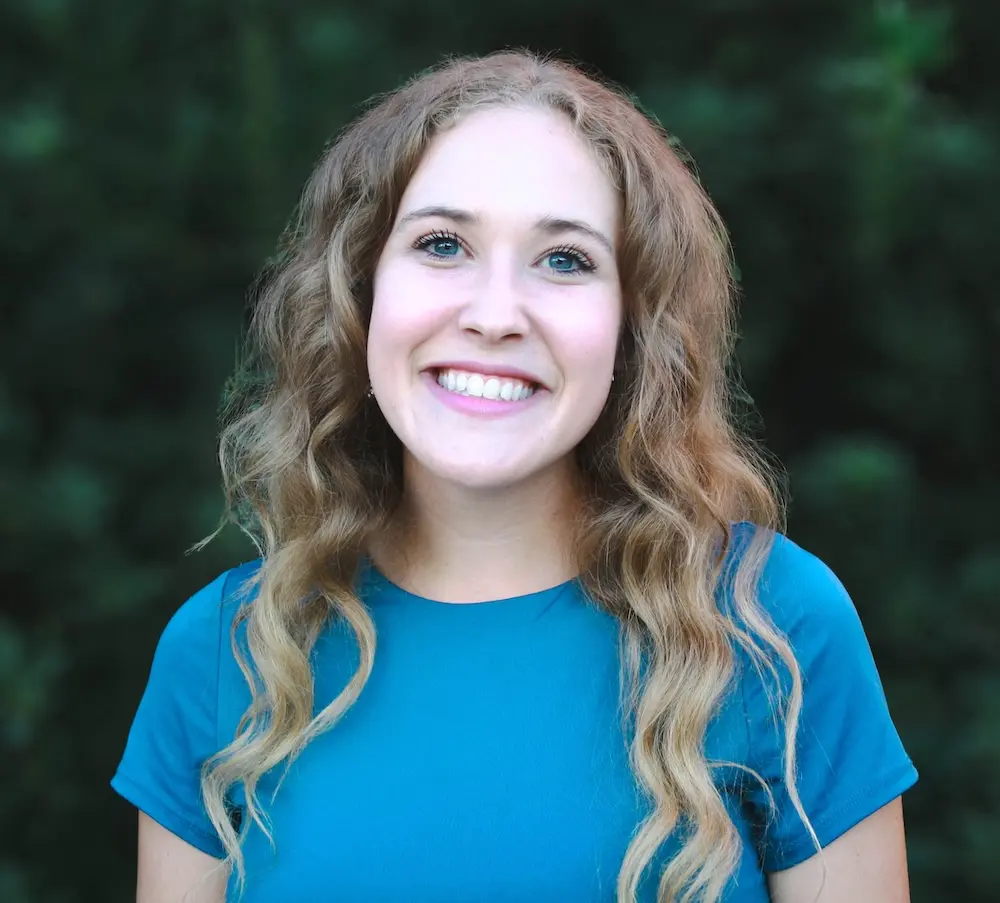
Gibbs, who’s earning degrees from both the College of Liberal Arts and College of Health, is focused on outcomes of women who give birth in community-based birthing centers

Image
woman wearing brown dress smiling and standing in front of green background

Mady Gibbs

By Jessica Krueger, CLA Student Writer - February 11, 2026

Interested in the medical field — but don’t like needles? Yeah, Madeline (Mady) Gibbs, ‘23, feels that way too. 

That’s why she studies medical anthropology. “When I learned about the overlap between anthropology and medicine that exists, I was super excited,” Gibbs said, “because I knew I could still do health-related stuff, but through a social approach.”

A graduate student in her second year at Oregon State University, Gibbs is working not just on one, but two degrees: a Master of Public Health in epidemiology from the College of Health and a Master of Science in applied anthropology from the School of Language, Culture, and Society. 

It is important that healthcare workers be familiar with the diversity of human culture, and that they prioritize participant expertise, Gibbs explained. Anthropology requires good communication, organization, project planning, and empathy — all of which are crucial skills in the field of public health.

Gibbs is particularly interested in reproductive healthcare. Under the guidance of Dr. Melissa Cheyney and Dr. Kenneth Maes, Gibbs’s research focuses on what are called freestanding birth centers: medical facilities that offer a more comfortable, cozy atmosphere than hospitals generally do, where people with low-risk pregnancies receive midwife support during and after their delivery. “Think of a freestanding birth center as a place that offers an experience in between what you might expect of a hospital or home birth,” Gibbs said. 

Gibbs’s thesis is a mixed-method case study which focuses on the Corvallis Birth and Wellness Center, under the former leadership of Dr. Susan Heinz, DNP, CNM, NP, MSCP. She is interviewing the owners and staff of the birth center, as well as other community stakeholders, to gather qualitative data about their experiences with freestanding birth centers and the midwifery model of care. She is combining this information with quantitative data that represents patient health outcomes.

“It frustrates me that we have healthcare models that we’re aware of, that are studied and practiced, and that we know lead to positive health outcomes, but that aren’t financially incentivized,” Gibbs said. “Freestanding birth centers offer care that is patient-focused to an extent that bio-medical or for-profit health care models do not.”

Gibbs hopes that her thesis will highlight the successes and joys of the Corvallis Birth and Wellness Center. “The midwives I’ve talked to are deeply passionate about the work that they do. That’s not to say that healthcare professionals in other settings aren't that way,” Gibbs said, “but there is something really unique about these midwives, the pride they take in their work, and the impact they've had on their communities.”

Gibbs knew about the Corvallis Birth and Wellness Center because she worked there as a medical receptionist during a gap year after completing her undergraduate degree (also at OSU) in 2023. At the center, Gibbs helped with scheduling, cleaning, and data entry.

During this time, Gibbs also worked as a research assistant for her now-advisor Dr. Cheyney and as an administrative assistant for the Community Doula Program (which Dr. Cheyney is also involved in). The Community Doula Program, Gibbs explained, “provides low-income and marginalized families with doulas who are culturally and linguistically matched.” Doulas provide emotional and physical support to their patients during birth and are shown to “significantly improve inequities in health outcomes.”

“Getting to take a gap year from school was genuinely life changing. Getting to experience what it’s like not to have homework, to just have a life — and live life — really changed my relationship with academia for the better. And the experiences I had during that gap year really informed what I’m doing my thesis on in a big way,” Gibbs said. 

During her undergraduate years at Oregon State, Gibbs majored in anthropology, minored in music, and earned a medical humanities certificate. 

She was also a part of the university’s Wind Ensemble and Honors College. Working with Dr. Cheyney as her mentor, Gibbs completed an Honors College thesis based on the experiences of the Wind Ensemble during the height of the COVID-19 pandemic. Her goal was to preserve ensemble members’ experiences of remote learning and of group practice, when Covid restrictions forced them and their instruments outside. 

At the start of her freshmen year in 2019, Gibbs enrolled in the University Exploratory Studies Program. She briefly considered going the pre-med route, but realized she was more interested in the social sciences after taking an introductory course on interpersonal communication. Still exploring her options, Gibbs took an anthropology class the next term and knew, then, that anthropology was the major for her. 

Best of all? “There are an infinite number of ways to engage with anthropology,” Gibbs said. “There are professional anthropologists who research Dungeons & Dragons or World of Warcraft. To be human is to be an infinite number of things and anthropology is the study of being human.”

You don't have to do something deeply profound,” Gibbs added. “You can do something personal or engage with your own hobbies. Leisure, pleasure, joy are all very important things.”

Advocating for Oregon’s farmers and ranchers

By Colin Bowyer on Feb. 2, 2026

How a fifth-generation rancher and FFA leader found her calling in agricultural communications at Oregon State

Image
woman in blue shirt smilling and standing in front of a green background

Tayleur Baker

By Jessica Florescu, CLA Student Writer - February 18, 2026

Before arriving in Corvallis, Tayleur Baker grew up on her family’s ranch near Burns, Oregon, where she worked as a fifth-generation cattle rancher and an active member of the region’s Future Farmers of America (FFA) and 4-H organizations. Both youth leadership programs helped her develop tangible career skills and a deeper connection to agriculture, which informed her decision to attend Oregon State, focusing on agricultural communications. 

Baker was nine years old when she first became involved in 4-H, leading to a years-long passion of showing livestock. After many years of competing through elementary, middle, and high schools, Baker began to prepare and mentor younger participants for showing animals, such as livestock and swine. 

“One of my favorite memories was a competition during my sophomore year of high school,” Baker explained. “I was defending a two-time grand champion title in the final drive for my event and the judge ended up giving the win to a girl I’d mentored. It was really special to see.” 

Over the course of her time involved in FFA, Baker participated in a variety of competitive events and attended the National Convention twice, which included receiving the 2024 American Degree, the highest award achievable in the National FFA Organization achieved only through exceptional dedication to her chapter. A favorite FFA competition event of Baker’s was Extemporaneous Speaking, which involves creating a four to six minute speech after only 30 minutes of preparation, as well as events surrounding discussing agricultural issues.

Right before her senior year of high school, Baker had the opportunity to attend the National Rural Electric Cooperative Association (NRECA) Youth Tour in Washington D.C., where she was able to interact with politicians and advocacy groups.

“After meeting with senators and representatives,” she explained, “I began to notice the disparities in agriculture education. I decided that I wanted to advocate for agriculture to bridge the gap between producers and consumers.”

These events, and her wider involvement with FFA and 4-H, inspired Baker to enroll at OSU as an agricultural science major with a minor in communication, with financial support from the coveted GE-Ronald Reagan Foundation Scholarship. Reflecting more on her experience with the NRECA, along with her continued positive experiences in the School of Communication, as well as the Honors College, Baker decided to flip her major and minor.

“Advanced Interpersonal Communication [COMM 318] with Dr. Colin Hesse was very influential in solidifying my choice in changing to a communications studies major,” said Baker. “In addition to agricultural communication and leadership courses with Dr. Whitney Stone and Dr. Haley Traini.”

Outside of the classroom, Baker has interned with the 4-H Youth Development program through the OSU Extension for all three of her years at OSU. During her first year, Baker was assigned to help with Extension communications from the office in Harney County, then, during her second and third years, she was focused on statewide communication, which included writing press releases, as well as producing videos and taking photos. 

After graduating from OSU next year, Baker plans on entering the agriculture communications field. Aside from academics, her favorite hobbies include baking, dancing, spending time with friends, and leading a Bible study group. 

Baker expressed, "Equipped by OSU, fueled by ambition, and led by my faith, I look forward to serving communities and loving others in the future.”

Brad Hutchison and the brave new world of influencer marketing

By Colin Bowyer on Jan. 30, 2026

Brad Hutchison, an alumnus of the digital communication arts program, outlines his path to influencer marketing from the School of Communication

Image
a headshot of a person in front of a white background

Brad Hutchison

By Halle Sheppard, CLA Student Writer - February 2, 2026

With the rise of the Internet, the world is changing in more ways than it seems possible to keep up with. Social media has played an enormous role in reshaping society, particularly how companies view advertising. School of Communication alumnus Brad Hutchison, ‘16, is on the cutting edge of the new digital advertising world, stemming from a passion dating back to his youth.

Growing up in Burns, Oregon, Hutchison loved playing video games and watching YouTube. These interests aided in his decision to attend Oregon State. “I just loved anything digital media and I was always tinkering with a camera. OSU had so much to offer as far as majors go and they all seemed to really align with my interests at the time.”

Hutchison entered OSU as a computer science major, but the curriculum was far more STEM-forward than he originally wanted. “I appreciated the exposure CS gave me to technical computing,” he noted, “but I soon found myself wanting to get back in touch with my creative side.

This eventually led him to find his place in digital communication arts (DCA), which proved to be vital for his future career and helped him hone all of the skills necessary to compete in the changing job market.

This collaborative element of the major allowed Hutchison to use his skills to strategically think through problems and to be adaptable in any team format, and gave him “a strong foot in the door to being prepared for working in media.”

“DCA’s collaborative curriculum truly prepared me for my professional career,” Hutchison explained. “I felt that the robust projects that used real-world examples tied specially into my career. ”

Additionally, along with the hands-on, project based classes, the major provided unique courses that taught him vital skills, including media law, which equipped him with a strong understanding of the legal aspects of the digital workplace.

After graduating from OSU and equipped with an intense digital skillset, he was quick to find his first job as a project coordinator at Tek Syndicate, a YouTube show that covers computer hardware, audio gear, and software, based out of Portland. Hutchison directly utilized the knowledge learned through his Media Management and Entrepreneurship courses and described the atmosphere of the company as “almost like a startup environment” and loved the creative freedom and flexibility he was allowed.

Tek Syndicate led to other opportunities in digital sales, before transitioning into influencer marketing at numerous advertising agencies. Currently, Hutchison is a full-time Senior Influencer Marketing Manager at Shareability. 

So what is influencer marketing exactly?

In Hutchison’s case, he serves as a bridge between large brands and online influencers. These large brands, such as Ford Motor Company, YouTube, and eBay, see the value of social media in marketing their goods and services. They partner with Hutchison’s agency to seek out relevant influencers to promote their products in a unique and engaging format. Hutchison has a hand in every step in the entire process from research and budgeting to contracting, content review, and finally approving release to the public.

“There's a lot of data that goes into it,” he stated, going on to explain how his time at the School of Communication allowed him to be successful. “The research elements of those big projects really help in navigating the influencer space of who's relevant, who would be a good fit for this audience, content strategy, etc.”

He works for pop culture icons and massive brands, having recently partnered with Sabrina Carpenter on her new song “Tears,” orchestrating a viral dance trend by sponsoring influencers to promote the new music. As for future projects, he teased he’ll be marketing possible new exciting ways content creators can generate content.

So while his job not only allows him to promote global brands, Hutchison also finds it extremely fulfilling.

“I think it's the most creative and fulfilling advertising space as far as the industry is concerned,” explained Hutchison. “I’m not working with huge production companies developing a 30-second television advertisement; I'm working with independent content creators who are their own boss. In a way, I get to help a ton of small businesses.”

Hutchison hopes to keep making a difference with his unique skills in the digital sphere, giving independent creators the opportunity to do what they love, and support their livelihood.

How photojournalist Morgan Barnaby turns empathy into art

By Colin Bowyer on Jan. 28, 2026

Photography and psychology student Morgan Barnaby interned at Oregon Public Broadcasting in Portland as a part of the Charles Snowden Program for Excellence in Journalism

Image
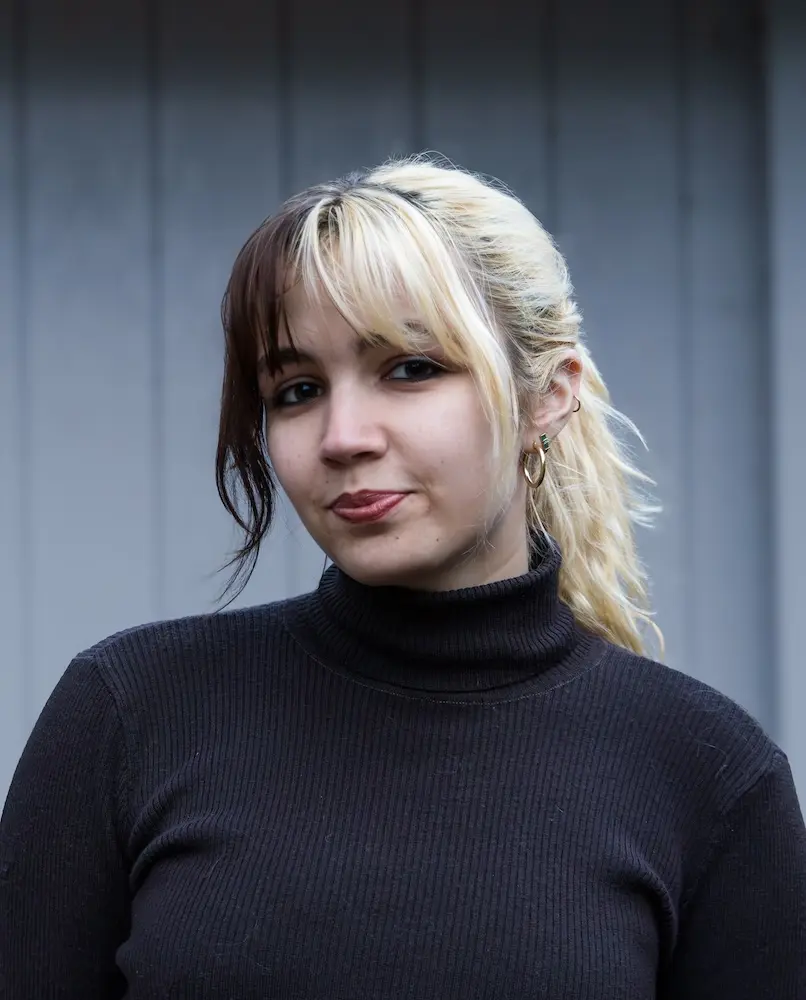
person wearing a black sweater standing in front of a grey background

Morgan Barnaby

By Taylor Pedersen, CLA Student Writer - February 11, 2026

When the world shut down in 2020, Morgan Barnaby was stuck in her childhood bedroom in New Jersey with nowhere to go but inward. With all the time in the world, Barnaby and her mother picked up photography as something to learn together while the world felt paused.

“I basically was stuck in my room and just started taking pictures of myself,” Barnaby said, laughing.

That impulse, to make meaning out of stillness, ended up changing everything. What started as a pandemic hobby became a calling. Now a senior, double majoring in psychology and photography at the College of Liberal Arts, Barnaby is the Senior Creative Photographer for Orange Media Network and spent her summer photographing stories across Oregon as the Snowden Visual Journalism Intern with Oregon Public Broadcasting (OPB).

At OPB, Barnaby was thrown into the fast-paced world of professional journalism. “The first two weeks, my brain felt like mush every night,” she said with a grin. “But my editor, Kris, had this wealth of knowledge. Every time we talked, I learned something new.”

The internship also gave her confidence and a taste of being a trusted team member. “At OPB, people really trusted me,” she said. “That made it so much easier to build genuine connections with the people I was photographing.”

Photography, for Barnaby, began as a bridge between her and her mother, but it’s now evolved into a way to connect with people far beyond her family.

“I get to meet people I never would have met otherwise,” she said. “It’s wild how photography creates connections, not just between me and the person I’m photographing, but between them and whoever ends up seeing the image. That connection, between subject and viewer, is what makes it powerful.”

Barnaby’s academic pairing of psychology and photography might sound unusual, but for her, they’re deeply intertwined.

“I just love the way people work,” she said. “Human brains are so interesting, and photojournalism is really about that; understanding people, empathizing with them, figuring out how to tell their story.”

That empathy often manifests in emotional moments behind the camera. “Sometimes I’m crying right alongside the person I’m photographing,” she admitted. “It’s not about being detached, it’s about feeling what they feel and showing that through the image.”

Her psychology background also informs how she approaches sensitive stories. “It helps me understand what people need from me…There’s a lot of distrust in the media right now, and part of my job is showing people that I’m there for them, not to exploit them.”

Barnaby left New Jersey craving a complete change. She applied almost exclusively to West Coast schools, and when Oregon State offered both a strong psychology program and artistic opportunities in photography and theatre, she leaped.

“OSU ended up being this perfect mix of everything I cared about. The photo program is small, but it’s full of people who’ve completely changed my life, like my mentor, Professor Kerry Skarbakka. He made me realize I could actually do art for a living.”

Alongside her photojournalism work, Barnaby’s portfolio also includes fine art photography, which showcases her creative passions. Looking ahead, Barnaby hopes to keep using her camera as a tool for both empathy and resistance.

“Photojournalism is art,” she said. “And art has power. With all the media layoffs and budget cuts happening, it feels like a fight to prove how important visual storytelling still is. I want to cover protests, social movements, anything where people are passionate and fighting for something they believe in.”

Her voice lifted as she spoke, equal parts conviction and awe. “Even if I don’t agree with what someone’s fighting for, that passion deserves to be documented. Because those are the moments that make us human.”

“I think,” she said, “that’s what photography does best. It reminds us that every person, every moment, deserves to be seen.”

Building a community across campus

By Colin Bowyer on Jan. 28, 2026

Digital communications arts senior Clara Commons is bridging her interests and creating her own community of peers in marketing and creative spaces

Image
a person holding up a badge from an academic conference

Clara Commons attending the National Association of Broadcasters Show in April 2025

By Jessica Florescu, CLA Student Writer - January 30, 2026

From early on, Clara Commons was forging her creative path in Missoula, Montana. Art club president, yearbook photographer, and a Starbucks barista, keeping busy was an understatement. What consumed most of her time though was being an active member of her high school’s speech and debate team, traveling around Montana crafting  speeches and giving presentations to panels of judges on topics such as emotional intelligence, and the country's obsession with constantly being "busy." 

When deciding on where to attend college, finding a degree program that could fit all of her interests and experience in communication, art, and multimedia was a challenge. Commons began looking at schools in Oregon, “just far enough away from home,” and was drawn to the digital communication arts (DCA) program at Oregon State’s College of Liberal Arts. The program’s blending of art, business, marketing, and multimedia, a combination of “hard and soft skills” noted Commons, provided a plethora of potential career options for after graduating. She also really wanted to gain new perspectives and experiences that differ from her upbringing in Missoula. 

Commons said, “It was really hard to be away from my family and twin sister in an environment where I didn’t really know anyone, but it was encouraging that so many new people coming to college felt the same way. I loved my campus visit and even had the opportunity to speak with freshman year advisor Tam Ward.”

Her first class in the School of Communication, Interpersonal Communication (COMM 218) with Senior Instructor Erin Cook, who still remains one of her favorites, followed by the many courses she took with Instructor Alina Padilla-Miller, including Pre-Production (NMC 380), Documentary (NMC482), and Viral Content (NMC 418).

Going back to the 2000s, a chosen handful of DCA students have had the unique opportunity to intern at the annual National Association of Broadcasters conference in Las Vegas. In 2025, Commons, along with a few other DCA students, was chosen to join Padilla-Miller in Las Vegas as an intern, working behind the scenes to help production crews record and broadcast the conference worldwide. 

“It was so much fun to be able to attend and see how a convention at this scale works,” said Commons. “In addition to meeting so many interesting people, ranging from a person in sports marketing at ESPN all the way to different olympians and magicians.”

Outside of DCA, Commons has been heavily involved in Greek Life and student media on campus. Although she didn’t fully know what being a part of Greek life would entail at the start of college, she is grateful for the opportunities that it provided her with. Joining Chi Theta Phi, a design/creative academic sorority, early on, led to now serving as vice president of public relations for her chapter, as well as president of the Collective Greek Council (CGC), which oversees five academic or interest-based organizations. As part of the CGC, Commons has had the opportunity to present at workshops hosted by the Center for Fraternity and Sorority Life and speak at OSU President Murthy's residence, as well as the annual Greek Awards and Greek Senior Send Off. In June 2025, Commons attended the Association of Fraternal Leadership & Values (AFLV) conference in Indianapolis, Indiana, with other CGC council officers to build on their leadership development skills. 

Simultaneously, Commons is also a marketing associate for Orange Media Network (OMN). In this student-employment role, Commons manages OMN’s marketing campaigns from start to finish, including budgeting, planning, presenting, and executing events across campus and social media posts promoting PRISM and Beaver’s Digest. PRISM, OSU’s student-run arts and literature magazine recently received a first-place Pinnacle award for Literary Magazine of the Year for its most recent issue, Roots.

“I know a lot of people say this, but try to be a part of clubs and Greek life while at OSU,” Commons said. “I’ve met some amazing friends and gained some incredible leadership skills. There are so many options to be a part of groups that value similar things as you.” 

As a full-time college student with a lot of extracurricular activities, Commons shared that time management can be difficult when trying to branch out while still wanting a balanced school-life schedule. One of her biggest tips is to set boundaries with yourself, and for her that has meant leaving Friday’s open in her schedule to use for things she enjoys. Aside from that, Commons says that an Outlook calendar is something that she “lives and dies” by and has been a helpful tool for her.

After graduating from OSU, Commons hopes to find a job that blends her creativity with her marketing skills, and is still deciding what that will look like. 

For students pursuing the DCA program, Commons advises, “try to connect with as many people in the major as you can. The DCA major is very hands on and requires a lot of collaboration with others in and outside of class. The networking in the program has the potential to lead to so many new opportunities.”

Building coalitions for the pursuit of peace

By Colin Bowyer on Jan. 27, 2026

Mark Ward brings his decades of experience in foreign affairs to the School of History, Philosophy, and Religion, teaching a global Conflict Resolution class (PAX 415/515, PS 499/599, PPOL 499/599) in spring 2026

Image
a self of a man wearing glasses standing on a cliff

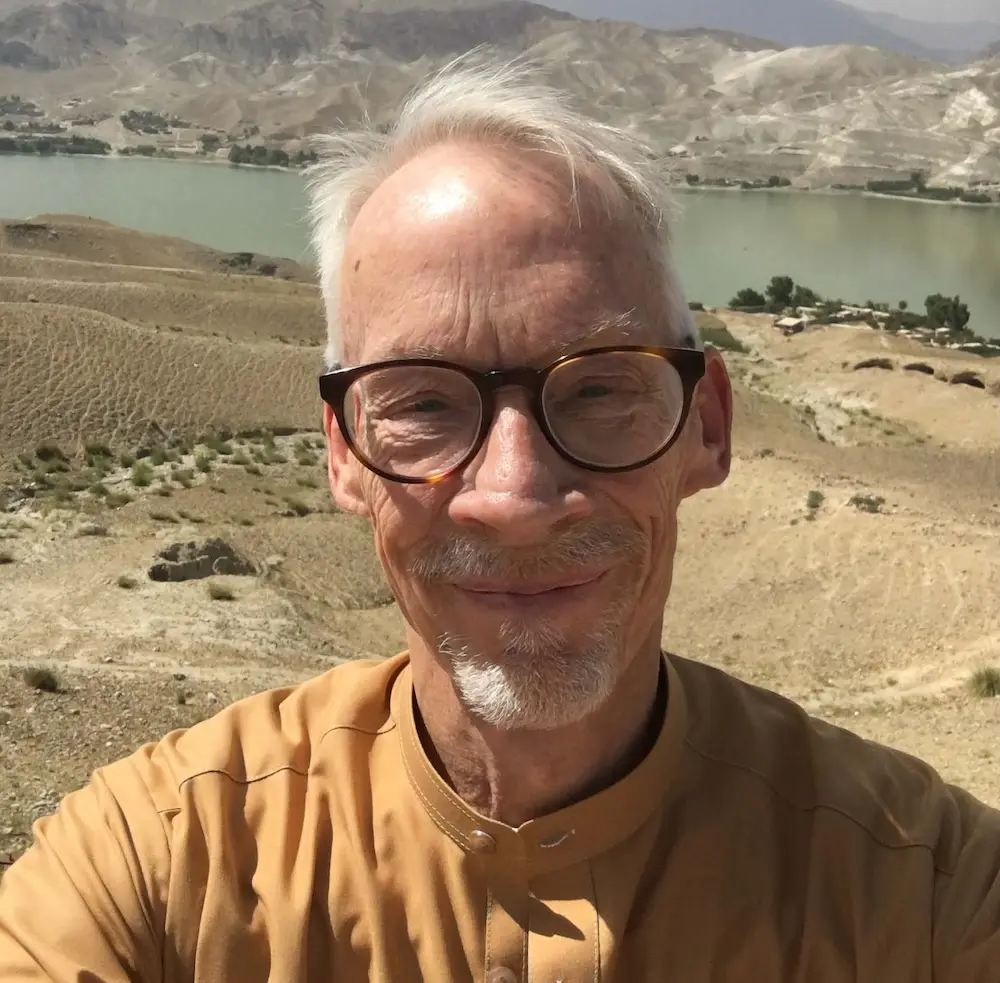
Mark Ward in Afghanistan in 2025

By Colin Bowyer, Communications Manager - January 28, 2026

It was President George H.W. Bush who gave Mark Ward, 31-year veteran of the U.S. Foreign Service, the nickname “Mr. Disaster.” Walking down the steps of his home in Kennebunkport, Maine, Bush was meeting with Ward about the federal response to the 2004 Indian Ocean tsunami that devastated Indonesia, Thailand, and more countries in South Asia. Working closely with Bush and former President Clinton, Ward was in charge of organizing and distributing relief funds and supplies. He was also preparing to depart for that part of the world to be the U.S. government’s man on the ground.

A career defined by moving from “fire to fire,” Ward moved toward crises, across cultures, and into places most people would rather avoid. It was essential work that kept him curious, useful, and close to the human realities behind immense tragedy. Now an instructor at the School of History, Philosophy, and Religion, Ward is looking forward to sharing his background and extensive experience and knowledge of conflict resolution with OSU students. 

Raised in Marin County, California, Ward attended UC Berkeley, where he earned a bachelor's degree in political science and ultimately a law degree, but before law school, Ward took a diversion that would shape everything that followed; he became headmaster of a girls’ high school in rural Kenya. The job was demanding, humbling, and deeply human. 

After law school, Ward practiced corporate law in Washington, D.C., focusing on claims against Iran following the 1979 revolution. His firm represented U.S. companies before the Iran–U.S. Claims Tribunal, which eventually compensated losses with Iranian government assets. The work was challenging, but it felt oddly distant and not as personally and professionally satisfying as he wanted. 

“I kept reflecting about my experience in Kenya,” said Ward. “It was mostly all good memories and I could see the impact I was making.”

Through word of mouth, Ward learned about the U.S. Foreign Service. It sounded to him like a way to combine law, public service, and those memories of Kenya. He joined in 1986, beginning what would become more than 30 years of service across some of the most complex environments in the world.

His early assignments took him to Egypt, Pakistan, the Philippines, and Russia. In Cairo, his first overseas post, he and his wife, an Oregonian he had met in Baltimore through a mutual friend, arrived with a new baby in tow. The city was loud, historic, chaotic, and endlessly instructive. Ward learned quickly that to be productive, you needed to build positive and personal relationships with the local people. He developed a habit, unusual for Foreign Service Officers, of avoiding the protective cocoon of embassy life. He preferred to be out, walking neighborhoods and talking with Egyptians to learn more about how things really worked.

That instinct would define his reputation. After September 11, 2001, as the U.S. government increasingly faced conflicts and disasters in high-risk environments, Ward found himself assigned repeatedly to the “hard places,” like Pakistan, Afghanistan, Libya, and the Turkish-Syrian border. When earthquakes struck, floods overwhelmed regions, or wars displaced millions, he was often the person the State Department or USAID called.

At USAID, Ward rose to senior leadership roles across Asia and later as Acting Director of the Office of U.S. Foreign Disaster Assistance. He chaired task forces for the Indian Ocean tsunami, the Pakistan earthquake, and Lebanon’s reconstruction. The 2004 tsunami, in particular, was a turning point. As USAID’s point person for Asia, Ward helped coordinate one of the largest humanitarian responses in U.S. history, including working closely with former Presidents Clinton and George H.W. Bush to raise public awareness about the disaster.

What distinguished Ward’s approach was proximity. He believed that you could not manage a crisis from a distance. “If you only talk to people who work in our embassies,” Ward explained, “you’ll never get to know the countries you’re trying to be effective in.” He insisted on setting up operations close to front lines, whether those lines were drawn by floodwaters, fault lines, or fighting.

That philosophy guided him in Afghanistan, where he served as a Special Advisor on Development to the head of the United Nations Assistance Mission in Afghanistan, then in Libya as Senior Advisor to the head of the UN mission during the fragile period after Muammar Qaddafi’s fall, and later in Turkey, where he became Director of the Syria Transition Assistance and Response Team on the Syrian border. 

After retiring, Ward did not slow down so much as change direction. He led humanitarian efforts with organizations like the International Medical Corps. Through the Afghan nonprofit PARSA, he continues to support youth leadership development and girls’ education, even under Taliban rule. Every summer, Ward returns to Afghanistan, drawn by the energy and courage of young Afghans, as well as PARSA’s mission. 

Ward decided to settle in Corvallis for a personal reason, the birth of his first grandchild. In Corvallis, Ward found a new platform for his experiences, teaching in the School of History, Philosophy, and Religion. Ward’s course on global Conflict Resolution (PAX 415/515, PS 499/599, PPOL 499/599) blends traditional scholarship with lived history. With the help of guest speakers, Ward walks students through how wars end, or fail to, using case studies like Afghanistan, Libya, and Syria.

“The world is full of conflict today,” Ward said. “We need a lot more people thinking seriously about how conflicts are resolved. My hope is not that every student becomes a diplomat, but that they leave my class with a deeper appreciation for the complexity of finding lasting peace.”

###

Cover photo: Ward doing pull-ups on an abandoned Soviet tank on the road between Kabul and Jalalabad in 2025.