

Undergraduate student Cecily Evonuk illuminates forgotten queer histories in the rural Pacific Northwest
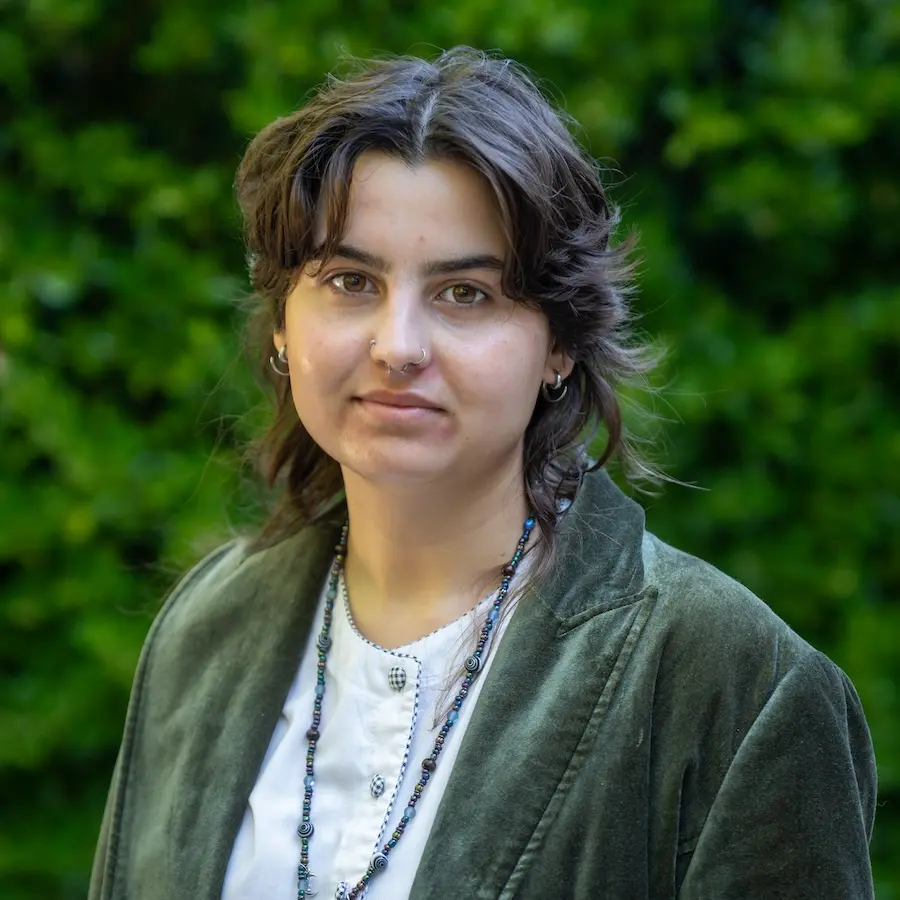
Cecily Evonuk
By Taylor Pedersen, CLA Student Writer - September 3, 2025
On a hazelnut farm outside Silverton, Oregon, Cecily Evonuk grew up surrounded by art, agriculture, and stories. Their parents (both artists) fostered a childhood that blurred the lines between creativity and labor, history and imagination. Now, as a senior in the College of Liberal Arts, double majoring in history and women, gender, and sexuality studies (WGSS), with a minor in studio art, Evonuk is weaving those early influences into groundbreaking scholarship on queer communal living in rural America.
“I was a queer person growing up out in the middle of nowhere,” Evonuk said. “So I started to get fascinated with others who also sought rural life as a place to build queer community.”
That fascination became the foundation of Evonuk’s undergraduate research. A deep dive into lesbian and queer communal spaces in the Pacific Northwest: largely undocumented histories of resistance, care, and complexity. While mainstream queer histories often focus on urban centers like San Francisco or New York, Evonuk set their sights on more rural spaces. Their project, which examines communes established in the 1970s in places like Grants Pass and Estacada, Oregon, is as personal as it is political.
“There’s this misconception that queerness only exists in cities,” Evonuk explained. “But rural life, despite its challenges, offered freedoms too. I could dress like a tomboy on the farm, and it was just seen as practical. It didn’t raise questions the way it might have elsewhere.”
The work is academically rigorous and emotionally resonant. Evonuk not only combed through archival material as a Tee A. Corinne Memorial Travel Fellow at the University of Oregon, but also conducted oral history interviews, including a conversation with the now-octogenarian co-founder of a lesbian collective in Grants Pass. That moment, spanning generations of queer experience, was one of the most meaningful in Evonuk’s academic life.
“She told me about how she embraces change, even when some of her friends don’t,” Evonuk recalled. “It really struck me how we connected across time and identity. I could see my future self in her.”
Their research is also surprisingly global. During their fellowship, Evonuk discovered love letters, community newsletters, and artwork that reflected deep interconnection among queer collectives across the U.S., Canada, and even Europe. “The archives were full of beautiful, handmade things. And the fact that these groups communicated across such vast distances without modern technology? It was honestly inspiring.”
But beyond nostalgia, Evonuk believes these histories offer concrete lessons for today. “These communities had robust systems for mutual aid, conflict resolution, and collective care,” they said. “There’s a lot we can learn from them, especially as LGBTQ+ people still face geographic and cultural isolation.”
Evonuk’s work has already reached beyond academia. They’ve presented at the Oregon Historical Society and the Western Association of Women Historians, where audiences were often surprised and delighted to learn about rural queer life in conservative-leaning towns like Grants Pass. “That’s the most fun part,” they laughed. “Challenging assumptions about what queer life looks like, and where it can thrive.”
Their academic pursuits are deeply informed by their creative background. Art and activism, they say, are inseparable. “Studio art, history, WGSS—it’s all in conversation. Art is a record. It’s also a form of resistance. Making art, studying art, writing about it, it all deepens how I understand queer history.”
Looking ahead, Evonuk plans to pursue a Ph.D. and eventually teach. For them, the dream is not just to produce scholarship, but to build spaces: classrooms, exhibits, and books that nurture others the way their professors did for them. “The educators who shaped me made me feel seen. I want to be that person for someone else. And in a time when a lot of what I study is under attack, I want to be part of protecting and sustaining these histories.”
If given the chance to curate an exhibit or write a book based on their research, Evonuk already has the perfect title: An Eden with Only Eves, borrowed from a presentation they gave earlier this year. The project would be collaborative and multimedia, just like the communities it celebrates.
“I’d want it to reflect the complexity of these histories,” they said. “There was beauty, and there were flaws. There was community, but also exclusion. I think we have to hold both truths, and ask how we move forward carrying what was good, and leaving behind what wasn’t.”
With a future as bright as their intellect is sharp, Cecily Evonuk will continue to dive into a new kind of historical storytelling, one that refuses erasure, embraces nuance, and invites everyone to the table.