

Martin’s work in religious studies and bioethics highlights how moral reasoning informs medicine, leadership, and social responsibility
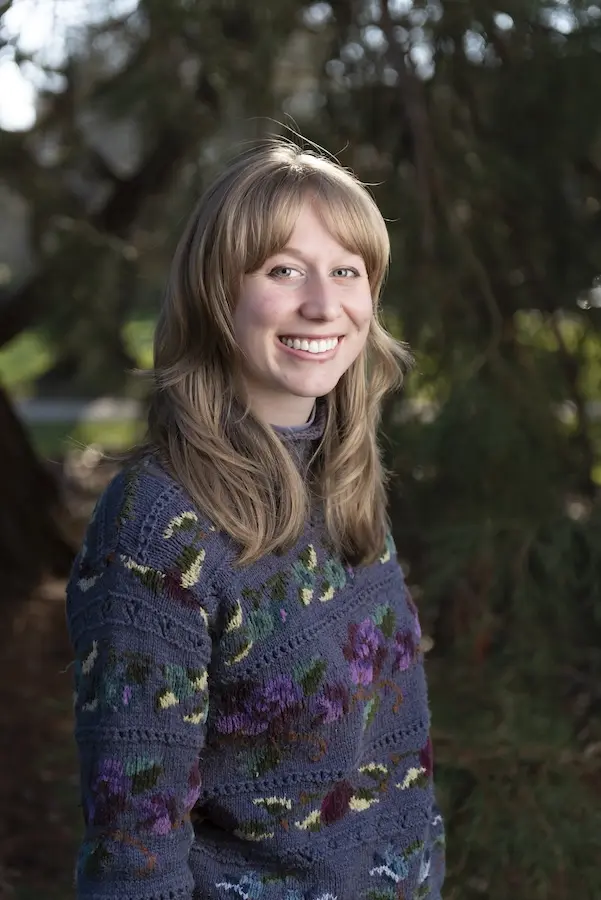
Julia Martin | Credit Rudy Uhlman
By Taylor Pedersen, CLA Student Writer - April 14, 2026
Julia Martin grew up in Santa Cruz, California, a small beach town where the ocean and the redwoods meet. She attended a private Christian high school, even though she doesn’t identify as religious. At first, her participation in youth groups was more social than spiritual. “I just wanted to hang out with my friends,” she recalled. Yet the experience unexpectedly opened a window into the ways faith can shape lives.
She told the story of her junior-year physics teacher, who walked away from the final term of his Ph.D. program to enter ministry. “That story really resonated with me,” she said. “It was my first real understanding that faith isn’t just about going to church or youth group, it can guide life choices in incredibly meaningful ways.”
Her college journey began at Cabrillo Community College, just outside of Santa Cruz, where she initially pursued an English degree. “I loved the close reading, the writing, the analytical thinking,” she explained, “but I wanted to apply those skills to something that felt more alive, something that explored human questions and real-world dilemmas.” Philosophy and religious studies offered that. “I just had this open curiosity,” Martin said. “I wanted to explore the what, why, and how of people’s beliefs and ethical choices.”
Family connections to the area and repeated visits to Corvallis made Oregon State University an appealing transfer option. “I just loved the feel of the campus; the trees, the bricks, the sense of community,” she said. Arriving at OSU as a religious studies major in the College of Liberal Arts, Martin discovered a close-knit program that allowed her to cultivate meaningful relationships with professors and peers. One of her first major milestones came when a professor encouraged her to present a paper at a conference. “I hated public speaking at first,” Martin laughed. “I thought, ‘no way am I going up there.’ But I did it, and it changed everything. That was my first real push out of my comfort zone, and it taught me that opportunities often come disguised as challenges.”
Over time, Martin’s academic focus broadened. Complementing her religious studies degree, she also earned certificates in peace studies and medical humanities, drawn to the intersection of ethics, conflict resolution, and human-centered care. Classes like Pacifism, Just War, and Terrorism (REL 344), Biomedical Ethics (PHL 444), and Science, Politics, and Peace Literacy (PAX 481) challenged her to think critically about moral frameworks and global responsibility. “In ethics classes, you’re forced to really analyze why you think the way you do,” she explained.
“It’s one thing to say, ‘oh, that’s right,’ and another to defend it with reasoning. And you start to see that other people, people who seem to have completely different views, are often working from their own, equally valid ethical base. That changes how you approach every decision, big or small.”
As president of the Bioethics Society, Martin leads weekly discussions on medical and ethical dilemmas, from gene editing and prosthetics in sports to assisted suicide. She’s learned that even divisive topics can yield common ground when people take the time to listen and engage thoughtfully. “It’s easy to see these issues as black and white,” she said. “But when you break them down, there’s a lot of agreement hiding under the surface. That perspective has been invaluable. Not just in class, but in how I interact with people in everyday life.”
Her campus involvement extends beyond the classroom and the society she leads. She serves as secretary of the philosophy club, a CLA student ambassador, and a member of the Hiroshima and Nagasaki Commemoration Committee. “When you’re looking at global issues like nuclear disarmament, it can feel overwhelming,” Martin said. “Being part of a committee makes it tangible. We may not single-handedly solve the world’s problems, but we’re raising awareness, fostering dialogue, and making local change. That teaches you responsibility and agency; how to make a difference even when the challenge seems insurmountable.”
Perhaps the most transformative experiences for Martin have been outside academia, volunteering at Lumina Hospice Center in downtown Corvallis. There, she has spent time with patients in end-of-life care, many of whom live with dementia or Alzheimer’s. One interaction stands out: a patient who never recognized her until their last encounter remembered her, and in that moment, Martin felt the profound importance of presence. “It reminded me that medical care can’t always fix everything,” she reflected. “It’s about seeing the person, not just their condition. Recognizing their humanity is what matters most, especially in hospice. The patient, not the process of dying, should always be the focal point.”
These experiences have cemented her interest in social work, particularly advocacy for patients navigating medical systems. Martin is motivated by the idea that systemic flaws in healthcare can be mitigated by human connection, understanding, and empathy. “Even small interventions, helping someone navigate paperwork, making sure their wishes are respected, make a huge difference,” she said. “I want to be that person who ensures patients are heard, cared for, and treated with dignity.”
This fall, Martin will begin a dual degree in social work and bioethics at Case Western Reserve University. Her goal is both practical and deeply human: to influence medical practice in ways that honor the voices and autonomy of patients. “The broad goal is ensuring that people feel respected, listened to, and empowered, especially at life’s most vulnerable moments,” she said. “Even impacting just one person’s experience in the system makes the effort worthwhile.”
For Martin, the journey from Santa Cruz to Corvallis to Cleveland is a path defined by intellectual curiosity, ethical reflection, and a commitment to empathy. In a world that often treats ethical dilemmas and medical care as abstract or procedural, Martin’s approach reminds us that at the heart of every decision, policy, or treatment is a human being with a story that deserves to be heard.
Whether leading campus discussions on complex bioethical issues, commemorating the victims of nuclear warfare, or sitting quietly with a patient at the end of life, Martin approaches every challenge with a grounded belief: that ethics, empathy, and action are inseparable, and that meaningful change often begins with small, deliberate steps.