


The Applied Anthropology Graduate Program is excited to offer the Deanna Kingston Scholarship for Graduate Student Excellence.
In 2018, our program initiated the Deanna Kingston Graduate Teaching Assistant (GTA) Award designed to promote the advancement of Native Oregonian, Native American, Alaska Native, Indigenous North American, Native Hawaiian, and Pacific Islander students within the OSU Anthropology Program, the university, state, and world. The award honors the life and legacy of Dr. Deanna Paniataaq Kingston, a descendant of the King Island Native Community (Alaska) and Associate Professor of Anthropology at OSU.
Beginning with academic year 2023-24, our program changed and deepened the form of support this award provides, and broadened eligibility to include all Indigenous peoples from throughout the Americas and Pacific Islands who seek a Master's (MA or MS) or Doctoral degree in Applied Anthropology at OSU.
The Deanna Kingston Scholarship for Graduate Student Excellence will provide funds that an awardee can use throughout their degree program for professional development opportunities, such as participation at professional conferences, and/or thesis and dissertation research expenses. The total amount per award will depend on available resources, though we hope to provide up to $5000 per award.
This award is meant to complement the support that graduate students in our program already receive. Each year, approximately 25 Applied Anthropology graduate students receive GTA positions, which come with a full tuition waiver, health benefits, and a stipend. Master’s students are eligible for up to 6 terms of GTA support, and PhD students are eligible for up to 12 terms of support. In addition, over the course of their degree, all Master’s students in our program can receive up to $500, and Doctoral students up to $1000, for conference participation. Our program also strives to provide $2000 per student to support Master’s and Doctoral research. We’re so happy we can support Indigenous American and Pacific Islander graduate students and honor Dr. Kingston in these ways.
Dr. Kingston dedicated her career to studying and honoring the culture of her ancestors: the Inupiat of King Island, Alaska. In addition to her pioneering work on traditional ecological knowledge, she studied traditional kinship systems, as well as the role of songs and hunting dances in preserving cultural identity. Her research was uniquely informed by her personal understanding of the colonization and relocation of Native peoples. Dr. Kingston interned at the Smithsonian’s Arctic Studies Center, and worked on a film collection of King Island life, now housed at the National Museum of Natural History. In 2003 she received a National Science Foundation grant to document and compare scientific knowledge with traditional knowledge of King Island, for the betterment of all.
Dr. Kingston's impact extended beyond her research. Later in life, she worked with Oregon State Representative Sara Gelser on a prescription drug repository bill to help uninsured cancer patients who could not afford prescription drugs. In 2010 she received the Phyllis S. Lee Award from OSU for her commitment to social justice. She dedicated much of her time to supporting Native students at OSU, and served as an advisor for OSU’s Native American Longhouse (now the kaku-ixt mana ina haws).
In 1993 Dr. Kingston received a Master of Arts in Interdisciplinary Studies, with a focus on Anthropology, from OSU. In 1999 she completed her PhD at the University of Alaska-Fairbanks. She died in 2011 at the age of 47 from metastatic breast cancer. Deanna meant so much to so many people at OSU and beyond. This award is one way the OSU Anthropology Program and School of Language, Culture & Society honors her life's work and legacy.
How to apply for this award:
Applicants to our graduate program who are interested in this award simply indicate their interest and briefly discuss their tribal affiliations and engagement with Indigenous communities in their Statement of Purpose. At least one letter of recommendation included in the application should also address the applicant's affiliations and engagement with tribal or indigenous communities.
Awardees
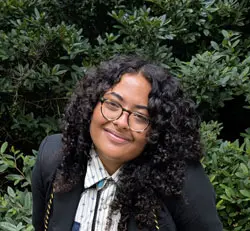
Loren Lombardo is an enrolled member of the Lakota Nation (Oglála) and a Master's Student in Applied Anthropology. The current territory of their band is located in South Dakota, specifically on Pine Ridge reservation. Their research focuses on plant cultivation and cultural revitalization throughout the Great Plains. Their research works to connect current and ancestral knowledge and land stewardship towards the existing struggle for sovereignty within their community. Their work lies upon the foundations of Indigenous ecology, botany, and decolonial theory to explore how ecological knowledge can connect generations throughout space and time. Prior to relocating to Oregon, Loren was an undergraduate student in Archaeology at the University of California, San Diego, focusing on geoarchaeology and paleobotany using sediment samples in coastal sites within Puerto Rico. There they gained skills in sampling botanical materials and utilizing soil samples to understand environmental variability to support the protection of tribal lands.
For the 2023-24 academic year, we have 2 Kingston Scholarship awardees: Katie Irvine Minich and Shimiko Montgomery!


Ryan Younker

Ryan Younker is a Master’s student in Applied Anthropology. Ryan is an enrolled member of the Coquille Indian Tribe, and is a descendant of Kit-sun Gin-um, Gek-ka, and Adulsa Wasson. Although the Coquille Indian Tribe is based out of Coos Bay, Oregon, Ryan grew up in Spencerport, New York until his first year of high school. His family moved to Eugene and Ryan finished high school there. Ryan started his undergraduate degree in music performance and environmental studies but switched to biological anthropology in his second year at the University of Oregon. His research focuses on culturally appropriate gender affirming care, and the history of Two-Spirit Indigenous individuals. During his graduate studies at Oregon State University, Ryan has taught Introduction to Cultural Anthropology and Peoples of the World - North America.
Alicia Duncan
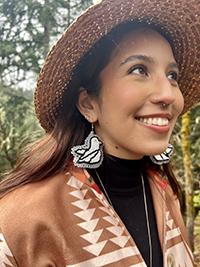
Alicia aa.eegáakushée Duncan is a Master’s student in Applied Medical and Reproductive Anthropology, with a focus on Indigenous maternal health. She is Tlingit, from the T'akdeintaan tribe, a daughter of the Teikweidí clan and a granddaughter of the Kiks.ádi clan. Her family originates from Sitka and Angoon, Alaska. Through her research on Indigenous maternal health, she looks at the role that traditional healers, traditional ceremonies and Indigenous community health workers can play in improving health outcomes for Indigenous birthers in the Pacific Northwest. She was able to train as a Doula with the Community Doula Program and the Alaska Native Birthworkers Community during her time in the program, specializing in serving Indigenous families. She is an artist, focusing on the Tlingit traditional weaving styles of Raven's Tail and cedar & spruce root, as well as beading. She spends her spring and summer months with her grandparents, learning and practicing traditional Tlingit subsistence cycles.