

Technical communicator Khan bridges the literary and STEM world through written word by translating complexity into clarity
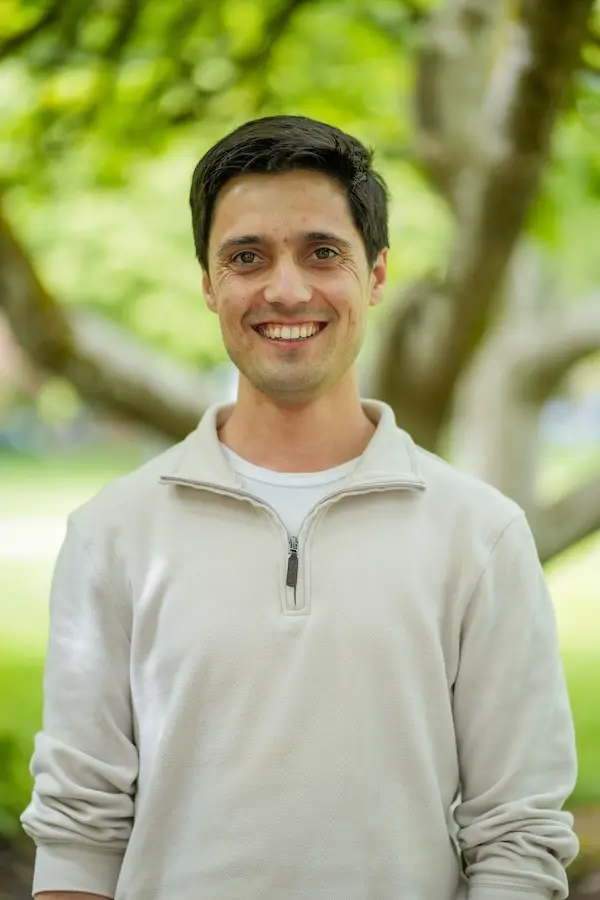
Khawar Latif Khan | Credit: Kiarra Ruff
By Taylor Pedersen, CLA Student Writer - May 21, 2026
Khawar Latif Khan used to sit in engineering lectures and write stories no one was meant to read. In the margins of dense notes on circuits and systems, he doodled with fragments of fiction, strange and unstructured, written quickly before attention snapped back to the front of the room. “The word that I use to describe my creative writing is weird,” Khan said. “It did not make any sense… it was just free writing.”
At the time, he saw writing as just a habit, maybe even a distraction. Growing up in Pakistan, Khan’s academic trajectory was largely decided for him long before he stepped into a university classroom. Students who performed well were funneled into a few options: medicine or engineering. Humanities and creative fields existed, but were much less visible, less stable, and lacked support.
“If you’re good in academics, you kind of have these three or four different areas to choose from,” Khan said. “No one was really thinking about the humanities and social sciences.”
He chose engineering simply because it was presented to him. At his college, Pakistan Institute of Engineering and Applied Science, the options narrowed even further to choosing between electrical and mechanical engineering. He enrolled in electrical engineering and stayed for four years. By the time he realized it wasn’t what he wanted to do, it felt too late to leave. There were no alternative programs to pivot toward and no visible models of what a different path could look like. He finished, but between lectures and exams, Khan made himself a private promise: If he couldn’t change direction now, he would later. He didn’t know exactly what it would be, only that it had to be different.
That promise carried him further than he expected. After graduating, Khan applied to graduate school and received a Fulbright Master's Scholarship, one of the most competitive academic awards in the world. It was, by any measure, a turning point. But it came with a condition: the funding applied only to engineering. Khan accepted.
“I’d be lying if I said I wasn’t feeling good about it,” he said. “I was really happy.”
The scholarship brought him to North Carolina State University, where he enrolled in a electrical engineering program. For the first time, he was in a new country, surrounded by new possibilities. And for the first time, the promise he had made to himself began to feel urgent. Within three weeks, he knew he couldn’t stay in engineering.
“I wasn’t feeling good in the classes,” Khan said. “It’s not that I wasn’t getting good grades. It was more about not feeling that I belonged in that particular space.”
Changing direction wasn’t close to simple. His scholarship, his visa status, and his academic standing were all tied to engineering. Walking away from the program meant sorting through layers of bureaucracy, uncertainty, and risk. But the alternative, staying, felt worse. A conversation with a friend, Hammad Abbasi, helped clarify the stakes.
“People die to get an opportunity to come to the U.S.,” Khan recalled him saying. “If you don’t make the most of it, that will be a disservice to yourself.”
So Khan started looking. He searched through course catalogs and program descriptions, looking for something that felt even slightly aligned with the interests he had carried privately for years. That’s when he found it: a master’s program in technical communication. He had never heard of the field before.
“I was like, the name seems interesting,” he said. “Then I started looking into it.”
Technical communication, as Khan described it, is the practice of translating complexity into clarity; explaining scientific or technical processes in language that everyday people can understand. It was, in many ways, exactly the bridge he had been searching for: a space where his engineering background could coexist with his instinct for writing. More importantly, it showed him that the divide he had experienced growing up, the separation between STEM fields and the humanities, wasn’t as fixed as it had seemed.
“I saw people with backgrounds in engineering and computer science coming here to learn writing and communication,” Khan said. “That helped me understand this is not a path that is unheard of.”
With support from faculty and approval from the Fulbright program, Khan made the switch. He went on to complete his master’s degree and later earned a Ph.D. in communication, rhetoric, and digital media, building a career at the intersection of technical expertise and human understanding. Now, as an assistant professor of teaching in the School of Writing, Literature, and Film, he brings that same intersection into the classroom.
Khan often teaches engineering students. People who, not long ago, were sitting where he once sat. He recognizes the mindset, the problem-solving approaches, and oftentimes black-and-white thinking. Because of that, he’s able to meet them in a way that feels relatable.
“When I tell them that I have a background in engineering, they feel like they are learning from someone who knows what it feels like,” he said.
His teaching pushes beyond familiarity. He asks students not just to explain what they’ve built, but why it matters, who it affects, and what its consequences might be. In an age defined by rapid technological development, Khan sees technical communication as more necessary than ever.
“There are a lot of things that are in a black box,” he said. “People may not know what’s going on inside, but they need to understand the impact.”
That belief shapes not only how he teaches but how he thinks about the future of his field. He’s particularly interested in closing the gap he once felt so strongly; the distance between technical disciplines and the humanities.
Today, it’s a gap he’s actively working to close, making that path more visible and accessible for others.