Sophie Bottum Musa is mastering all the tools to lead

By Colin Bowyer on March 16, 2026

A recent graduate with a double degree in political science and marine studies, Sophie Bottum Musa explores her pursuit of justice and inclusion

Image
woman sitting on steps in graduation regalia

Sophie Bottum Musa

By Halle Sheppard, CLA Student Writer - March 19, 2026

Oregon State University has long prided itself on its diversity of student experience, and nobody encapsulates this idea better than Sophie Bottum Musa. In 2025, she graduated with a double degree in political science and marine studies, stemming from her passion for environmental justice.

The road to environmental justice turned out to be a combination of Bottum Musa’s chief interests: marine biology and civics. During high school in Columbus, Ohio, Bottum Musa was interested in pursuing something marine-related (and figured she’d have to leave Ohio for it), but it was a government class that shook things up. 

“I’ve always been very inclined towards advocating for the environment and thought I was heading in the direction of marine biology, until I took an AP government class,” Bottum Musa explained. 

Bottum Musa soon found that she had a knack for crafting arguments and understanding the law, along with a sense for rectifying injustices. This set her on the path of studying political science at Oregon State supplemented with the marine studies major, so that she could have a nuanced interdisciplinary approach to environmental issues.

Bottum Musa loved the political science program at the School of Public Policy, which allowed her to choose classes that suited her interests. She was also a member of Professor Michael Trevathan’s International Politics Research Lab, where she studied gender representation in global politics. “I loved working with Dr. Trevathan,” Bottum Musa said. “He would work with you one on one to understand what your goals were and where to go next.”

In addition to her political science classes, the marine studies curriculum provided her a different lens in which to view the ocean. Her time taking classes at the Newport based Hatfield Marine Science Center also aided her college journey and provided another layer of unique perspective to her worldview. “The two programs complemented each other really well,” said Bottum Musa. “And Hatfield gave me the time to be outside and see the things I want to protect through conservation and policymaking.”

While studying at the intersection of the humanities and social sciences, her passion for environmental and social justice took a clearer shape, which informed more of what she did while at OSU and what direction she chose to take after graduating. 

Bottum Musa joined AmeriCorps VISTA, a federal anti-poverty program, and is currently stationed at the Center for Social Justice Research, Teaching, and Service at Georgetown University. Working with low-income or homeless students and members of the community, she strives to better understand their basic needs and how the university can respond. “At Oregon State, we have the awesome Basic Needs Center, but they don’t have anything like that here,” an issue she tries to rectify by finding out ways to support community members.

Bottum Musa explained how she found AmeriCorp through the social scientists she met at OSU, as, “it was more than environmental work, it was socioenvironmental.” Passionate about community service and having worked at OSU’s Community Engagement and Leadership (CEL) for three years, it is unsurprising how she found herself drawn to AmeriCorp’s mission.

Her experience at CEL “showed me the importance of being engaged in my community and showing up for populations that aren’t necessarily always supported.” Bottum Musa served as a program leader, hosting leadership workshops, service projects with local community partners, and dialogues to provide safe spaces for students. Her passion found its outlet throughout OSU, becoming involved in the cultural centers on campus, as well as working as a member of the student advisory board for Student Experiences and Engagement.

One of her most impactful achievements was in co-founding Students United for Palestinian Equal Rights (SUPER). The connection was personal, as Bottum Musa’s grandparents were removed from their village in Palestine after the 1948 Nakba (displacement of Palestinian Arabs in and around the State of Israel). At a United Nations-run refugee camp located in Jordan, her grandfather finished his schooling and received his medical degree before eventually immigrating to upstate New York for work.

Her Palestinian roots remained an important part of her identity throughout college, and after October 7, 2023, many of her fellow students joined together to start protesting against the war in Gaza. Bottum Musa organized events like Hummus & History to educate people on Palestinian history and further engaged with the wider OSU community to spread awareness. “It was really hard while so much was happening, but it was the strongest sense of community I had ever felt, anywhere,” said Bottum Musa. Even amongst the turbulence, she emphasized that “OSU has good people.”

Instead of having a concrete career path set in stone, Bottum Musa explained, “I know what I want to do, I know what I’m good at, I know what I value,” and uses that to guide her to career paths that align with her goals, using the skills and experience that she has garnered to make a difference and find new opportunities.

OSU helped Bottum Musa realize that she can use things that she didn’t see as positive traits for good. “I had a strong aversion to authority and a big mouth, and I used to think those were bad things, but there are no bad traits. All of them are strengths and you just have to use them in the right capacity.”

Bottum Musa still works at AmeriCorps, using her skills from her double degree to implement change in Georgetown college’s community. While she is unsure whether she will stay to finish the multi-year project she is currently working on, she feels equipped with the experience and passion she needs to succeed.

“I think that is the most meaningful thing that I learned at OSU, is that I’m a good person and I can do good work. Anything that I might ever view as a weakness is a strength in one way or the other.” As her passion for justice continues to grow, there is no doubt that she will continue to use her strengths to help strengthen her community wherever she may be.
Where history meets the timber field

By Colin Bowyer on March 2, 2026

Senior Mason Dunn is blending his love for history, education, and the outdoors—pursuing dual degrees while documenting the evolution of logging sports and preparing for a future in the classroom

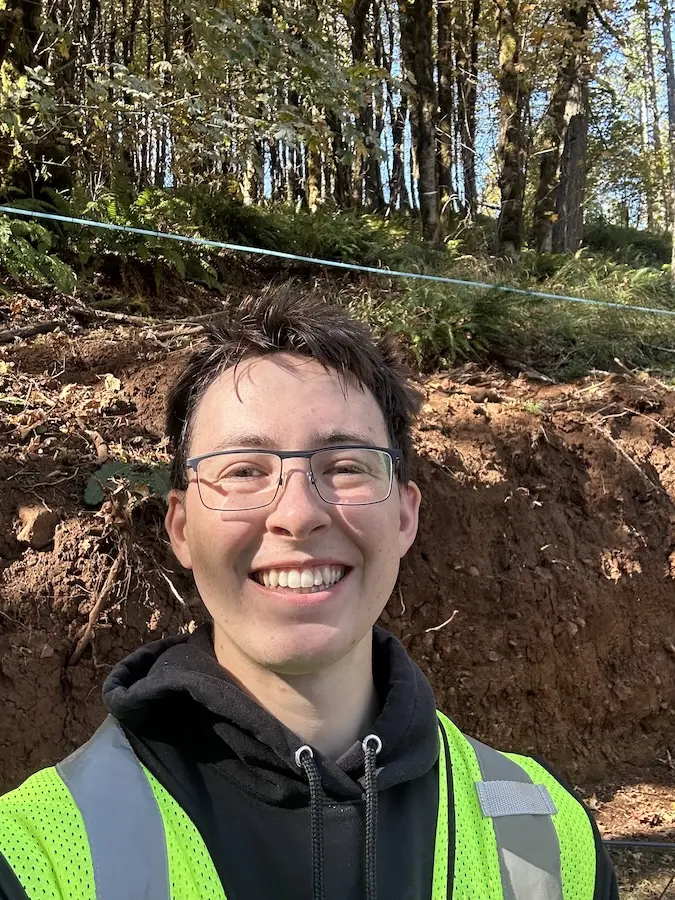
Image
a selfie of a man in the forest

Mason Dunn

By Ellie Webb-Bowen, CLA Student Writer - March 6, 2026

Growing up in Central Oregon with both parents as teachers (sixth and fourth grades), senior Mason Dunn has always been passionate about enriching his academic side. That fervor for learning led him to Oregon State to pursue a dual degree from both the College of Liberal Arts and College of Education in history and secondary education. 

Dunn attributes his enthusiasm for history directly to his father and how he made learning about history fun in the classroom. Now, Dunn is finishing his time at OSU in a different classroom, teaching world history and personal finance as a student teacher at Crescent Valley High School in Corvallis.

“I knew I was going to be a teacher in some capacity,” said Dunn, reflecting on his upbringing in Bend. “I was always learning, either by being outdoors, or at home. Being an educator was something I was always drawn to.”

Dunn started his freshman year with a loaded schedule of history classes. Some of his favorites included Civil Wars and Civil Rights (HST 202) and Contesting Freedoms: Making the Modern U.S. (HST 203), as well as The Ancient Mediterranean (HST 101) and History of Beer and Brewing (HST 417), both of which taught by the late-Kendall Staggs, a School of History, Philosophy, and Religion instructor who passed away in 2023. 

“Dr. Staggs was hugely influential in my history studies,” said Dunn. “Really everyone at the School of History, Philosophy, and Religion has been very supportive.”

During his freshman year, Dunn discovered the Forestry Club during a club fair. A week later, Dunn watched a logging sports demonstration organized by the club. He was immediately hooked. 

"I fell in love with it," he said. Come Veterans Day, the following weekend, the club traveled to Moscow, Idaho, for a competition. “I had an absolute blast. That weekend helped me connect with people at college for the first time, it felt like I had a solid group, a solid foundation,” Dunn added. 

In addition to competing in axe throwing, log rolling, and crosscut sawing, Dunn served as treasurer during his freshman and sophomore year, responsible for managing the club’s expenses. This year, he’s club historian, combining his academic pursuit and outside interest into one community building experience. 

For the last three years, primarily as club historian, Dunn has been developing an ongoing oral history project. This project is centered on interviewing Logging Sport community members and collecting their history. Dunn has used this project as independent research credit, and is hoping to continue his academic research through graduate school. With guidance from Assistant Professor Joel Zapata and Senior Instructor Steven Shay, Dunn looked to explore not only the history of the Forestry Club, but the nuances of logging sports history at OSU. 

The sport dates to the late 19th century and evolved from the daily responsibilities of lumberjacks. As the sport evolved from small town events into larger regional and more professional events, the competitors were predominantly white men. Today, the sport has since matured into a diverse outlet for people of all genders and ethnic backgrounds, which Dunn explores in his project. Conducting over 30 interviews with past members of OSU’s logging sports team and the wider community, Dunn recorded and transcribed hours of spoken accounts from competitors, including women loggers, loggers of color, and international students who have taken part. 

"Logging sports began with small-town events, but quickly spread to the masses and through generations of families,” explained Dunn. "My goal with the project was to expose to people that not only does OSU have a logging sports team, but to celebrate its history as a welcoming place for all who are interested.”

During homecoming, Dunn set up an exhibit in the College of Forestry’s home of Peavy Hall for visitors to view historical club photos and materials that he was able to gather. His wider goal is to submit the hours of recorded accounts to OSU’s Special Collections & Archives Research Center for preservation.

After spring term, Dunn plans to enter into the College of Liberal Arts’ history master’s program with a focus on community and civic engagement, with the goal of eventually becoming a high school history teacher, preferably back in Bend. 

“I love working on history and the faculty at the School of History, Philosophy, and Religion have encouraged me to pursue my interests” concluded Dunn. “Being able to combine historical research with my hobby of Logging Sports is something I never even thought of. I have loved exploring and pushing the boundaries of when it comes to finding what is possible.”

Image
a person sawing timber

Dunn part way through a Single Buck cut, with Angus Nicholson acting as Dunn's wedger, during the 2023 OSU 83rd Association of Western Forestry Clubs (AWFC) Conclave Competition at the George W. Brown Logging Sports Arena in the Peavy Arboretum outside of Corvallis.

Image
a group of people sitting on steps

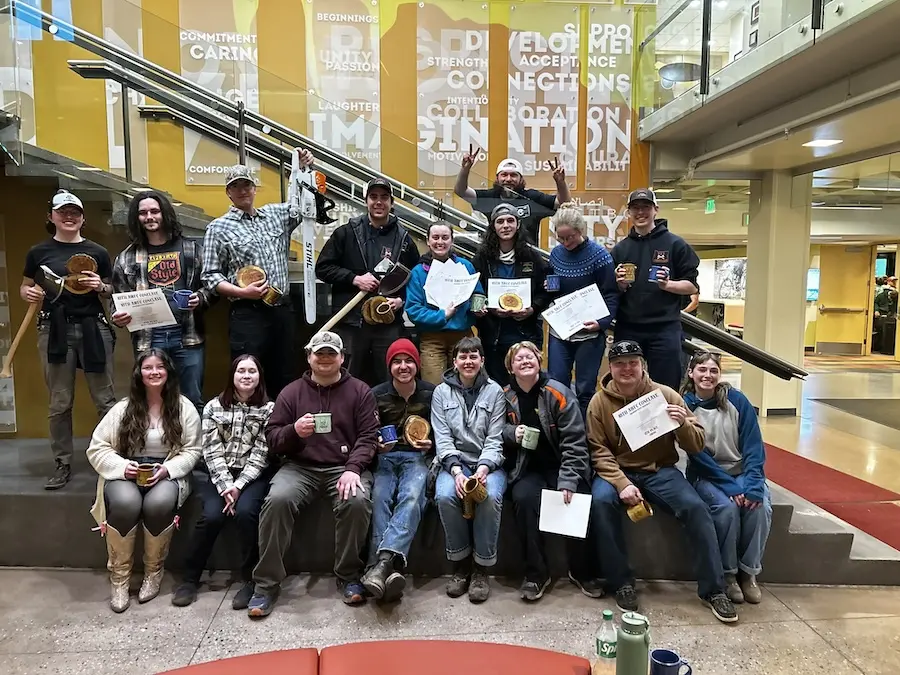
The OSU Forestry Club holding awards (chainsaw, axes, plaques, certificates) from the 2025 Colorado State University 85th

AWFC Conclave Competition.

Image
two women cutting a tree

The Forestry Club's 2025 Spring Thaw Competition and Alumni Potluck.

Image
a large group of people

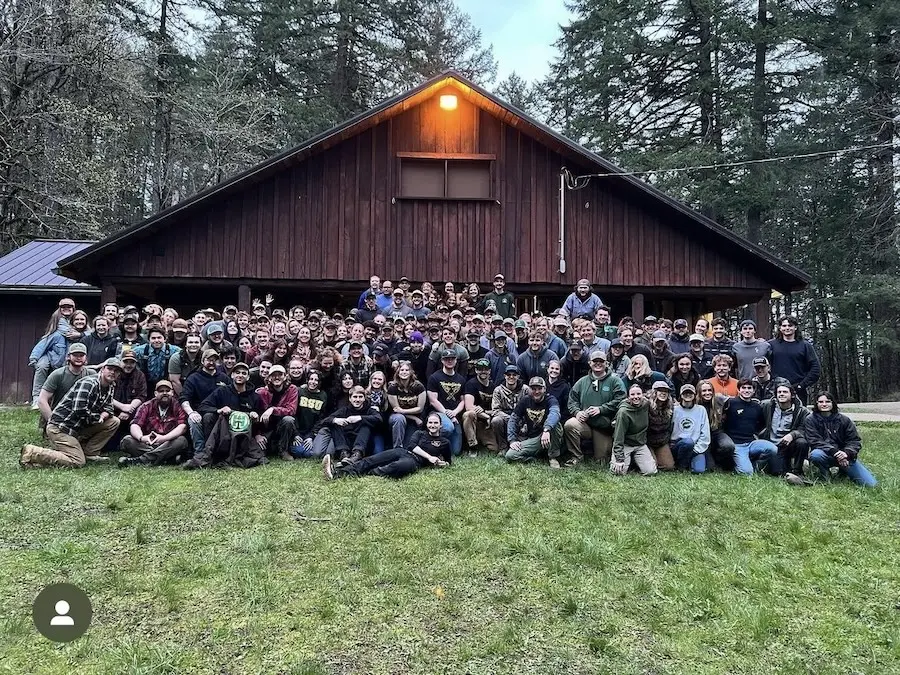
All 150 competitors from the 2023 OSU 83rd AWFC Conclave Competition, gathered outside of the OSU Forestry Club Cabin.

Image
a group selfie

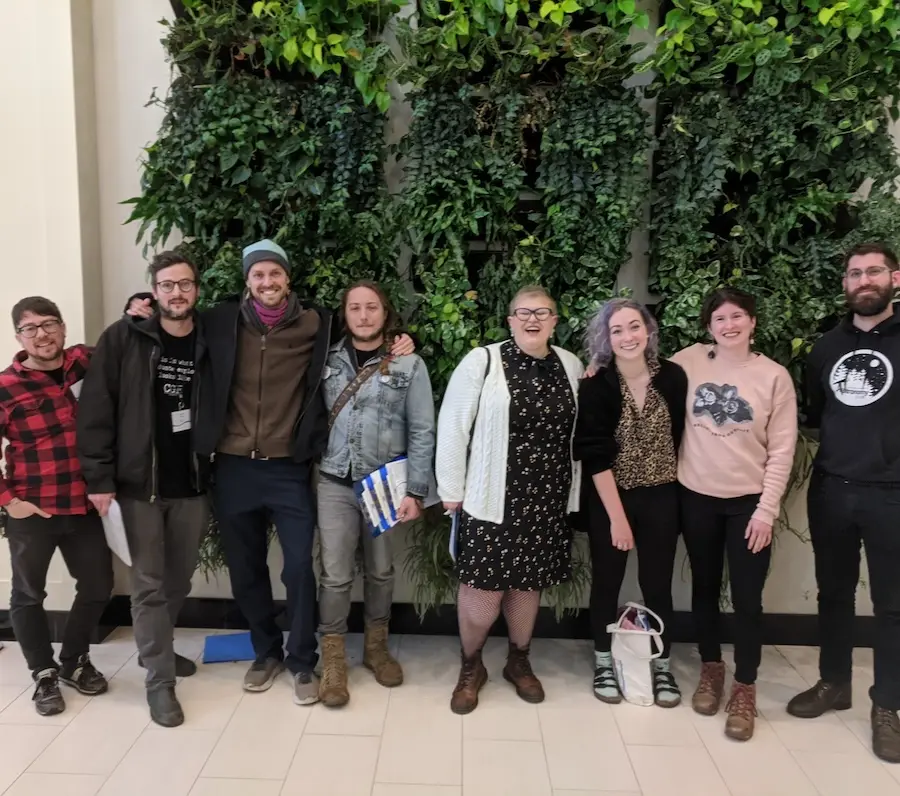
Dunn (foreground) after the water events had concluded at the CSU 85th AWFC Conclave with competitors from the University of Idaho. 

Image
a historical photo

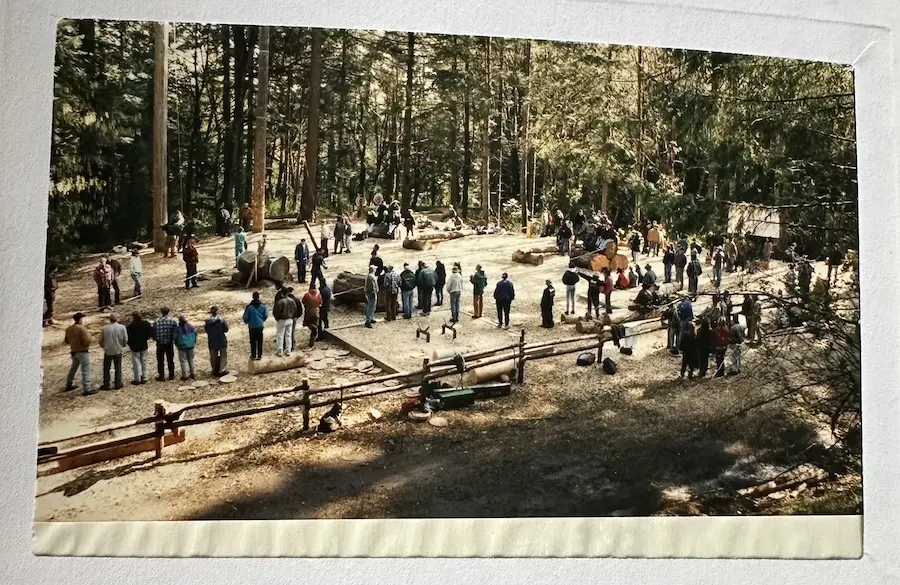
The George W. Brown Logging Sports Arena during OSU's 1997 57th AWFC Conclave Competition.

Who gets to turn the tap on? Erin Kanzig’s work at the intersection of water and justice

By Colin Bowyer on March 2, 2026

Kanzig, an alumna of the School of Public Policy’s master’s program, leads efforts to increase equitable access to clean, safe, and affordable drinking water nationwide

Image
profile picture of Erin Kanzig

Erin Kanzig

By Taylor Pedersen, CLA Student Writer - March 6, 2026

By the time Kanzig, M.P.P. ‘20, had language for “environmental justice,” she had already been living it for years.

She grew up in Sisters, Oregon, where the outdoors was like a teacher to her. Hiking, camping, and learning the local ecology were everyday experiences, reinforced not just at home but in school. As a teenager, Kanzig participated in an immersive environmental education program that brought together science, outdoor recreation, and nature writing; an early introduction to the idea that land and people are never separate.

“That really helped me understand what a sense of place means,” Kanzig said. “And it was probably the first time I started thinking seriously about the intersection of social, economic, and environmental issues.”

That curiosity followed her to Whitman College in Walla Walla, Washington, where she deliberately chose what she described as “the broadest possible combination” of environmental studies and sociology. Starting college at 17, Kanzig wasn’t chasing a specific career path so much as an understanding of how the world works and how humans shape it: often unevenly.

“I was mostly just curious about everything,” she said. “How humans are part of the world, but also have an undue influence on it.”

Her undergraduate thesis reflected that impulse. Kanzig studied perceptions of wolves returning to Oregon, interviewing ranchers, conservationists, and state agency staff to understand how geography and identity shape environmental conflict. The issue itself, wolves moving back into the state, was different for everyone, emphasizing the urban-rual divide between those who were directly affected by wolves versus those who wanted to protect them.

“That was when I really started asking questions about how place influences belief,” she said. “And how people can be responding to the same reality in completely different ways.”

After graduation, Kanzig moved far from the forests of Central Oregon to Detroit, Michigan, joining a year-long volunteer program with Alternatives for Girls, a shelter serving young women ages 15 to 21, many of them navigating homelessness, parenthood, and systemic neglect. The move marked her first sustained immersion in a large city, and in a majority-Black community dealing with decades of disinvestment. 

“I probably romanticized it,” Kanzig admitted. “The reality was emotionally grueling.”

As a resident advisor, her days were intimate: helping with meals, driving residents to appointments and job interviews, and making sure people were safe. Many of the young women she worked with were her own age, but their life experiences couldn’t have been more different. 

“It was my first real step into adulthood,” she said. “And a very unique entry point into the workforce.” 

While Kanzig was learning how gender, poverty, and survival intersect on an individual level, Detroit itself was unraveling. During the city’s municipal bankruptcy in the early 2010s, the state installed an emergency manager with sweeping authority, effectively neglecting local democracy. One of the most visible consequences was the mass shutoff of residential water service to collect unpaid bills. 

“They were shutting off whole blocks,” Kanzig said. “Thousands of people didn’t have running water in their homes.”

The public health implications were immense. Residents with negligent landlords lost access to water. Families waited hours in line to restore service. Community organizers mobilized, protesting what they saw as an inhumane policy that disproportionately harmed low-income Black residents while corporations with massive water use faced little scrutiny. 

For Kanzig, it was a turning point.

“I hadn’t really participated in protests or rallies before that,” she said. “But seeing people around me organize, and knowing people directly who had their water shut off, made it impossible to ignore.” 

She pointed to the late Charity Hicks, founder of the People’s Water Board Coalition, as a key influence. Hicks helped frame water shutoffs as an issue of public health, environmental justice, and economic survival, connecting dots Kanzig has continued to spend her career tracing.

“I think that was the start of feeling like I needed to show up for my community,” Kanzig said. “Even if it was just being another person at a rally.” 

After several years in Detroit, Kanzig did something radically different: she returned to the West Coast to hike the Pacific Crest Trail, something she always wanted to do. While she clarifies that she wasn’t entirely alone, the experience was still an intense physical and emotional reset after years of community building and service work.

“It strips life down to the basics,” she said. “Finding water. Eating food. Putting one foot in front of the other.”

The hike offered simplicity, slowness, and a rare opportunity to think; an experience Kanzig described as transformative. Moving through ecosystems at walking speed, she reconnected with the natural world in a way that contrasted sharply with the political complexity she’d been navigating. 

That clarity ultimately led her back to school. Seeking a deeper understanding of policy processes and environmental justice at a structural level, Kanzig enrolled in Oregon State University’s Master of Public Policy program. In addition to offering a graduate teaching assistantship to Kanzig, the program emphasized a practical and applied approach, exactly what Kanzig was looking for. 

“What surprised me most was how often the language didn’t translate into action,” she said. 

The coursework gave her the analytical tools she felt she’d been missing and provided a comprehensive look at socioeconomic issues from a systems-level. Economics, political science, and policy design layered onto her lived experience.

Her thesis examined whether state-level environmental justice policies in Oregon, Michigan, and New Mexico actually achieved their stated goals. Through interviews with advocates and organizers, Kanzig found a familiar gap between intention and impact. 

“Progress was slow, if it was happening at all,” she said. “A lot of policies sounded good, but they didn’t have accountability mechanisms. They didn’t have teeth.” 

Still, she noted that momentum has grown since she completed her research. States like New Jersey have passed stronger environmental justice laws that consider cumulative impacts, acknowledging that some communities simply cannot absorb more pollution.

After finishing her degree, Kanzig returned to Detroit, this time to work for River Network, a national nonprofit that supports water-focused organizations navigating local, state, and regional water issues and policy. Her early work included building a state water policy hub: a centralized resource for advocates tracking efforts like lead service line replacement, addressing emerging contaminants like PFAS, and watershed restoration across the country.

Today, her focus is capacity building: training community groups to understand water infrastructure funding and advocate for resources where they’re needed most. 

“It’s not a sexy topic,” Kanzig said. “It’s pipes under the ground. But it matters.” 

Defining impact, she explained, looks different now. Rather than measuring success through visible protest or immediate wins, her work often shows up indirectly through strengthened coalitions, better-informed advocates, and long-term policy shifts.

“It can be hard to trace,” she said. “But hearing from groups who’ve seen real changes in their communities makes it feel worth it.”

One recent example is River Network’s resource on reducing water shutoffs, which outlines best practices for utilities and communities working to keep water accessible and affordable; a continuation of the issues that first motivated Kanzig in Detroit more than a decade ago. The resource is available through River Network’s Safe and Affordable Drinking Water initiative.

Much of her success today with collaborative governance and finding solutions through partnerships forged between community organizations and government stakeholders can be traced back to what she learned during the M.P.P. program. Associate Professor Erika Wolters' environmental policy course provided a strong foundational understanding of bedrock environmental laws, Kanzig said, and Professor Mark Edwards' social research class that Kanzig took during her first term helped her ease back into school after a six year break, applying research questions to issues she wanted to understand through a policy lens. Additionally, a class on Collaborative Governance (PPOL 544) was a “big influence” with how she carries on the mission of River Network today. 

Looking back, from Sisters to Detroit, across the Pacific Crest Trail, through Corvallis, and back again to Detroit, Kanzig sees water as the constant tying her experiences together. 

“It’s about dignity,” she said. “And about whether we treat people’s health and well-being as disposable.”

In a moment marked by setbacks in environmental protections and growing inequity, Kanzig remains committed. Impact isn’t about a single victory, but about building skills, strengthening communities, and pushing systems, however slowly, toward justice.

Image
a group of people outside of a congressional office

Kanzig (foreground-center) with partners from We the People of Detroit and West Street Recovery, advocating for water affordability and climate resiliency in Washington, D.C. in April 2025

Image
a sunset

Hiking up Half Dome in Yosemite National Park at dawn while thru-hiking the Pacific Crest Trail. | Photo credit: Clayton Feider-Sullivan.

Image
a group of people

Kanzig (second from right) with other members of the Coalition of Graduate Employees in 2019

CLA Research: Regulations and climate top list of challenges for West Coast shellfish farmers

By Colin Bowyer on Feb. 25, 2026

Interviews with growers in Oregon and California show that complex permitting processes often hinder rapid adaptation to ocean stressors like acidification, hypoxia, and marine heat waves

By Colin Bowyer, Communications Manager, February 26, 2026

Image
Kristen Green

Kristen Green

Aquaculture is a growing source of food production worldwide, including along the Oregon and California coasts. Despite recent increases in production and the growing global importance of aquaculture products for food security and livelihoods, yield is projected to decline under stressors from climate change, such as ocean acidification, hypoxia, marine heat waves, algal blooms, and more. 

In addition to environmental stressors, shellfish-reliant communities also face troubling socioeconomic concerns, such as labor shortages, supply chain challenges, and a complex regulatory environment. Such obstacles can limit the expansion of future aquaculture operations, as well as the ability of aquaculture growers to respond to stressors.

A new qualitative study published in Ecology & Society reveals how shellfish farmers in California and Oregon are adapting to and coping with a fast‑changing climatic and socioeconomic environment, including what helps them stay resilient in the face of growing challenges. 

Researchers from the School of Public Policy and College of Earth, Oceanic, and Atmospheric Sciences, along with the University of Washington, San Diego State University, Smithsonian Tropical Research Institute, and the California Marine Sanctuary, interviewed nine out of 17 farmers in California and 13 out of 19 in Oregon. Most of the shellfish growers principally cultivated oysters (Pacific, Kumamoto, and Olympia), in addition to mussels, Manila clams, and abalone. 

Lead author Kristen Green, a former postdoctoral fellow in the School of Public Policy and now a researcher at the University of Washington, led the interview process throughout 2020 to 2022. 

“Bivalve farm owners and managers along the U.S. West Coast, particularly in California and Oregon, where they tend to be smaller-scale operations, face unique pressures at both a chronic and acute scale,” said Green. “They’re aware of what climate effects like ocean acidification and hypoxia can do to their production, as seen by the Oregon shellfish hatchery larval crash in the late 2000s, but pressures can overlap and build on each other. Understanding how and when to prioritize adaptation response strategies to these stressors is paramount.” 

Image
Lauren Rice

Lauren Rice

Among all the stressors identified, regulatory hurdles were the most disruptive, causing costly delays and financial strain for farms in both California and Oregon. Growers reported that navigating complex rules often slows down their ability to respond to urgent environmental problems or invest in improvements. Adapting to the oftentimes onerous regulatory and permitting process has led to creative problem-solving by growers. For example, some growers have transitioned from retail sales to wholesale to avoid certain state regulations, found business partners through local networks, and been bolstered by assets like natural capital. Other growers relied on peer knowledge-sharing networks about more effective ways of designing and using suspended gear in response to stress caused by nuisance and invasive species, as well as the best way to obtain permits.

“Certainly working in fisheries you hear growers talk about regulatory complaints,” said Green. “But it was surprising to hear a common complaint from both growers in California and Oregon was that regulations and permitting were often the most challenging aspects of running a farm. In the future, particularly as environmental stressors become more prominent, farmers will need to be more nimble, but ideally the regulatory processes will also be flexible enough to accommodate these changes.”

“Interviewees described regulatory stress as a compounding issue,” added research assistant Lauren Rice, ‘23, M.S. ‘25. “Some permitting and regulatory processes are pervasively restrictive, and these stressors are often much more tangible and apparent in growers’ daily operations. Because permitting and regulatory processes can also get in the way of responding to environmental changes and invasive species, the impacts compound, making this root stressor all the more pressing.”

Following regulations, ocean acidification and hypoxia remain major environmental concerns for growers. Consistent with current oceanographic trends, these conditions can result in acute mortality events and production losses, underscoring the sensitivity of bivalve aquaculture to dynamic ocean upwelling. Some farmers were able to adapt when ocean acidification and hypoxia were detected through water monitoring, often in collaboration with external scientists. Support for these strategies, particularly the technology for water monitoring and the skills to interpret the results, can advance adaptation, which will be essential with increasing climate change impacts.

“Growers try to be as attuned to ocean dynamics as much as possible,” said co-author Erika Allen Wolters, associate professor at the School of Public Policy. “There is high awareness of ocean acidification and hypoxia amongst those in the industry because of previous low-oxygen events. Few individual farms have the technology to constantly monitor water quality and marine heatwaves are hard to forecast, so building strong networks amongst growers increases knowledge-sharing and adaptiveness.”

Image
Erika Wolters

Erika Allen Wolters

Other stressors that growers identified outside of regulatory and environmental conditions were lingering supply chain disruptions from the initial years of the COVID-19 Pandemic and rising operating costs, like fuel, gear, and labor.

Of all the identified stressors, growers successfully executed an adaptive response for a majority of cases, while cope responses accounted for over a third of and react responses for just over 10 percent. This distribution highlights that although adaptive strategies are common, substantial portions of grower responses remain constrained to shortterm coping or reactive measures, indicating limitations in structural or resourcebased adaptive capacity.

Adaptation was most successful when farmers could draw on certain strengths, including flexibility, learning new skills, support networks, and having the agency to make decisions independently. Governance‑related support, such as permitting and regulatory systems, were least reported by growers to aid in adaptation, suggesting a gap between policy structures and on‑the‑ground needs. Shellfish growers will often combine multiple forms of knowledge and resources to solve problems. For example, a grower’s ability to take initiative, or agency, was most effective when paired with resources such as equipment investments, collaboration with others, or flexible farm practices. 

“It’s important to look at adaptive strategies in combination,” explained Green. “What are the recipes that people need to follow to better adapt to stressors and how do growers adjust the ingredients in order to continue to adapt? Oftentimes, we assume adaptation requires money, when that’s not necessarily the case. Growers have shown a lot of different ways of adapting and the important thing is having access to these adaptive capacities and combining them when needed.”

Shellfish aquaculture is a vital part of coastal food systems. As climate change and regulatory landscapes continue to shift, understanding how growers adapt can help policymakers, researchers, and communities better support sustainable seafood production.

Jackie Goldman champions student success through research, mentorship, and real-world impact

By Colin Bowyer on Feb. 23, 2026

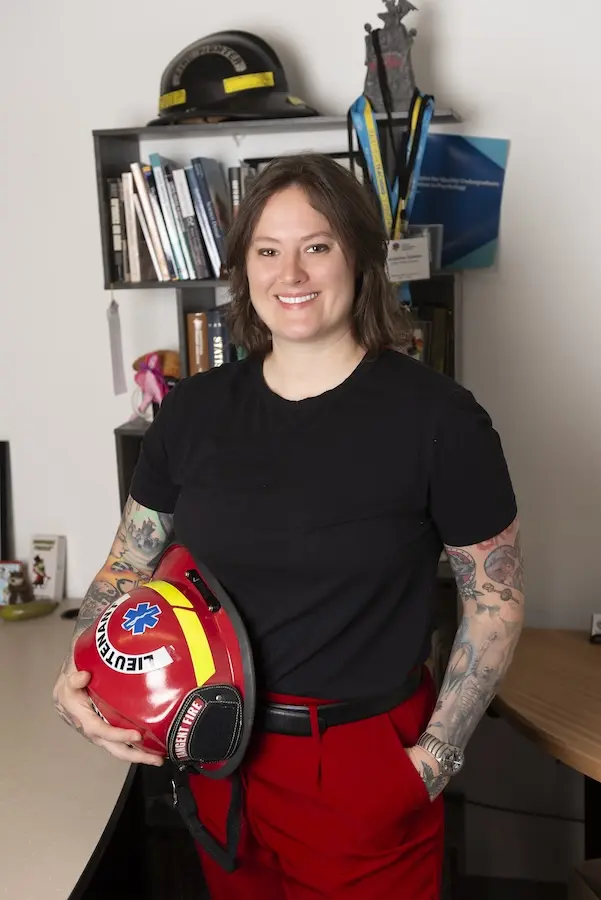
An educational psychologist reshaping how students learn, and a volunteer firefighter dedicated to helping her community, Goldman brings both heart and rigor to everything she does

Image
woman standing in an office holding a fire fighter's helmet

Jackie Goldman | Credit: Rudy Uhlman

By Jessica Floescu, CLA Student Writer - Feburary 25, 2026

Professor of Teaching in the School of Psychological Science Jacqueline (Jackie) Goldman discovered her deep interest in cognitive psychology and how the brain affects learning while attending Whitworth University in her hometown of Spokane, Washington. She loved it so much that she decided to keep going to school. 

After a stint in a theoretical psychology lab at the University of North Carolina at Greensboro, she went on to receive her M.Ed. and Ph.D. in educational psychology from the University of Oklahoma. Behind all of Goldman’s research was the fundamental question: how do we help students learn how to learn? Her wider research agenda examines the study strategies, motivation theory, and systemic issues that prevent students from being successful. 

Much of her research resume has focused on challenges faced by first-generation college students. Her dissertation showed that first-generation college students have a higher sense of costs and perceive coursework to have a higher value. Later research also looked at understanding what motivates first-generation students and how high-stakes assignments, where one test or paper is heavily weighted, affect stress levels in first-generation students more.

After completing her advanced degrees in the Sooner State, Goldman entered her first academic role as an assistant professor at Delta State University in Cleveland, Mississippi, which she described as a “tough” experience, particularly as a queer woman in the South. Her eyes set on returning to the Pacific Northwest, Goldman accepted a professor of teaching role at the School of Psychological Science in 2021, focused on learning strategies that help students achieve success. 

Goldman co-leads the Motivation and Engagement For Student Success (MESS) Lab with Rachel Soicher, Ph.D. ‘20, a part-time psychology instructor at OSU and associate director for research and evaluation at the Massachusetts Institute of Technology. Described as an “unorthodox” psychology research lab, Goldman and Soicher support students testing their own psychology theories through research projects. 

“The MESS Lab isn’t a traditional type of research lab,” explained Goldman. “We bring in students starting at the undergraduate level to be a part of this mentorship-style program. It’s the students who propose a research project that Rachel and I help them develop from the ground up.” 

Current and previous research projects proposed by students include burnout, goal-setting, student motivation and more. A recent project by undergraduate student Samantha Vogt considered the accuracy of comments by students on digital course materials. OSU students use the annotation tool Perusall to comment on materials provided by instructors. Vogt’s study explored how inaccurate comments made by students on that app affected their peers’ test scores. 

Goldman’s own research is currently exploring the relationship between student autonomy and burnout. It’s a student’s responsibility to study, Goldman explained, but educators can still play a larger role in offering the appropriate amount of support.

“When students aren’t receiving the help or support they need in their classes, the rate of burnout is naturally higher,” said Goldman. “Offering more choices to students and making them feel like real people can significantly affect a student’s level of stress. My research takes place in the classroom, which isn’t a controlled environment, but any real world implications are worth exploring.”

Goldman’s wider research agenda has touched on some of the largest obstacles to student success. From effective faculty-student communication and online learning to pedagogy and challenges facing first-generation students, Goldman’s research is focused on helping students and finding solutions within the wider higher education framework. 

“There are always going to be broader systematic issues outside of the classroom that will create barriers for students,” she explained. “I cannot change an entire school system that I believe is set up to mostly benefit affluent white people, but there are ways that educators can help break down learning barriers and frame obstacles to help all of our students succeed.” 

Goldman tries to convey practical applications for psychology in the everyday lives of students, hoping to create personal connections and encourage students to continue in the field. 

“There’s so much to explore and left to research in psychology, especially in educational settings,” said Goldman. “We’re still learning what are the best study strategies for students and what effective course pedagogy looks like, but there’s always going to be outside variables in the lives of students who require us to be flexible. I could run a beautiful study in a clean lab about the best ways to learn, but for a student with a demanding schedule applying these tips might not even be possible.”

Outside of research and teaching, Goldman has been a volunteer firefighter since her time in Mississippi. Certainly not something she thought she’d be doing, it was a way to become more involved and active during the initial year of the COVID-19 Pandemic. After moving to Oregon, Goldman continued volunteering, first with the Philomath Fire District and now with the Tangent Fire Department, where she serves as a volunteer lieutenant.

“Everyone in our department is there because we want to help people,” said Goldman. “Even though we see some people on their worst days, it’s amazing to interact with the community. I always wanted a life outside of academia and becoming a volunteer firefighter allows me to do that. I also get to do fun things, like eating lunch with kids at an elementary school and showing them the fire engine. I can get really disconnected in academia talking about more abstract theories, so it’s nice to balance it with these real world experiences.”

How Ali Lanenga found policy through trial, art, and education

By Colin Bowyer on Feb. 23, 2026

Lanenga balances being a professional photographer, school board member, part-time public policy graduate student, and legislative aide in pursuit of improving educational outcomes through effective policymaking.

Image
woman in blue shirt standing in front of a hydrangea

Ali Lanenga

By Taylor Pedersen, CLA Student Writer - February 25, 2026

Alejandra (Ali) Lanenga never planned on working in government. If anything, her life has been filled with detours; early adulthood was shaped by responsibility, years spent behind a camera lens, and a return to education after burnout motivated her to leave the classroom entirely. But for Lanenga, whose path has moved between creativity and structure, policymaking has become another way of framing the world, one that allows her to influence both individual lives and entire systems.

Raised in rural Sandpoint, Idaho, Lanenga grew up surrounded by both people and responsibility. Though she has older half-siblings, she often occupied the role of the oldest child. That position, paired with life on a farm, shaped her early understanding of obligation. There were animals to feed, siblings to watch, and expectations that weren’t easily bent.

“I came out of the womb a rule follower,” she said, laughing. “I’m the kind of person who naturally holds the line on whatever the rule or value is.” That instinct, to uphold structure and follow through, would carry her through nearly every chapter of her life, even when the structure itself began to crack.

Lanenga graduated from high school at 17 and began college at Brigham Young University (BYU) in Provo, Utah, shortly after. She married young, at 18, towards the end of her freshman year. Looking back now, she sees that period as a crash course in independence.

Once married, Lanenga and her husband were effectively on their own. They paid for college, insurance, and necessities without family financial support. Their weekly grocery budget for two adults hovered around $20. “We had to choose between food, tuition, and books,” she said. “And we just figured it out.” 

The struggle taught her how to prioritize, sacrifice, and lean on community; skills that would resurface years later in far different contexts. “We learned to value relationships and support systems,” she said. “That sense of chosen community mattered.” 

After graduating from BYU with a degree in family and consumer sciences education, Lanenga accepted her first teaching job in Utah, outside of Salt Lake City, working with seventh- and ninth-grade students. She was barely older than many of her students herself, just 21, and quickly found herself overwhelmed. 

She taught classes of more than 50 students, many of whom came from unstable home environments marked by poverty, foster care involvement, and incarceration. “I didn’t feel like I knew what I was doing,” she admitted. “Because I didn’t.” 

Lanenga poured herself into the work anyway. She stayed late to tutor students, meticulously planned lessons, and tried to support kids whose needs extended far beyond the classroom. The result was total burnout. By the end of her first year, while pregnant with her first daughter, she reached her breaking point.

“I was done,” she said. “I wasn’t going to do all of this and be pregnant. I hit my limit.”

After leaving teaching and later having a second child, Lanenga found herself struggling with postpartum depression. It was during this period that photography, an interest she had held quietly for years, became a saving grace.

Working in manual mode, she found comfort in the mechanics of the camera. Adjusting ISO, aperture, and light gave her a sense of control when her internal world felt anything but stable. “I could see how changing one thing changed the outcome,” she said. “That helped me reset.” 

Photography became both an emotional outlet and a practical one. She began with stock images, then moved into portraits, weddings, and events. Eventually, though, she found herself drawn away from people altogether. 

“Flowers don’t have vanity,” Lanenga laughed. “People care deeply about how they’re seen. With flowers, I could tell the story I wanted to tell.” 

Her work shifted almost entirely to flowers and inanimate objects, images that conveyed feeling without expectation. Over time, her photography evolved into a successful business. She now sells her work to interior designers, galleries, private collectors, and art licensing companies, supplying images for hotels, offices, and commercial spaces.

The business side, she said, came through trial by fire. “You fail your way to success,” she said. “You make art nobody buys. You make art nobody likes. And you keep refining.” 

The flexibility of being an artist allowed Lanenga to remain a stay-at-home mother until another turning point arrived.

In 2019, her family moved to Portland. Then the pandemic hit. Suddenly, Lanenga was an artist, a mother, and a teacher again, this time teaching her own children from her living room. 

“That’s when it became very clear the system wasn’t working,” she said. “Why was I paying taxes for my kids to go to school if I was the one teaching the lessons?” 

Teaching at home exposed gaps she couldn’t ignore: weak curriculum, poor outcomes, and policies that didn’t align with the realities families were facing. Oregon’s consistently low performance on national education metrics only reinforced what she was seeing firsthand. That motivated Lanenga to enter the race for Riverdale School District school board where won a four-year board position.

What kept her going after that initial push was policy work. As chair of the board’s policy subcommittee, Lanenga found a new outlet for her analytical instincts. “School boards don’t run districts, superintendents do,” she explained. “Boards set expectations. Policy is how boards let superintendents know what they expect.” 

One of her proudest accomplishments has been pushing for meaningful academic metrics in every grade, not just those required by the state or federal government. By implementing district-wide benchmarks for English and math across all grade levels, Lanenga helped create a system that allows for earlier intervention and more informed financial decisions.

“It lets us adjust resources in real time,” she said. “That’s how you actually support students.” 

Her growing interest in policy led her to Oregon State University, where she completed a public policy microcredential first, then a certificate program, and eventually enrolled as a part-time executive master’s student online. The “stackable” programs allowed Lanenga to smoothly roll her credits into the next program on her time and without having to reapply.

Classes like Public Policy Theory (PPOL 512) supplemented her work as a school board member and Intro to Econometrics (ECON 524) gave her the technical tools to help her understand public policy through large amounts of data. 

“From all stages of the public policy program, I saw an intense application to the real world,” explained Lanenga. “Econometrics was probably one of the hardest classes I’ve ever taken, but Professor Bollman took the time to walk me through it day-by-day. I learned so much from her and the entire program.”

She also began interning with Oregon State Senator Janeen Sollman (D-Hillsboro) and now works full-time as a legislative aide.

The leap from art to policy doesn’t feel as wide for her as it might seem. “Creativity is failing forward,” she said. “It’s looking at something from every angle.” 

That mindset, she believes, is essential in policymaking, where decisions affect people with different experiences and needs. “You have to invite people in,” she said. “Ask about their experiences. Listen. Then apply that.” 

Life, she reflected, rarely unfolds as planned. “Most of it is an adventure,” she said. “You’re never sure where you’ll end up.”

For Lanenga, that uncertainty has become a strength. Whether behind a camera lens or drafting policy language, she’s learned to frame the world carefully, adjusting light, perspective, and focus until the right picture finally comes into view.

Image
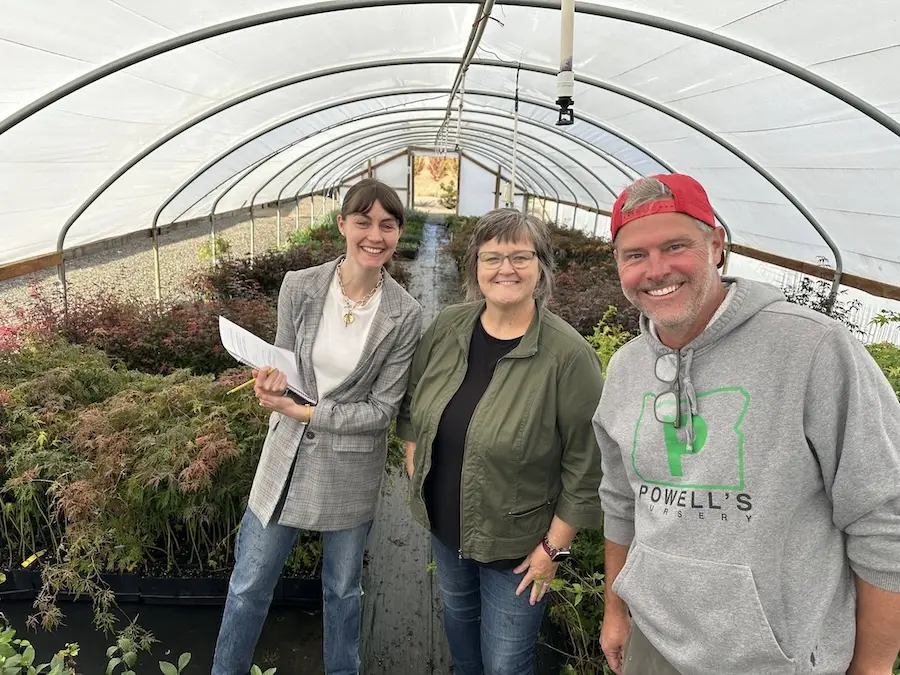
three people standing and smiling in a greenhouse

Lanenga on location with Senator Sollman (center) and Patrick Newton, President of the Oregon Association of Nurseries (OAN)

Image
a group of people standing on a farm

Lanenga with her family and Governor Kotek (right)

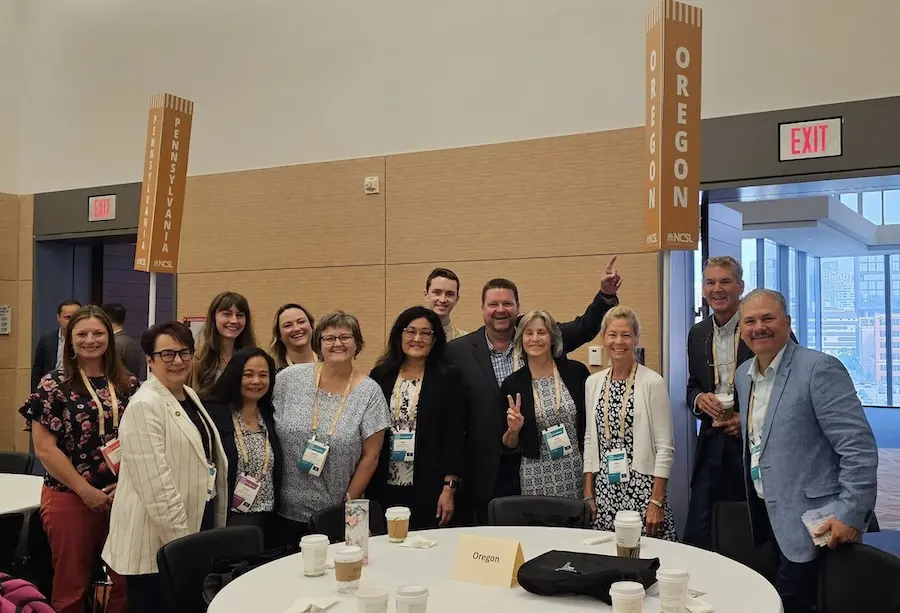
Image
a group of people pointing towards a sign that says Oregon

Lanenga with members of the Oregon Legislature and staffers at the National Conference of State Legislatures, 2025

The psychology of outer space: Morgan Stosic’s research on teamwork beyond Earth

By Colin Bowyer on Feb. 17, 2026

An alumna of the School of Psychological Science, Stosic researches nonverbal communication by astronauts

Image
woman sitting in front of the U.S. and N.A.S.A. flags

Morgan Stosic

By Taylor Pedersen, CLA Student Writer - February 18, 2026

Long before she studied astronauts, Morgan Stosic, ‘19, taught people how to ski. She grew up in Reno, Nevada, in a family where athletics were less of an extracurricular activity and more of a lifestyle. Track meets, volleyball tournaments, and competitive ski races filled her childhood. By high school, Stosic was spending her winters at Mt. Rose, just outside Reno, working as a ski instructor; learning how to read people, adapt on the fly, and keep small groups moving safely down a mountain.

Those early lessons, she said, quietly shaped the way she now thinks about human behavior.

“When you’re looking at small teams, whether it’s a ski lesson or an astronaut crew, the dynamics really matter,” Stosic said. “Who works well together, how people communicate, how personalities fit; it all affects performance.”

At the time, though, Stosic didn’t imagine herself working in research, much less at NASA. She entered OSU with an interest in medicine, drawn to helping people but uneasy about working directly with the body. Psychology stood out as a compromise: a way to understand people without blood or scalpels.

That interest sharpened into something more concrete during her first year at OSU, when retired psychology professor Frank Bernieri invited her to join his Interpersonal Sensitivity Lab. Bernieri, a pioneering researcher in nonverbal behavior, became not only her mentor, but a defining influence on her career.

“I really lucked out,” Stosic said. “Frank was one of the early people pushing psychology to take nonverbal behavior seriously; facial expressions, posture, small movements. Joining his lab shaped everything I’ve done since.”

Working with Bernieri, Stosic discovered something unexpected about herself: she loved statistics. While many psychology students shy away from the math-heavy side of research, Stosic gravitated toward modeling, coding, and data analysis.

“That surprised me,” she said. “But it also pushed me toward research in a big way.” 

By her junior and senior years, Stosic was traveling to conferences and publishing papers with Bernieri, developing a growing fascination with how people unconsciously read and respond to one another. The lab’s work focused on subtle behaviors: head nods, hand gestures, shifts in posture, that quietly shape social interaction. Studying those signals changed how she moved through the world. 

“You start noticing how much information is exchanged without words,” she said. “It’s everywhere.”

That curiosity followed her east when Bernieri encouraged her to pursue a Ph.D. at the University of Maine under Dr. Mollie Ruben, a research colleague of Bernieri’s. There, Stosic narrowed her focus even further, studying nonverbal synchrony and mimicry; the ways people unconsciously coordinate their movements during interaction. Part of that interest came from an unlikely source: ballroom dancing. 

“I took all the ballroom classes at OSU,” she said. “Sometimes you dance with someone, and it just clicks. You move together without thinking. Other times, it’s awkward no matter how hard you try.”

That sense of effortless coordination, or its absence, became central to her research. Her dissertation examined why people synchronize their nonverbal behavior and what those patterns reveal about motivation, intention, and group performance. While in graduate school, Stosic balanced academic work with contract research at Boston Children’s Hospital and the Dana-Farber Cancer Institute. Those applied settings pushed her to think beyond journal articles.

“In academia, the endpoint is often publishing a paper,” she said. “But I wanted my work to actually change how things function; policies, procedures, communication.” 

Working in hospitals also taught her how different disciplines speak about the same ideas.

“You have to translate your findings,” she said. “The language doctors use isn’t the same as academic psychology, even if you’re studying the same behavior.”

That ability to translate would soon become critical. During her Ph.D, Stosic’s research caught the attention of NASA. Funded by the agency, she began studying fatigue through nonverbal behavior, exploring how doctors on Earth might assess astronauts’ cognitive and physical states while they’re in space.

“It was this intersection of everything I cared about,” she said. “Behavior, performance, high-stakes environments.”

After finishing graduate school, Stosic briefly worked as a UX researcher at Collective Health, a third-party healthcare administrator, before being hired full-time by KBR at NASA’s Johnson Space Center. She has now been a research psychologist there for over a year and a half, working in human spaceflight and studying how small, tightly knit teams function under extreme conditions. Astronaut crews, she noted, are usually made up of four to six people, far smaller than most teams studied in traditional organizational psychology.

“When you’re sending a group into space, team composition really matters,” she said. “Personality, motivation, background, communication style, all of it shapes performance.”

Her work often looks nothing like a traditional psychology lab. At NASA, research can involve giant pools used to simulate microgravity, underwater spacewalk tests, and collaborations with engineers, physiologists, and medical doctors.

“It’s not a little conference room,” Stosic said. “It’s this massive, integrated scientific environment.”

That interdisciplinary approach, and her growing impact in the field, recently earned Stosic a spot on Forbes’ 30 Under 30 list. While the recognition is significant, she sees it as just one moment in a much longer journey.

“If you’d told 16-year-old me, teaching skiing at Mt. Rose, that I’d work at NASA, I wouldn’t have believed you,” she said.

Stosic never had a single, fixed plan. Instead, she followed what interested her: statistics, nonverbal behavior, teamwork, letting those threads pull her forward. 

“My path zigzagged,” she said. “I just kept asking, ‘What makes me excited to get out of bed?’ and followed that.” 

From snowy slopes in Nevada to astronaut crews, that curiosity has carried her farther than she ever expected, and, fittingly, has kept her studying the quiet signals that hold teams together, even in space.

Advancing inclusive psychological research

By Colin Bowyer on Feb. 17, 2026

Through her work in the Psychophysiology, Intersectionality, Latine, and Acculturative Science (PILAS) Lab, Lianelys Cabrera Martinez challenges one-size-fits-all models and uplifts the diverse identities, struggles, and strengths within Latine communities

Image
woman in black and white sweater

Lianelys Cabrera Martinez | Credit: Rudy Uhlman

By Hoku Tiwanak, CLA Student Writer - February 17, 2026

Lianelys “Lia” Cabrera Martinez, a fourth-year Ph.D. student in School of Psychological Science at the College of Liberal Arts, is driving research that explores bicultural identity development, social cognition, and discrimination within Latine communities. Her work, conducted through the Psychophysiology, Intersectionality, Latine, and Acculturative Science (PILAS) Lab, led by Dr. Iván Carbajal, challenges existing psychological models that often overlook the diversity within Latine identities.

“My research highlights the nuance of the Latine experience,” Martinez explained. “There are so many differences within our communities in terms of assimilation, legal status, racism, and cultural identity that we can’t generalize them all under one model.”

As an undergraduate student studying psychology at the University of Nevada, Las Vegas, (UNLV) she wasn’t sure what she wanted to specialize in until she joined her first research lab. “That experience opened my eyes to the social justice and cultural sides of psychology,” she recalled. “It made me realize psychology could be about people’s lived experiences, not just traditional mental health.”

Through a mentor’s connection at UNLV, Martinez discovered Dr. Carbajal’s lab at OSU. She now describes her relationship with Dr. Carbajal as the “perfect match.” “It’s the healthiest mentor-mentee relationship I've had,” she said. Martinez explained that connections throughout education, especially in grad school, are so important when you are navigating it alone. “Having a mentor who understands what it means to be a minority in academia has been life changing,” she said.

Last year, Martinez received the Thurgood Marshall Graduate Fellowship, awarded to graduate students whose accomplishments and activities demonstrate leadership, service, and commitment to fostering a just community. Her upcoming dissertation proposal will focus on community-based, mixed-methods (qualitative and quantitative) research centered on the Cuban diaspora. She hopes to challenge traditional research frameworks by diving further into the nuanced experience. “There’s still hope in academia,” Martinez said. “Even as some topics and language face restrictions, researchers continue to find ways to amplify marginalized voices. That’s what keeps me going.” 

Despite her accomplishments, Martinez admits imposter syndrome remains a challenge. “It’s something that never really goes away.” To help others that share the same feeling, Martinez took part in developing a graduate student support group within the School of Psychological Science. The initiative connects students with resources, union stewards, and peers navigating similar struggles.

As she continues her studies, Martinez remains committed to ensuring that the next generation of scholars sees themselves reflected in the research and institutions that shape academia. “Getting to be part of that small percentage who reach higher education is powerful,” she says. “It’s difficult, but we have to keep going, for ourselves and for those who come after us.”

The radical connection between 19th-century literature and today

By Colin Bowyer on Feb. 12, 2026

Monique McDade, assistant professor in the School of Writing, Literature, and Film, explores women writers of the American West and their impact on modern literature and society

Image
woman in brown jacket and white shirt standing in front of a green bush

Monique McDade | Credit: Rudy Uhlman

By Taylor Pedersen, CLA Student Writer - February 17, 2025

“I think connection is radical in our moment. Storytelling is going to be our lifeline.”

This kind of statement might sound lofty in another voice, though coming from Monique McDade, OSU’s new assistant professor of teaching in early American literature, it lands as both an observation and a call to arms. For McDade, stories are where human connection lives, and she’s determined to remind her students, and the world, of that fact.

McDade grew up in Sacramento, California, in a household where the family’s first computer became her portal to a life focused on words. “When my parents got a second computer, they put the old one in my room because I wouldn’t stop writing stories,” she laughed. “After that, I don’t think I ever came out of my room.”

That private, passionate writing habit led her to become the first in her family to attend college, study creative writing, and eventually earn a Ph.D. in literature from the University of Nevada, Reno. But her path wasn’t linear. “I thought I was solely a writer,” she said. “Then a mentor made me TA a class, and when I saw that moment in students…that click when a text suddenly means something, I fell in love with teaching.”

Today, McDade’s classroom is less about transmitting knowledge than about building a community of readers that dissolves the distance between text and life. Her students don’t just study 18th- and 19th-century women’s writing; they bring those voices into the world through partnerships with public libraries, literacy organizations, and local archives.

“I think a lot about what happens when literature leaves the classroom,” she said. “The humanities aren’t dying, they’re being rediscovered in new forms. When students engage with literacy programs or banned book organizations, they see how reading is not just academic. It’s power.”

Her interest in community engagement grew during her postdoctoral fellowship at Kalamazoo College, in Kalamazoo, Michigan, where she connected students with local literacy programs. “I want students to understand that what we do in the classroom doesn’t end when the class does,” she said. “The goal is to deploy what we learn out in the world.”

That same ethic runs through her scholarship on women writers of the American West, a project that began, unexpectedly, during the 2016 presidential election. “I remember the night after the election. I was up all night, and by morning I knew I had to scrap my dissertation and start over,” she recalled. “I realized we weren’t listening to the women. These were the same stories about progress, power, and erasure that women had been telling for centuries. I wanted to make people listen.”

The result became her first book, a study of women’s writing and the mythologies of the American West. She examined how the language of Manifest Destiny— “frontier,” “progress,” “expansion”—still circulates in modern political rhetoric. “History has always been violent,” she said. “But these narratives keep getting repurposed, and the only way to interrupt them is to bring in the voices that were silenced the first time around.”

McDade’s research and teaching share that same revolutionary thread: literature as a living, breathing conversation, not a relic. “Suddenly that 19th-century text feels alive. It’s not an artifact, it’s a connection.”

That word: connection—comes up constantly in conversation with McDade. For her, it’s both the foundation and the goal of her pedagogy. She sees her students not as receptacles for knowledge, but as collaborators in exploration. “I don’t want them to impress me,” she said. “I want them to explore. To think critically. To change their minds. Legacy, to me, is exploration; the courage to keep learning, even when you leave the classroom.”

In a time when the humanities are often dismissed as impractical, McDade’s work insists on their urgency. She partners with communities not to defend the humanities, but to prove their vitality. “We protect the humanities to protect everything else,” she said simply. “Reading helps us understand other people’s perspectives. It helps us have hard conversations. It helps us stay human.”

“If you brought 19th-century women writers into this moment,” she said, “I think they’d be proud. They would see women claiming their voices, their desires, their space in the literary world. They would see connection surviving.”

In the end, McDade’s work isn’t just about the past or even about books; it’s about people. “The stories we tell now will become the record of this moment,” she said. “Someday, someone will read them and learn how we survived… how we found each other again through words.”

At OSU, she’s teaching her students to start writing that story now.

Exploring education through a social cognitive lens

By Colin Bowyer on Feb. 12, 2026

Psychology Ph.D. student Stephanie Byers is researching how classroom environments, teaching practices, social cues, and personal experiences shape how students learn, persist, and see themselves as capable learners

Image
woman wearing a brown jacket and black shirt standing in front of a green bush with her arms crossed

Stephanie Byers | Credit: Rudy Uhlman

By Hoku Tiwanak, CLA Student Writer - February 17, 2026

Stephanie Byers’ interest in psychology grew when she realized that there was more to the field than just clinical work. “A lot of people think psychology revolves around being in the medical field,” she explained. “But that’s not the only area where psychology matters.” 

Growing up in a family of teachers in California’s Central Valley, she was drawn to psychology’s ability to explain everyday behavior. She watched adults around her devote hours to lesson planning, curriculum design, and student care, developing a deep appreciation for the labor behind effective teaching. “It was fascinating to see the level of care teachers put into their work,” she recalled. “That really stayed with me.”

Byers began her academic journey at Reedley College, outside of Fresno. Starting in community college and earning her associate’s degree first is an experience she continues to highlight and take pride in as a researcher today. She would eventually transfer to Humboldt State University (now Cal Poly Humboldt) to earn her undergraduate and master’s degree in psychology. During that time, Byers returned to community college to begin her first teaching assignment at College of the Redwoods in Eureka. “I loved stepping back into the classroom,” said Byers. “The mentorship part of teaching is something I am always attracted to.” 

Having once been a community college student herself, Byers was especially aware of the ways instruction, encouragement, and context can shape students’ confidence, identity, and sense of belonging. As an instructor, she often asked herself: “This might be the only psychology class a student ever takes. How can I make it intriguing and useful?”

Now in her final year of the School of Psychological Sciences’ psychology Ph.D. program, Byers focuses on educational psychology through a social cognitive lens. Her research is grounded in the idea that learning does not occur in a vacuum. “Our behavior is influenced by our thoughts, attitudes, and beliefs,” she explained. “But it also works the other way around, it’s cyclical.” She is particularly interested in how students come to see themselves as capable scientists or scholars, sometimes without even realizing it.

“Students are picking up information about psychology and research just by participating in it,” she noted. “The way research is conducted, the way classrooms are structured, it all influences how students see themselves.” 

One of the most surprising things Byers has encountered in her field is how often research has historically adopted a pessimistic lens toward students. Many studies, she explains, have focused on what students fail to do, why they don’t read, and why they disengage, placing responsibility solely on the learner. “There’s not enough focus on the instructor's side,” she said. “Negative learning outcomes are often talked about in education but not prevented.” Restrictive seating, for example, may subtly signal strictness or hierarchy, influencing how comfortable students feel participating.

Byers is also the current lab manager for Dr. Regan Gurung’s Applied Social Cognition (ASC) Lab, where she mentors students and helps guide research on learning in higher education. Her role encompasses not only organization and logistics, but also mentorship and professional development for undergraduate and graduate researchers.

A typical day at the lab might involve reviewing student writing, guiding peer-review exercises, or walking students through the realities of academic publishing. She makes a point to demystify the publishing process, especially rejection. “Failure is part of science,” she said. “Proposals get rejected. Papers come back with major revisions. Even people with Ph.D.s still make mistakes.”

By normalizing these experiences, Byers helps students build confidence and resilience. She emphasizes that progress in research is iterative and that setbacks are not indicators of inability. The ASC Lab itself investigates ways to improve learning in higher education, while also examining how factors such as prejudice, sexism, mental health, and even clothing influence perception and behavior. 

As she completes her Ph.D., she hopes her research will encourage instructors to become more intentional about their pedagogy, learning spaces, and curricula. Teaching, she believes, carries immense responsibility and equally immense potential. By centering context, connection, and meeting students where they are, Byers asks a question that shapes both her research and mentorship: What becomes possible when educational spaces are designed with students in mind?