

What is Characterization? Transcript (English Subtitles Available in Video)
By Damien Weaver, Instructor of English
24 November 2025
Characterization is the term we use to describe the process by which a character is developed within narrative. It’s how an author gives shape and substance to fictional beings–how they’re brought to life on the page. There are two types of characterization: direct and indirect.
Direct characterization is straightforward. The narrator simply tells the reader about a character’s traits, such as their personality, background, moral nature, and so forth. The description is clear and explicit, leaving less room for ambiguity. Indirect characterization, on the other hand, works through inference. Instead of being told who a character is, readers discover their traits through what the character says, thinks, does, the effect they have on others, as well as their appearance and body language. Through these clues, readers are able to piece together a sense of a character’s identity.

Typically, direct and indirect characterization are used to complement each other. But sometimes, there are cases where the two don’t align, where what is stated and what is observed paint conflicting images of who a person is, and that’s where things can get especially interesting. Tension is created that can deepen a story’s complexity and invite us to question what is true.
For example: Let’s imagine a scenario in which a new English teacher has come to your school. And the halls are abuzz with speculation. Word is the new teacher is a strict disciplinarian, very conventional and their lectures tend to run a bit dry. That’s direct characterization. That’s explicit description of their character traits courtesy of the rumor mill. You hear this and begin to form an impression of this person in your imagination.
But then, you happen to pass by their classroom and witness something unexpected. The new teacher is in full stride, delivering an animated and energetic lecture to an enthralled audience. Students are smiling and laughing and fully engaged. The atmosphere feels electric. Everyone seems to be enjoying themselves. That’s indirect characterization. That’s information about who this person is based on observation and inference, not from hearsay.
So, now you have two competing portraits: the rumor versus the reality. You’re forced to weigh one against the other. Are the rumors wrong? Is this teacher actually as fantastic as they seem? Or are they performing, concealing their true nature for some unknown reason? The uncertainty draws you in–you’re no longer a passive observer, but an active interpreter of character.
That kind of tension, between what is told and what is shown, can make for great storytelling. And authors are well aware of this.
One example that comes readily to mind is F. Scott Fitzgerald’s novel The Great Gatsby. Here, Fitzgerald really exploits the tension created by competing characterizations as he develops his protagonist, Jay Gatsby. We know from the outset that Gatsby’s identity is vital to the story. But rather than introducing him directly, Fitzgerald allows the figure of Gatsby to gradually emerge from a fog of ambiguity generated in the novel’s early chapters. Gatsby appears first as a name, then as a rumor, then as a persona, and finally as a flesh-and-blood human being. And this slow unveiling not only makes the story more engrossing, but it makes Gatsby himself a more complex and layered character.
In the beginning, he is this mysterious figure shrouded in rumors and speculation. A reclusive millionaire living next door to Tom and Daisy Buchanan. He throws extravagant parties but doesn’t interact with his guests. We hear the party goers whispering—that he is a German spy, a bootlegger, a murderer. Everyone wonders about the identity and origin of this character, Gatsby—and we, too, are drawn into that collective curiosity. When the narrator, Nick Carraway, finally meets Gatsby up close, this is how he describes him:
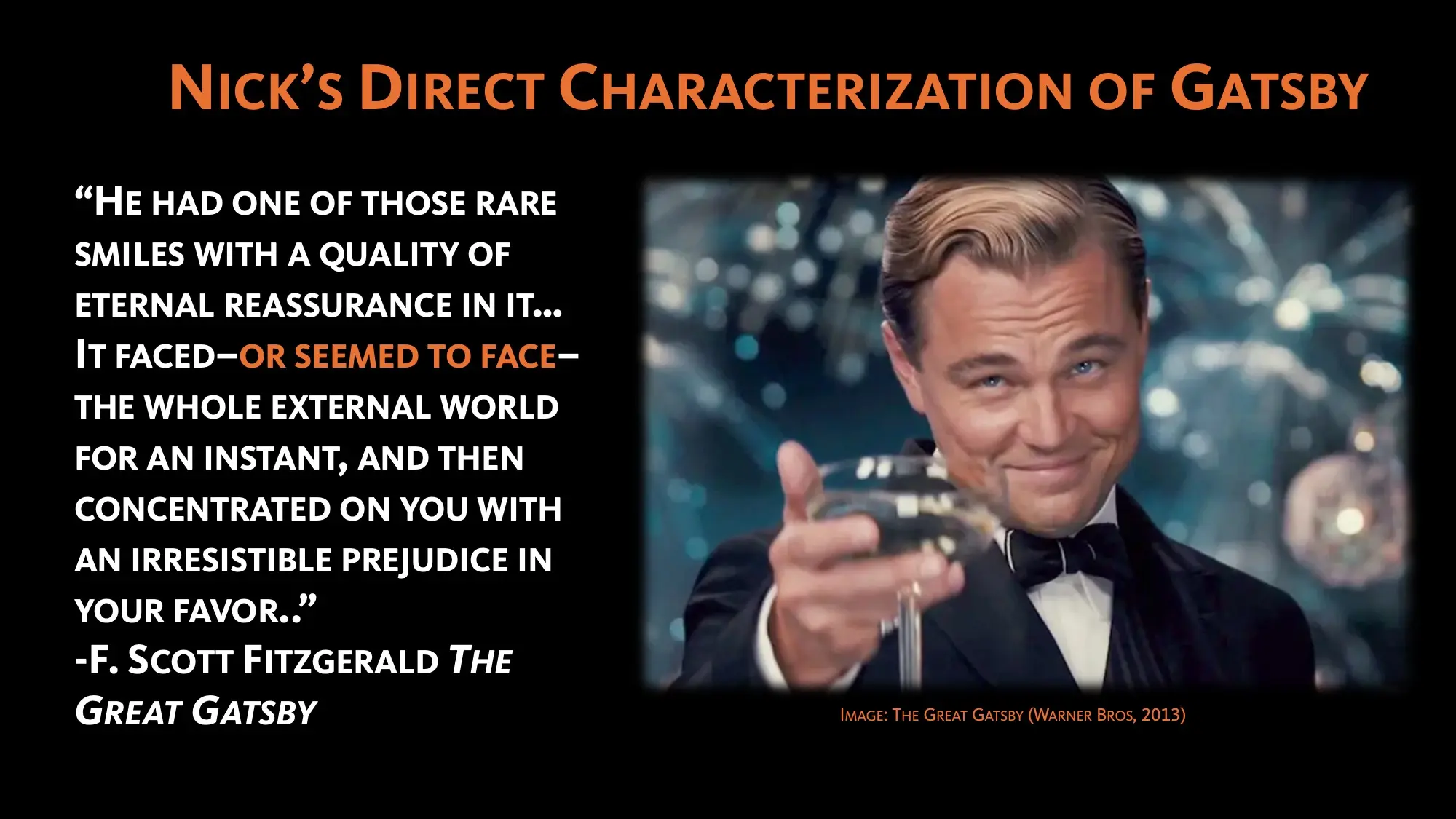
“He had one of those rare smiles with a quality of eternal reassurance in it… It faced–or seemed to face–the whole external world for an instant, and then concentrated on you with an irresistible prejudice in your favor.”
In that description, we experience the charm and charisma that radiates from Gatsby, but we also get a whiff of artifice—a sense that Gatsby’s performing for the world, that his persona is less a natural expression of his inner self, than something carefully constructed. We’ve only just met him, and already we detect a slippage between surface and substance. And it’s this persistent aura of uncertainty surrounding Gatsby that compels us to continue searching for answers.
At one point, Gatsby pretends to offer them. He declares, as if he is speaking to the reader:
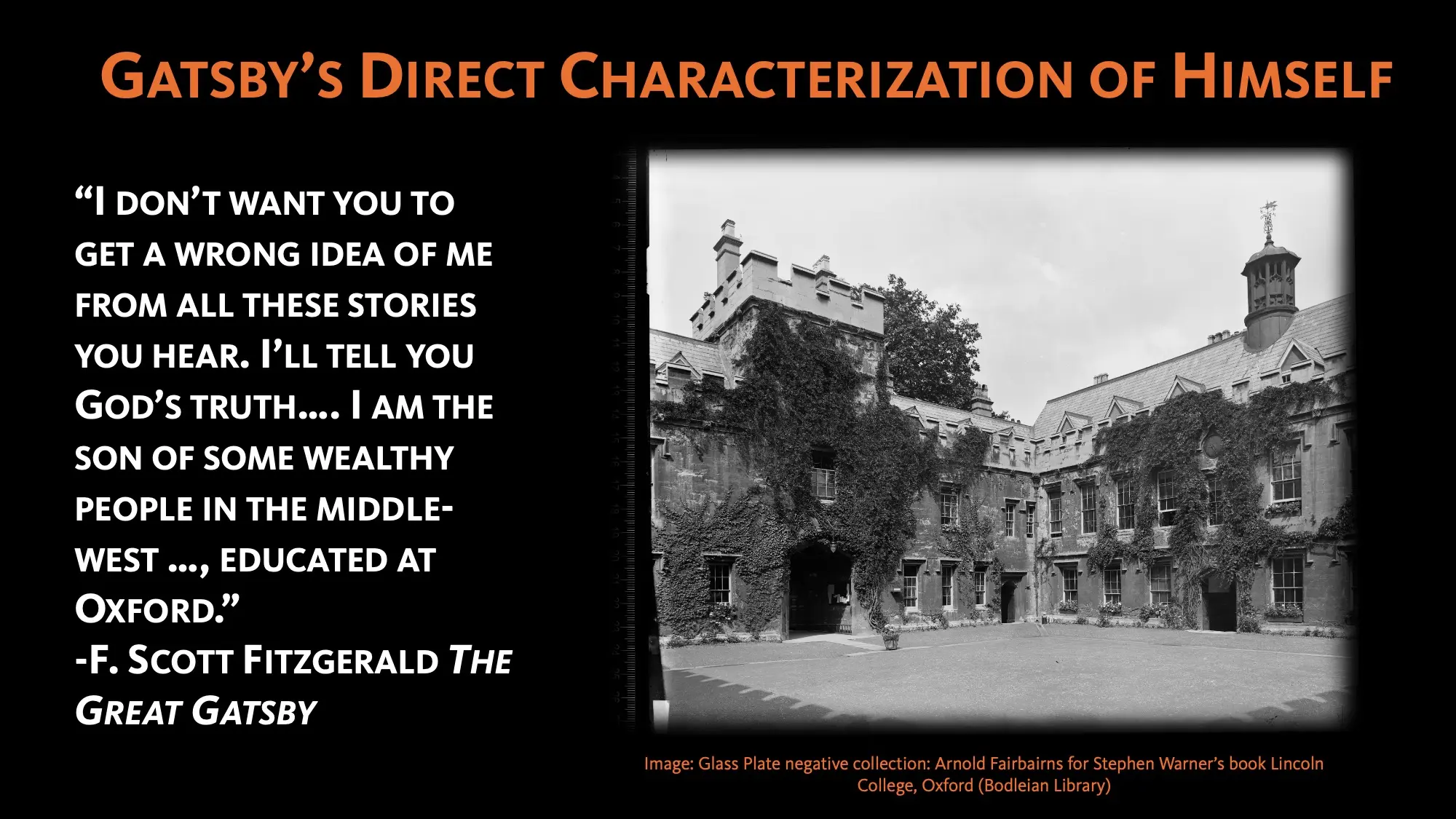
“I don’t want you to get a wrong idea of me from all these stories you hear. I’ll tell you God’s truth…. I am the son of some wealthy people in the middle-west …, educated at Oxford.”
But even as he says this, Nick realizes he is misrepresenting himself. His false front begins cracking under its own weight. At Chapter six, Nick finally employs his wisdom as a retrospective narrator and fills us in on Gatsby’s true and humble origins. We get a clear and straightforward rehashing of Gatsby’s past in an effort to, as Nick puts it, “explode those first wild rumors about his antecedents, which weren’t even faintly true.”
That’s Fitzgerald shifting modes — from indirect to direct characterization — and in doing so, he releases the tension that’s been accumulating up to this point. The tension between artifice and authenticity, between what is stated and what is real. There is a satisfying sense of discovery for the reader, as well as an intriguing suggestion of impending drama.
And as we proceed, we witness Gatsby’s polished facade give way to the portrait of loneliness and fragile longing that we ultimately come to know him by.
Gatsby’s defining character trait turns out to be an obsession with the past, his belief that he can somehow reclaim an idealized version of love with Daisy. And we hear this in his speech. When Nick tells him, “You can’t repeat the past,” Gatsby replies, “Can’t repeat the past? Why, of course you can!” That single line, so hopeful and delusional, pretty well encapsulates Gatsby’s character. It shows us, indirectly, his innocence and desperation, and the tragic impossibility of his dream.
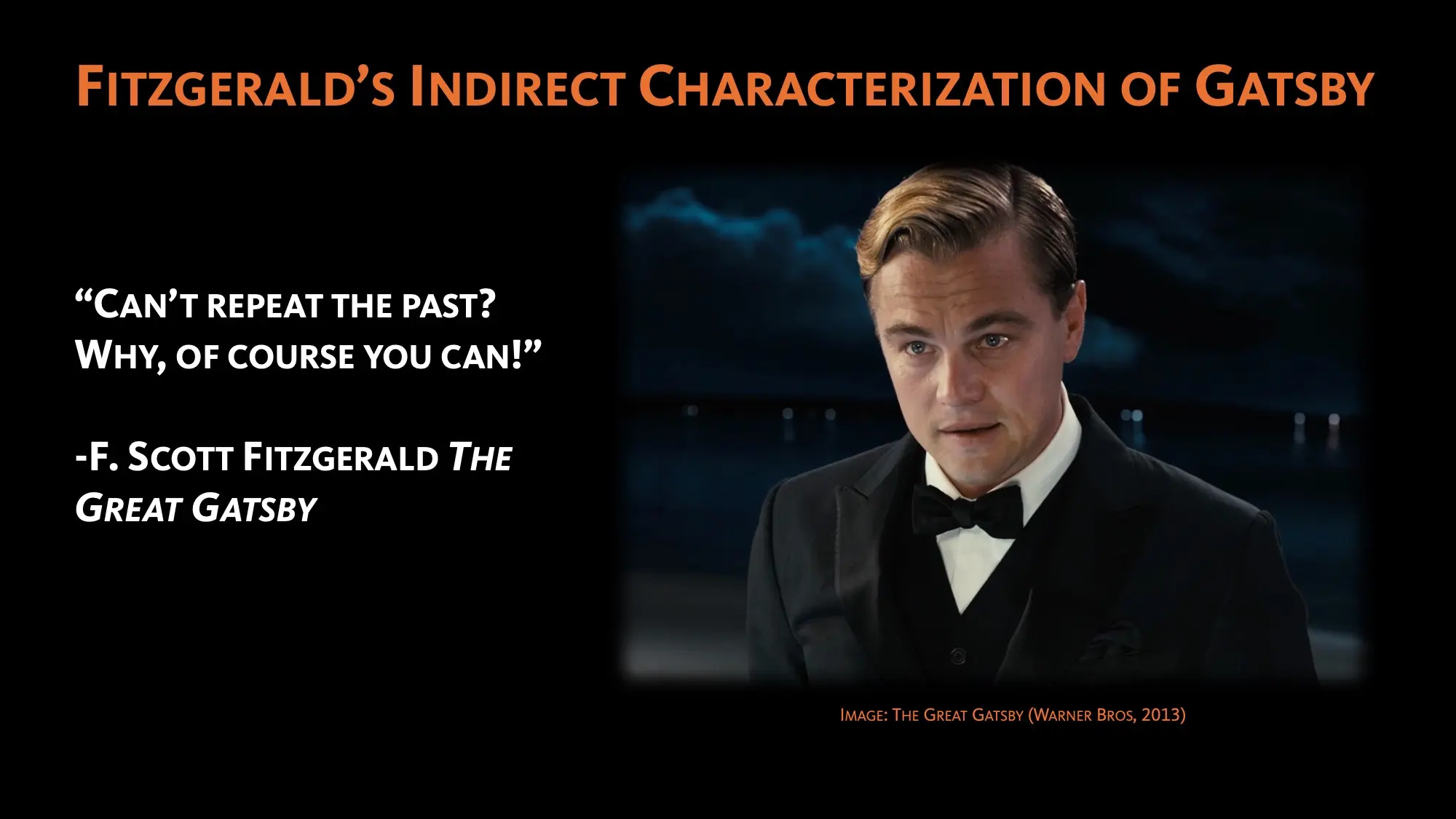
But even with the truth exposed, Gatsby remains somehow unknowable. His dream, his longing, his illusion of self-creation — those things still flicker beyond our reach, like the green light across the bay. And that’s the genius of Fitzgerald’s method. The power of his characterization lies not only in the revelation but in the restraint — in the space between what’s said and what’s left unsaid. Gatsby’s mystery isn’t just a plot device; it’s the very texture of his being. He is a man suspended between fact and fiction, performance and sincerity — and it’s precisely that tension between indirect and direct characterization that makes him live on in our imaginations long after the story ends.
Want to cite this?
MLA Citation: Weaver, Damien. "What is Characterization?", Oregon State Guide to English Literary Terms, 24 Nov 2025, Oregon State University, liberalarts.oregonstate.edu/wlf/what-characterization-literature-definition-and-examples. Accessed [insert date].