

What is Defamiliarization? Transcript (English Subtitles Available in Video)
By Ray Malewitz, Oregon State University Associate Professor of American Literature
21 September 2025
When I first moved out to Oregon from the East Coast, I was overwhelmed by its natural beauty. Every day when I walked to work, I would pass a grove of giant Sequioa trees on Oregon State’s campus and would always stop and marvel at their size. They are really, really big!
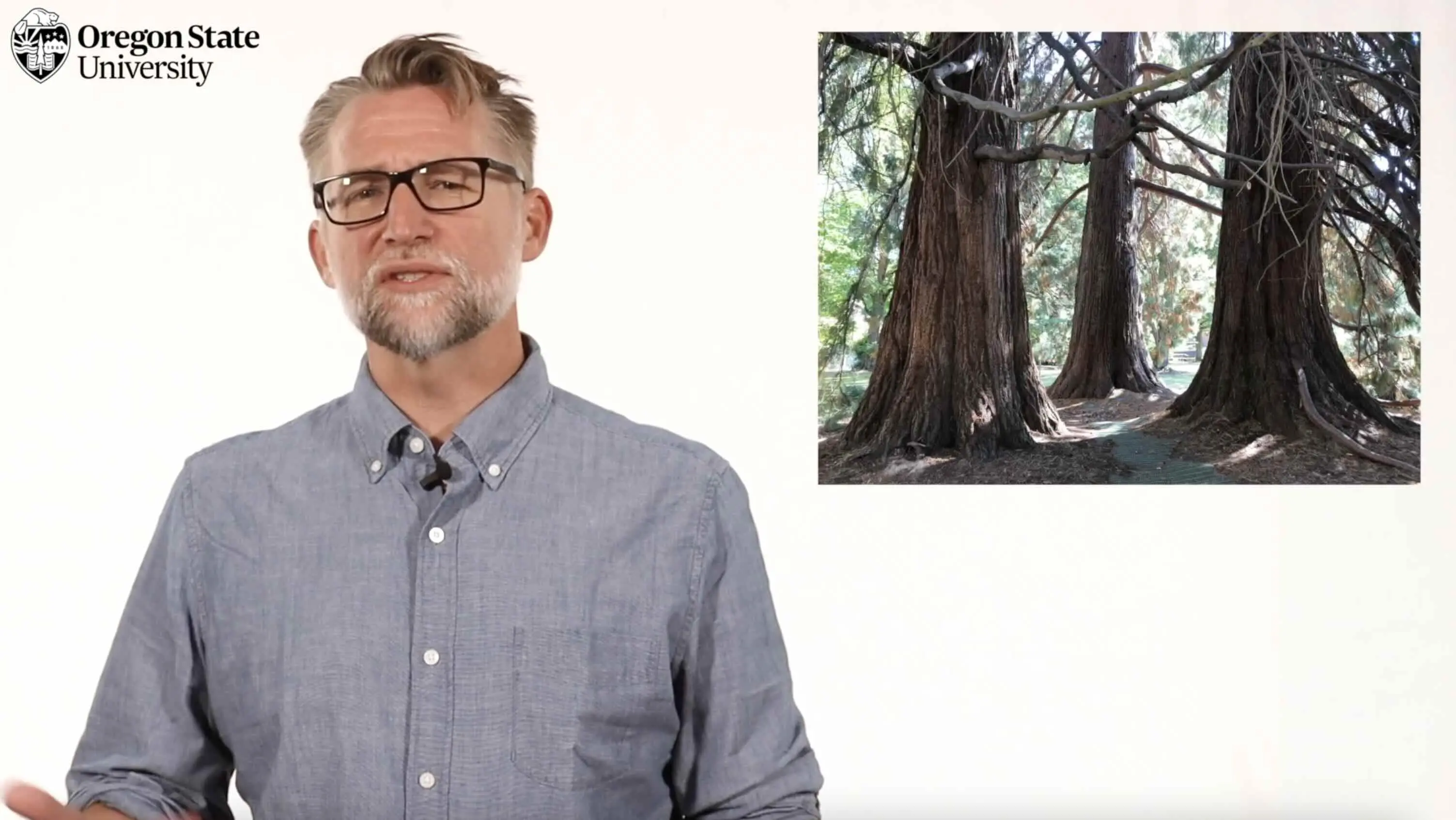
I still walk to work every day, but after living here for over a decade, I hardly notice those Sequoias anymore. They’ve fallen into the hazy background of my every-day world. And the only way that they become fully present to me again is when I see them in a different light—either through the eyes of visitors whom I show around campus or on the rare occasion when it snows in Corvallis and the trees are blanketed in white. At these rare moments, my vision of the trees renews itself and I experience all those old happy feelings of wonder again. What I am experiencing in those moments is a state of defamiliarization.
As critics have long recognized, great works of art can have a similar effect, showing us familiar things in ways that make them appear strange again. When literary scholars want to talk about defamiliarization, they often reference a Russian critic named Viktor Shklovsky, who wrote an essay on the subject called “Art as Technique” in 1917. Shklovsky begins his essay by telling a funny (and pretty relatable) story about cleaning his living room. As he walks towards his couch, he suddenly cannot for the life of him remember whether or not he had already dusted it. As he concludes, “if I had dusted it and forgot - that is, had acted unconsciously, then it was the same as if I had not.”
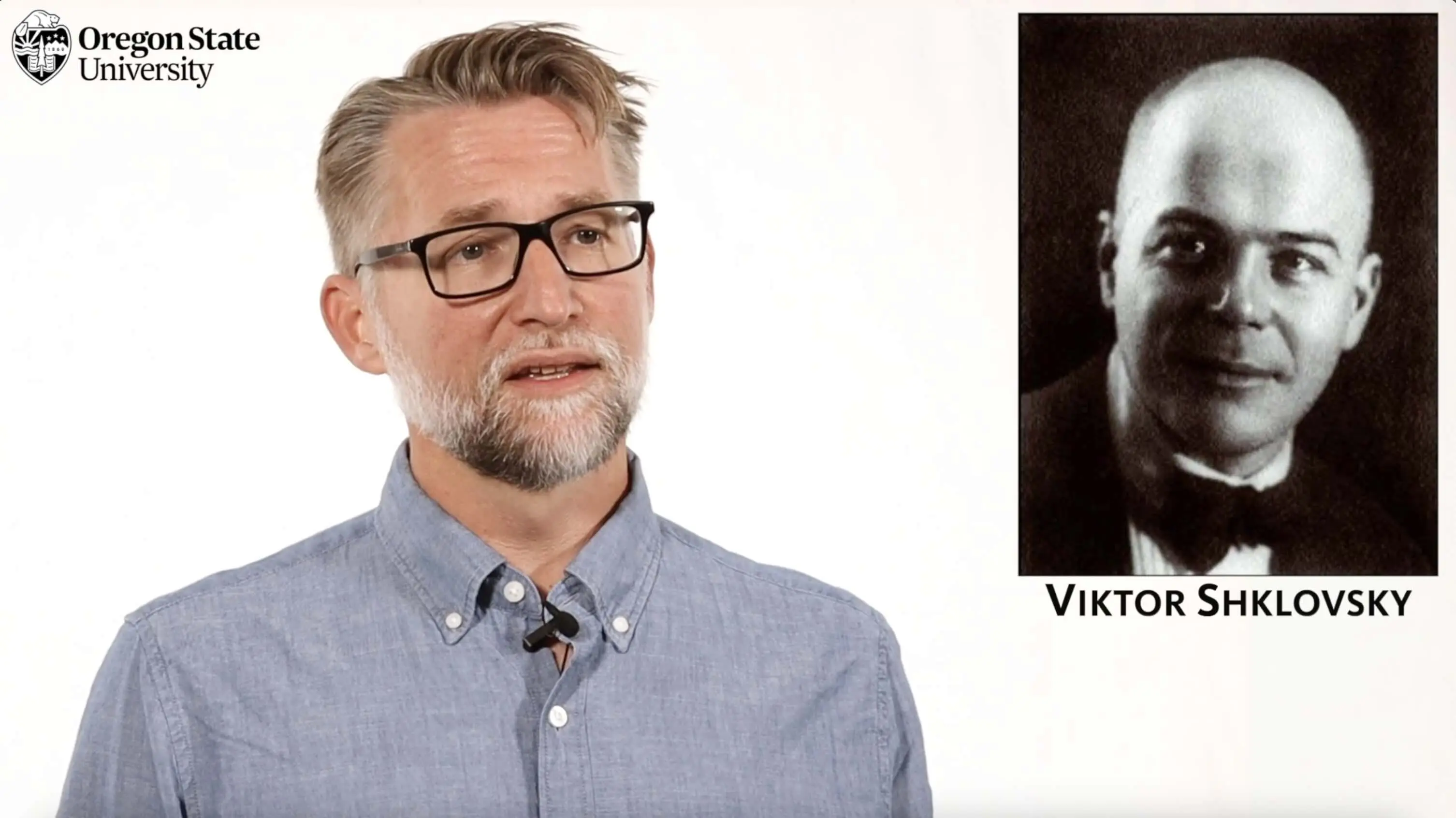
Now, this funny moment isn’t just an excuse to stop cleaning. Shklovksy also uses it to ask a set of profound questions about our daily lives. How many of our everyday actions do we perform automatically? How much of our daily life, in other words, is governed by simple, stupid habit? Do we turn off our minds only when we are washing the dishes or taking out the garbage? Or do we also do so at work or even at home when we interact with our loved ones? If we live our lives in this habit-driven way, Shklovsky concludes, then “such lives are as if they had never been,” like the sofa that may or may not have been dusted or the Sequoias I don’t see anymore.
This process may seem inevitable—and even more so in our current world. When I am scrolling through an endless social media feed on my phone, my brain is never fully (or even partially) engaged with what I am doing. When I am making my lunch or unloading the dishwasher, my actions amount to little more than sleepwalking. So how do we break out of these habits? Well, Shklovsky suggests that art—precisely by being difficult—can help. As he writes in this key passage of his essay:
“[A]rt exists that one may recover the sensation of life; it exists to make one feel things, to make the stone stony. The purpose of art is to impart the sensation of things as they are perceived and not as they are known. The technique of art is to make objects “unfamiliar,” to make forms difficult, to increase the difficulty and length of perception because the process of perception is an aesthetic end in itself and must be prolonged. Art is a way of experiencing the artfulness of an object: the object is not important...”
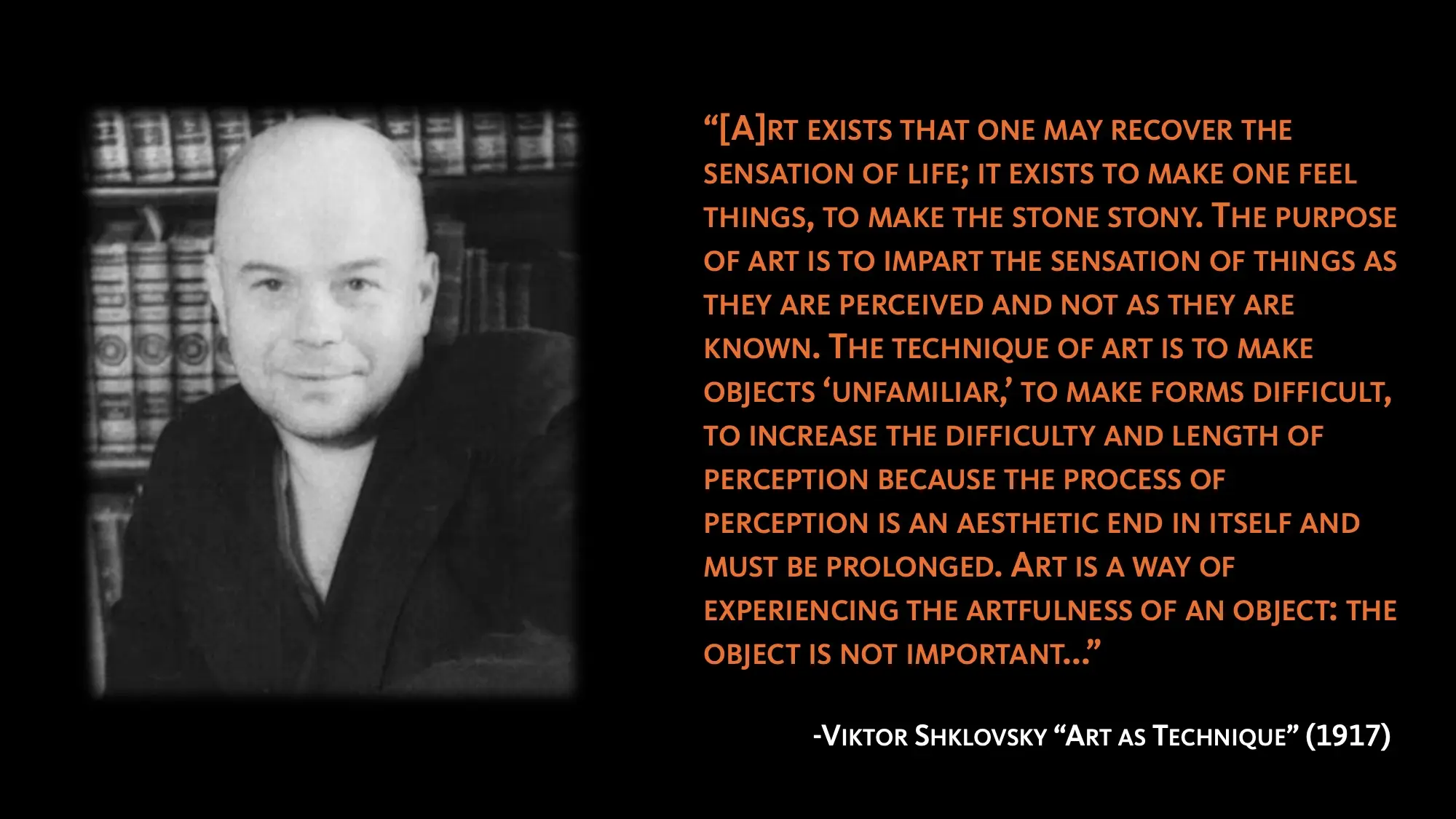
This is a pretty complicated passage, but what Shklovsky seems to be getting at here is that there is a difference between seeing something directly with our minds fully engaged and knowing something through habit. One way to counteract habit is to temporarily frustrate our minds, to conjure up a state when the thing I am looking at—whether it be a sofa or a stone or a Sequoia—appears strange and new. And this sensation of perceiving rather than knowing delights us. It makes us feel like we are children again and all the world is magic.
So what does this look like on the page? Well, given the Sequioa story I told you at the beginning of this lesson, let me give you one brief example of defamiliarization that is also about trees. One of my favorite early 20th-century poems is a very short work by the poet H.D called “Oread.” For those of you who don’t know, Oreads are nymphs from Greek mythology whose lives were thought to be intimately tied to the lives of mountain conifers. Indeed, according to some accounts, an Oread lives as long as its partner tree lives, making its experience of time far different than our own. H.D.’s poem attempts inhabit this worldview, as an Oread leaves behind its mountainous, everyday existence and gazes upon something it probably has never seen before: the sea. Here’s how it goes:
Whirl up, sea—
whirl your pointed pines,
splash your great pines
on our rocks,
hurl your green over us,
cover us with your pools of fir.
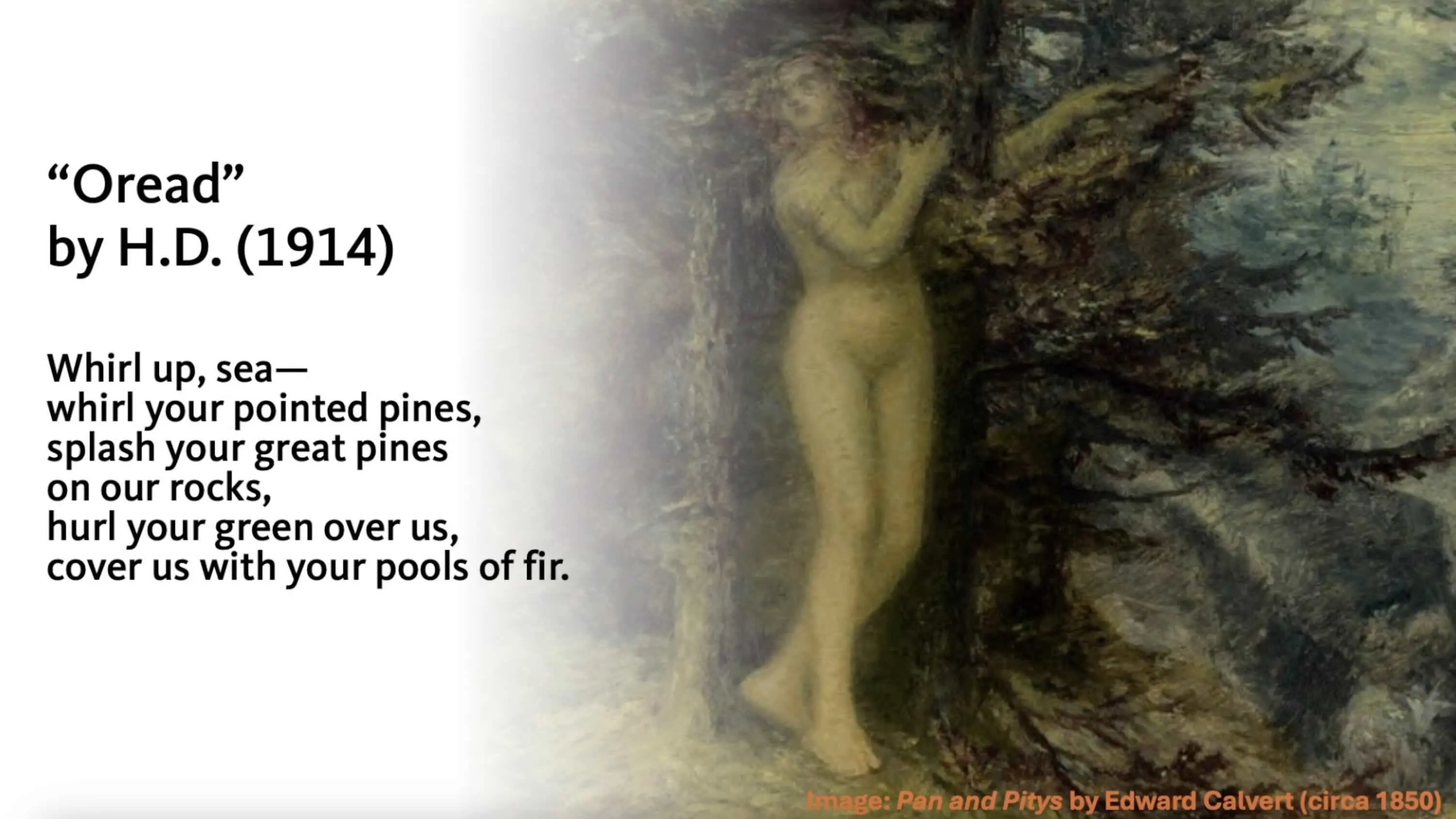
Now, this is a very strange description of the sea. The Oread seems to think that the waves of the sea are “pointed pines” that create “pools of fir” when they encounter a rocky coast. It also seems to think that the sea’s color is green, which departs from our conventional understanding and makes us see the sea again as if we were seeing it for the first time. While I won’t go into any detail in my analysis of the poem, I encourage you to determine why this creature might see the ocean in this strange way. How can the sea be green when everyone knows it is blue? How can the dynamic action of the sea be compared to pointed firs, when everyone know trees are static objects that do not move? And how might answers to these questions make you look at the sea—and trees, for that matter—in a new way?
If you have any potential answers to these defamiliarizing questions or have any other examples how literature can make you see some everyday object in the world in a new way, I hope you’ll share them with me in the comments section below. In the meantime, I’m off to have another look at those Sequioas. Happy reading everybody!
Want to cite this?
MLA Citation: Malewitz, Raymond. "What is Defamiliarization?" Oregon State Guide to English Literary Terms, 21 Sept. 2025, Oregon State University,